Expertenanalyse zu Hans Hofmanns Provincetown
Stil: Cubism · Genre: cityscape
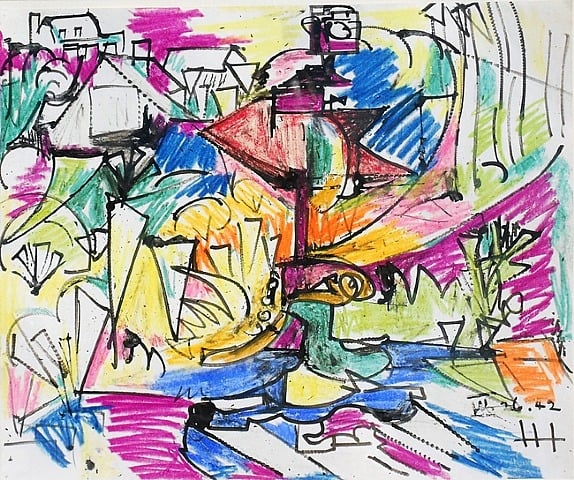
Expert Analysis: "Provincetown" by Hans Hofmann
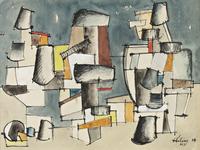
Hans Hofmann’s Provincetown occupies a pivotal position within the Cubist tradition, demonstrating how the movement’s analytical structure could be adapted to the specific energies of an American coastal cityscape. While Hofmann is often celebrated for his later Abstract Expressionist and Color Field innovations, this work reveals his deep roots in European Cubism—particularly the faceted planes and spatial ambiguities pioneered by Picasso and Braque. However, Hofmann injects a distinctly American vitality through his signature “push-pull” theory: overlapping, translucent geometric forms seem to advance and recede simultaneously, creating a dynamic tension that animates the scene. The painting’s significance lies in its synthesis of Cubist order with Hofmann’s own emphasis on color as a structural, emotive force—here, the vibrant hues of Provincetown’s light and architecture are not merely decorative but actively define the pictorial space. This work exemplifies how Hofmann used Cubism as a foundation to move toward a more fluid, expressive abstraction, marking a key moment in the transition from European modernism to the American postwar avant-garde.
Visuell ähnlich
20 Werke mit ähnlicher Komposition und Farbpalette
Provincetown
Hans Hofmann
Untitled
Hans Hofmann
Study for Agony
Arshile Gorky
City Movement
John Marin
Untitled
Vasile Kazar
From an Omnious Chord
Boris Margo
Untitled
Vasile Kazar
Landscape of Casola Valsenio
Carloluigi Colombo
Untitled
Mark Rothko
Komposition
Gosta Adrian-Nilsson
Untitled
Andre Lanskoy
The key
Jackson Pollock
Italian Landscape in 2073 BC
Carloluigi Colombo
Grey oval
Wassily Kandinsky
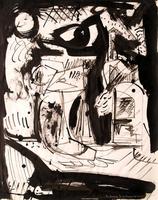
Untitled
Hans Hofmann
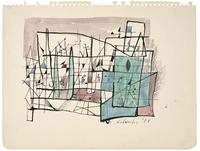
Abstract Composition
Louis Schanker
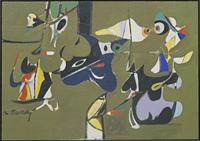
The Garden in Sochi
Arshile Gorky

LE BLÉ (CORN FESTIVAL)
Alice Rahon
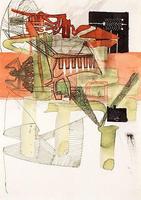
Untitled
Oyvind Fahlstrom
Untitled
Jean Helion