Expertenanalyse zu Jack Bushs Takeoff
Genre: abstract
Expert Analysis: "Takeoff" by Jack Bush
Jack Bush’s "Takeoff" is a quintessential example of Color Field painting, a movement within Post-Painterly Abstraction that emerged in the mid-20th century as a reaction against the gestural intensity of Abstract Expressionism. Bush, a Canadian painter closely associated with the New York-based Color Field artists—including Morris Louis, Kenneth Noland, and Helen Frankenthaler—brought a distinctive lyrical sensibility to the style.
Significance within the Abstract Style
-
Emphasis on Color as Subject
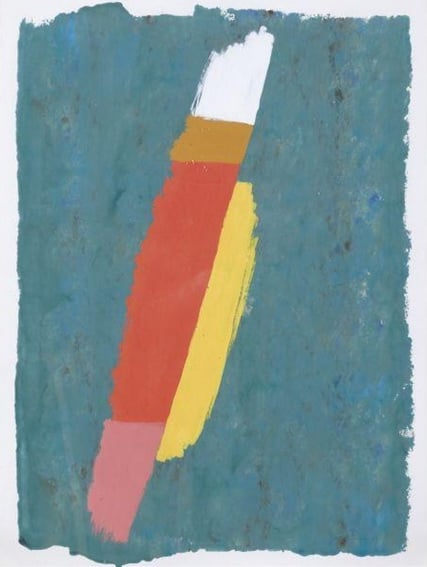
In "Takeoff," Bush abandons traditional composition in favor of saturated, unmodulated hues that appear to float or soar. The title suggests movement and liberation, which is achieved through the interaction of broad, stained color bands. Like his contemporaries, Bush applied thin washes of acrylic paint directly onto unsized canvas, allowing pigments to soak into the fabric, creating a luminous, ethereal surface. This technique—pioneered by Frankenthaler—became a hallmark of Color Field abstraction, valuing optical effects over tactile brushwork. -
Lyrical Abstraction and the "Bush Style"
Unlike the rigid geometric forms of Hard-Edge painting, Bush’s shapes are organic and irregular, often resembling floating ribbons or swathes of fabric. "Takeoff" demonstrates his signature “stripe” and “sash” motifs, where broad vertical or diagonal bands are interrupted by small, vivid accents (often a single contrasting spot or line). These accents provide a rhythmic pulse, hinting at narrative or musicality without becoming representational. Bush’s work is frequently described as “lyrical” because of this graceful, open-ended dynamism. -
Bridge Between Canadian and American Abstraction
As a founding member of the Toronto-based “Painters Eleven” (1953–1960), Bush helped launch a distinctly Canadian modernist voice. However, after meeting Clement Greenberg and visiting New York in the late 1950s, he aligned his practice with the American Color Field movement. "Takeoff" exemplifies this synthesis: its confident, unapologetic color and atmospheric space place it firmly in the International postwar canon, while its gentle, almost musical rhythm retains a Canadian sensitivity to landscape and light. -
Contribution to Post-Painterly Abstraction
In Greenberg’s landmark 1964 exhibition Post-Painterly Abstraction, Bush was featured alongside his American peers. His work—including paintings like "Takeoff"—was praised for clarity, openness, and flatness. By eliminating illusionistic depth and brushy texture, Bush achieved a painting that is “all surface” yet deeply engaging. The bright, often pop-like colors (pinks, oranges, turquoises) also anticipate the chromatic intensity of later 1960s abstraction.
Conclusion
"Takeoff" is significant because it encapsulates the evolution of abstract painting in the 1960s: a move away from angst-ridden expression toward pure visual pleasure and optical sensation. Jack Bush’s mastery of color staining, combined with his personal lyrical touch, elevates this work from mere decorative pattern to a profound statement on the power of color to evoke motion, emotion, and transcendence. It stands as a testament to his role in expanding the vocabulary of non-objective art on both sides of the border.
Genre
Visuell ähnlich
20 Werke mit ähnlicher Komposition und Farbpalette
Pink Moon
Jack Bush
My Country
Sally Gabori
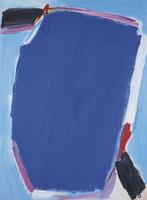
Comienzo
Jose Guerrero
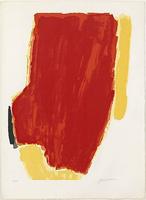
Untitled
Jose Guerrero
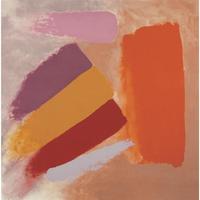
Madame X
Friedel Dzubas
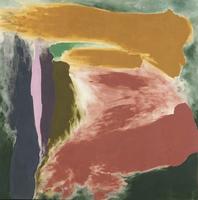
Eagle Pass
Friedel Dzubas
Ritmico
Esteban Vicente
Untitled
Jose Guerrero
San Bivar Signal
Friedel Dzubas
Niagara Series IV
Larry Zox
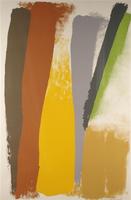
Untitled Abstraction
Friedel Dzubas
Dibirdibi Country
Sally Gabori
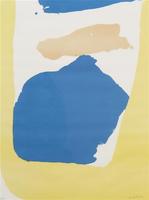
Frankenthaler Preview
Helen Frankenthaler
Dibirdibi Country
Sally Gabori
Untitled
Friedel Dzubas
Bonac
Larry Zox
Rojo-Morado
Jose Guerrero
Summer Insignia
Helen Frankenthaler
Medeanus
John Ferren
MP-KREBM-00092
Michael Krebber