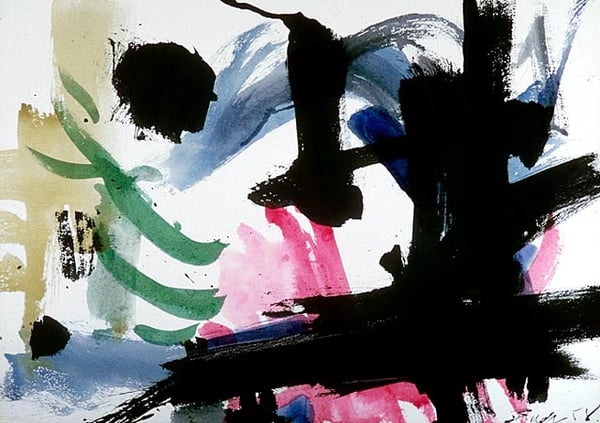
Analisi esperta di Three Greens and Black di Jack Bush
Genere: abstract
Expert Analysis of "Three Greens and Black" by Jack Bush
Jack Bush’s "Three Greens and Black" stands as a quintessential example of mid-20th-century abstraction, specifically within the trajectory of Color Field painting and Post-Painterly Abstraction. While the provided facts are limited to the artist, title, and genre, these elements alone place the work in a critical art-historical context.
Significance within Style and Period:
As an abstract work, "Three Greens and Black" embodies Bush’s mature style, which emerged after his pivotal shift away from figurative and landscape painting toward pure abstraction in the late 1950s. Bush was a key member of the "Toronto School" and a close associate of the influential critic Clement Greenberg, who championed what he termed "Post-Painterly Abstraction"—a move away from the gestural, emotional intensity of Abstract Expressionism toward a more flat, open, and color-driven approach.
The very title "Three Greens and Black" signals Bush’s core method: reducing his compositions to a few saturated, unmodulated color shapes, often defined by thin, irregular edges that suggest staining or drawing rather than thick paint application. This aligns perfectly with the Color Field ethos, where color itself becomes the subject and emotional carrier. By isolating three distinct green forms against a black ground (or as interacting fields), Bush explores the optical push-and-pull of hues, the tension between shape and void, and the lyrical interplay of transparency and opacity.
Why It Matters:
-
Bridging Canadian Abstraction and International Movements: At a time when New York dominated the art world, Bush’s work—including paintings like "Three Greens and Black"—demonstrated that a Canadian artist could engage with and innovate within global modernist dialogues. His use of crisp, poured or brushed color bands, often asymmetrical and seemingly weightless, offered a cooler, more disciplined alternative to the heroic scale of American Abstract Expressionism.
-
Focus on Color as Structure: Rather than relying on drawing, symbolism, or narrative, Bush makes the relationship between three greens (likely varying in hue, saturation, or temperature) and a black support the entire pictorial drama. This radical simplicity—a hallmark of his best work—invites the viewer to experience pure optical sensation, a key goal of Greenbergian formalism.
-
Legacy of "Lyrical Abstraction": Bush’s abstract works anticipate the 1970s movement of Lyrical Abstraction, where spontaneous, colorful shapes feel both structured and playful. "Three Greens and Black" may not be known for grand scale (though many Bush canvases are large), but its rhythmic arrangement and subtle irregularity give it a human, almost musical quality—distinct from the geometric hard-edge or the loose stain of Morris Louis.
In summary, "Three Greens and Black" is significant not just as a representative abstract composition, but as a refined example of how Jack Bush transformed the lessons of Abstract Expressionism and Color Field into a distinctly personal vocabulary—one that champions the primacy of color, the elegance of restraint, and the power of a few carefully placed shapes to evoke a world of sensation.
Genere
Visivamente simili
20 opere con composizione e palette affini
Untitled
Charlotte Posenenske
Untitled
Marcel Barbeau
Yellow line
Kazuo Shiraga
The head of the guinea pig
Alfred Freddy Krupa
Composition
Pierre Tal-Coat
Alienation
Wu Guanzhong
Untitled
Vilen Barsky
Signes en Mouvement
Zao Wou-Ki
A Next... Amitie
Guido Molinari
Untitled from 'Poèmes d'Eugenio Montale', Milan
Gerard Schneider
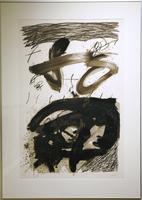
Calligraphique
Antoni Tapies
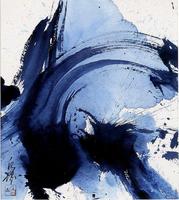
Prussian blue
Kazuo Shiraga
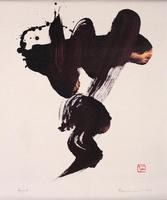
Beyond
Kazuaki Tanahashi
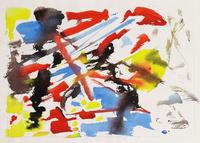
Farbspiele
Ernst Wilhelm Nay
Castle bridge and moonlight
Alfred Freddy Krupa
The forgotten boats (at the riverbank)
Alfred Freddy Krupa
Opus 110
Gerard Schneider
Figure Eight -
Franz Kline
Untitled
Paolo Scheggi
Mrežnica river
Alfred Freddy Krupa