Expert analysis of Henri Laurens’s Femme étendue
Style: Cubism · Genre: nude painting (nu)
Expert Analysis: "Femme étendue" by Henri Laurens
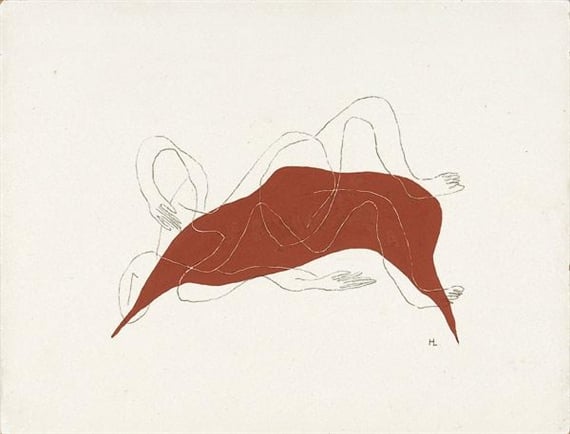
Henri Laurens’s Femme étendue (Reclining Woman) is a compelling example of Cubist nude painting that bridges the artist’s celebrated sculptural practice with two-dimensional innovation. While Laurens is best known as a seminal Cubist sculptor, this work demonstrates how his understanding of volume, plane, and space translates directly onto canvas.
Cubist Fragmentation & Synthesis
In true Cubist fashion, Laurens breaks the reclining female nude into a series of interlocking geometric facets. The figure is not rendered from a single viewpoint but is instead reconstructed from multiple perspectives—simultaneously frontal, profile, and from above. This technique, pioneered by Picasso and Braque, is here refined by Laurens’s sculptor’s eye: the body becomes a play of concave and convex shapes, with deep shadows and sharp highlights emphasizing tactile mass rather than atmospheric depth.
Sculptural Sensibility in Paint
The significance of Femme étendue lies in how it blurs the boundary between painting and sculpture. Laurens applies pigment in dense, modeled strokes, as if carving the form out of the canvas. The composition is compressed into a shallow relief-like space, with the figure’s limbs extending outward like projecting volumes. Even the background is treated as a series of faceted planes, echoing the Cubist interest in merging figure and ground into a unified, rhythmic surface.
Nude as Structural Subject
As a nude, the work departs from traditional titillation or idealized beauty. Instead, the body serves as a vehicle for formal investigation—a scaffold for exploring balance, tension, and the interplay of light and dark. The title “Femme étendue” is deliberately descriptive, grounding the abstract play of forms in a recognizable human subject, yet the viewer is encouraged to read the painting as a constructed object rather than a window onto reality.
Legacy within Cubism
Femme étendue represents a mature phase of Cubism (likely from the 1920s–1930s), when the movement moved from analytic fragmentation toward a more synthetic, decorative unity. Laurens’s contribution is crucial: he brings a physical weight and architectonic clarity to the Cubist nude that few painters achieved, anticipating the monumental, simplified forms of later modernism. The work stands as a testament to how Cubism, through a sculptor’s lens, could renew the oldest genre in art—the reclining nude—by making it a field of dynamic, abstract energy.
Visually similar
20 works with related composition and palette
Femme allongée au bras levé
Henri Laurens
A blue acrobat
Pablo Picasso
Vajda Lajos . .,.
Vajda Lajos
Les baigneuses
Georges Papazoff
Blue Nude
Henri Matisse
Torso in Space
Olexandr Archipenko
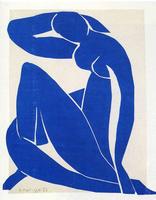
Blue Nude II
Henri Matisse
I was dreaming (first version)
Le Corbusier
Formfiguren
Johannes Itten
597
Luis Feito
War - fight
Vajda Lajos
Untitled
Conrad Marca-Relli
Centaurs and Lapiths
Yiannis Tsaroychis
TERRRRRR-RR-IBLE!
Ahmed Mhennaoui
3059 Ghots Thieves & Murals 12
MF ARLO
I wanted to love you more
Louise Bourgeois
Divers polychrome
Fernand Leger
Vajda Lajos Domb Virágokkal 1939 425x600mm
Vajda Lajos
Nude with arm down
Tom Wesselmann
TMC 026
MF ARLO