Expert analysis of Antoni Tapies’s El pa a la barca
Style: Tachisme · Genre: abstract
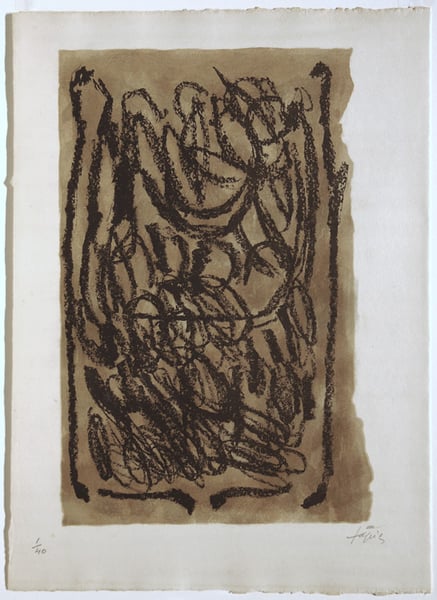
Analysis of "El pa a la barca" by Antoni Tàpies
As an exemplar of the Tachisme movement, "El pa a la barca" stands as a significant work within the broader context of European postwar abstraction. Tachisme (from the French tache—stain or blotch) rejected formal composition in favor of spontaneous, gestural mark-making and a raw, material-based approach. Tàpies, a leading figure in this style (often linked with the Spanish Art Informel variant), elevates the movement's core principles through this abstract piece.
Significance within Tachisme and the Period
The work's significance lies in its embodiment of Tachisme’s central tenets: the primacy of the gesture, the expressive power of texture, and the dismantling of representational space. While the title "El pa a la barca" ("Bread in the Boat") suggests a poetic narrative, Tàpies subverts literal imagery, reducing the subject to pure abstract form. This aligns with Tachisme’s reaction against both geometric abstraction and figurative art, emphasizing instead the artist’s physical and emotional trace.
Tàpies’ contribution to Tachisme is particularly notable for his introduction of matter painting (pintura matèrica). Though the supplied facts specify only the style and genre, his broader practice involves incorporating heavy impasto, sand, marble dust, or found objects into the canvas. In "El pa a la barca," the likely thick, crusty surfaces and earthen tones would create a tactile, almost archaeological presence—turning the painting into an object itself. This merges the gestural freedom of Tachisme with a profound interest in materiality, making the work a bridge between abstract expressionist spontaneity and the haptic, elemental concerns of European Art Informel.
The abstract genre here is not a retreat from meaning but a deliberate focus on existential and symbolic resonance. The implied objects (bread, boat) become archetypes of humility, sustenance, and journey, stripped of narrative to emphasize their raw, phenomenological weight. By doing so, Tàpies expands Tachisme’s vocabulary, proving that abstract stains and textures can carry deep cultural and personal significance without resorting to illusion.
In sum, "El pa a la barca" is significant as a mature example of Tachiste abstraction where material, gesture, and poetic allusion converge. It exemplifies how Tàpies transformed a French movement’s spontaneous energy into a more meditative, grounded practice—one that treats the canvas as a site of ritual, memory, and material truth.
Visually similar
20 works with related composition and palette
Pattern
Jackson Pollock
Les adieux
Joan Miro
Paysage, MP 216
Mario Prassinos
Echo (Number 25)
Jackson Pollock
Letter with Red
Brice Marden
Untitled (Automatic Drawing)
Wolfgang Paalen
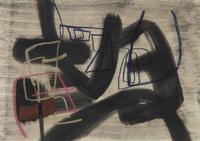
Untitled
Fritz Winter
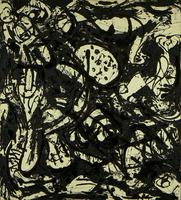
Black & White (Number 20)
Jackson Pollock
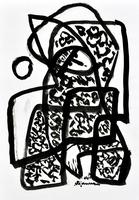
Prayer
George Stefanescu
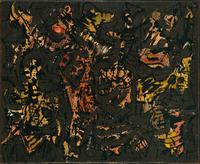
Tiger Lillies
Kenneth Noland
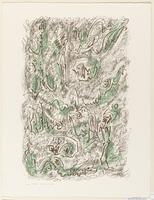
Bones and Chrysalids
Andre Masson
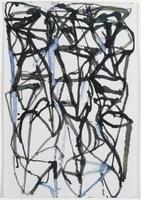
Workbook--Hydra, Tampere, N.Y.C., Bucks Co.
Brice Marden
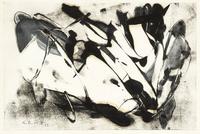
Untitled
Karl Otto Gotz
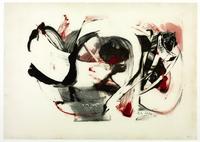
Untitled
Karl Otto Gotz
In Society (En société)
Pierre Alechinsky
Whirl
Daan Lemaire
GTW #14
Friedel Dzubas
Untitled (Anooralya Yam)
Emily Kame Kngwarreye
Leaves III
Jean-Paul Riopelle
Tacarigüeña
Oswaldo Vigas