
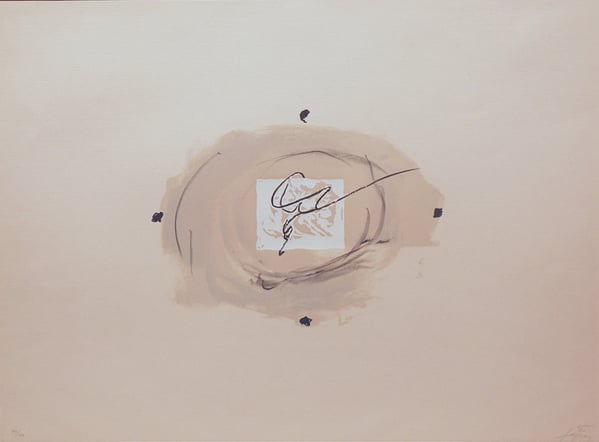
Expertenanalyse zu Antoni Tapiess Nocturn Matinal
Stil: Art Informel · Genre: abstract
Expert Analysis of "Nocturn Matinal" by Antoni Tàpies
Antoni Tàpies’ Nocturn Matinal (c. 1960s) is a quintessential work of Art Informel, the post-World War II European movement that championed raw, gestural, and material-driven abstraction over geometric order. The painting’s title—a poetic oxymoron blending “nocturnal” and “morning”—foreshadows the work’s meditative tension between darkness and light, stillness and emergence.
Style and Materiality (Art Informel) Tàpies was a pioneer of materic painting (matter painting), and Nocturn Matinal exemplifies this. The canvas is heavily built up with a mixture of oil paint, marble dust, sand, and glue, creating a crusty, almost wall-like surface. Deep browns, ochres, and black dominate the field, punctured by shallow incised lines and a few patches of white that seem to glow from within. The texture is not merely decorative; it is the vehicle for existential content. Scratching, scraping, and layering are the artist’s responses to the trauma of the Spanish Civil War and the absurdity of modern existence. Unlike American Abstract Expressionism’s heroic scale and dripped paint, Tàpies’ Art Informel is intimate, earthy, and deliberately impoverished—a “poor art” that finds beauty in decay.
Significance within Art Informel
-
Symbolism of the Wall: Tàpies famously transformed the painted surface into a “wall” or “gate”—a boundary between the real and the metaphysical. In Nocturn Matinal, the rough, scarred surface evokes a weathered wall in a Mediterranean village, marked by time and human touch. This aligns with Art Informel’s rejection of illusionistic space; the painting is its own object, not a window to another world.
-
Dialectic of Presence and Void: The title’s play on night and morning mirrors the composition: dense, dark matter vs. white “breathing” spaces. Tàpies uses these voids not as empty gaps but as active silences, charged with spiritual potential—a nod to Eastern philosophy and Zen aesthetics, which influenced his later work. This makes the piece a meditation on thresholds: between sleep and awakening, matter and spirit, despair and hope.
-
Catalonian Identity: Tàpies’ use of local materials and earthy tones connects his abstraction to Catalonian soil, memory, and Catholic iconography (crucifixion shapes often appear in his marks). Nocturn Matinal thus grounds Art Informel’s universal existentialism in a specific cultural and political context—Franco-era Spain, where overt symbolism had to be cloaked in abstraction.
Conclusion Nocturn Matinal is significant because it encapsulates Art Informel’s core aims: to make painting a tactile, phenomenological experience that speaks of human fragility and resilience. Tàpies achieves this not through representation but through the sheer physicality of his medium—a “nocturnal” surface that, upon patient viewing, reveals the first glimmers of morning light. It stands as a major work of European post-war abstraction, proving that spare, raw materials can carry profound emotional and philosophical weight.
Visuell ähnlich
20 Werke mit ähnlicher Komposition und Farbpalette
Divers Sillions
Pierre Tal-Coat
Amsterdam
Pierre Alechinsky
Untitled (Purple and Red)
Luis Feito
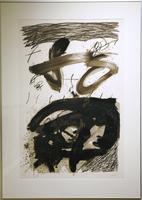
Calligraphique
Antoni Tapies
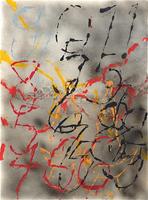
Untitled (number drawing)
Craig Kauffman
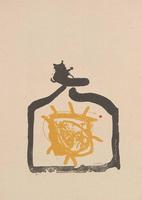
May 26th Backwards
Helen Frankenthaler
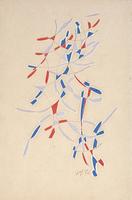
Untitled
Ivan Serpa
Seins
Antoni Tapies
Untitled (Diptych)
Li Yuan-chia
Composition
Pierre Tal-Coat
The head of the guinea pig
Alfred Freddy Krupa
Farbspiele
Ernst Wilhelm Nay
Untitled
Paolo Scheggi
Untitled
Perle Fine
Untitled
Jean Miotte
Untitled
Marcel Barbeau
T281
Pető István
Untitled from 'Poèmes d'Eugenio Montale', Milan
Gerard Schneider
A Next... Amitie
Guido Molinari
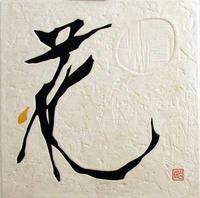
Poem 69-52
Maki Haku