
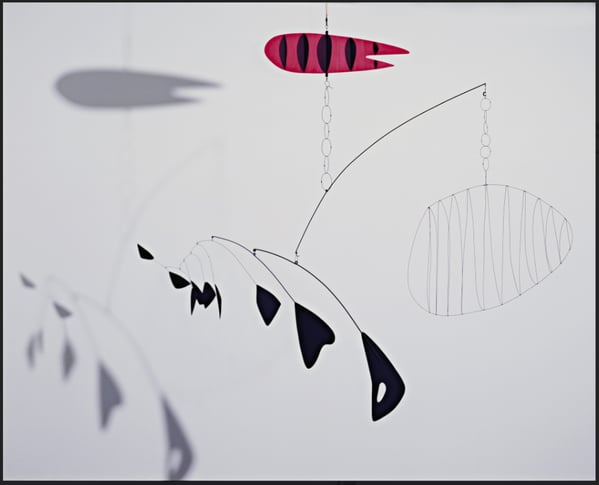
Lobster Trap and Fish Tail
Dettagli
Analisi esperta di Lobster Trap and Fish Tail di Alexander Calder
Stile: Kinetic Art · Genere: sculpture, mobile
Expert Art Historical Analysis: "Lobster Trap and Fish Tail" by Alexander Calder
Context and Period Significance
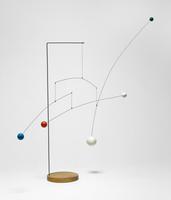
Created between 1937 and 1945, during a phase often termed "Public Commissions and the War," this work exemplifies Calder’s mature evolution of the mobile into a sophisticated, site-specific kinetic sculpture. The period saw Calder translating his earlier intimate objects into large-scale public works, yet "Lobster Trap and Fish Tail" retains the lyrical intimacy of his signature hanging mobiles. It was originally conceived for the stairwell of the Museum of Modern Art in New York, making it a landmark of mid-century modernism—a moment when art, architecture, and movement converged publicly.
Style and Kinetic Innovation
As a prime example of Kinetic Art, Calder’s mobile overturns the static tradition of sculpture. Here, air currents and subtle shifts in the environment animate painted steel wire and abstract sheet-metal forms. The title evokes marine imagery—a lobster trap and fish tail—but Calder abstracts these into biomorphic, organic shapes that float and rotate freely. The work’s significance lies in its dynamic balance: each element is precisely counterweighted so that the entire composition moves in slow, unpredictable arcs, creating a constantly changing silhouette against space. This reconciles industrial materials (steel, paint) with natural motion, a hallmark of Calder’s genius.
Artistic Significance within the Period
During the troubled years leading to and including World War II, Calder’s mobile offered a gentle, optimistic alternative to the era’s anxieties. Unlike the heavy, monumental public sculptures of the 1930s (e.g., socialist realism or Nazi classicism), "Lobster Trap and Fish Tail" is light, airborne, and interactive with its surroundings. It represents a democratic aesthetic: accessible, non-representational, and responsive to ambient forces. The piece also prefigures later environmental and participatory art by inviting the viewer’s presence to influence its motion.
Why It Endures
"Lobster Trap and Fish Tail" is significant as a pure synthesis of form, motion, and space. Calder achieves what no previous sculptor had: a weightless art that is both engineered and poetic. The work bridges the playful surrealism of his earlier years (influenced by Miró and Arp) and the rigorous abstraction of mid-century modernism. It remains a canonical example of how kinetic sculpture can transform negative space into positive aesthetic experience, establishing Calder as the undisputed pioneer of the mobile.
Museum / Gallery
Visivamente simili
20 opere con composizione e palette affini

The Star
Alexander Calder
TRIPLE GONG
Alexander Calder
Mobile
Alexander Calder
TINES
Alexander Calder

The Y
Alexander Calder
Arc of Petals
Alexander Calder
WHITE PANEL
Alexander Calder

Red Mobile
Alexander Calder
Finny Fish
Alexander Calder
FISH
Alexander Calder
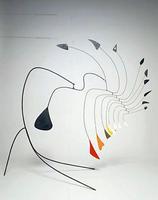
LITTLE SPIDER
Alexander Calder

Kinetic Object
Abraham Palatnik
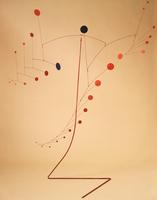
Red Cascade
Alexander Calder
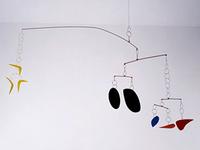
Boomerangs
Alexander Calder
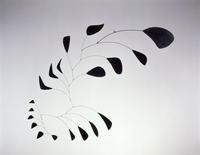
VERTICAL FOLIAGE
Alexander Calder
POMEGRANATE
Alexander Calder
Notte africana
Fausto Melotti
RED PANEL
Alexander Calder
1 RED, 4 BLACK PLUS X WHITE
Alexander Calder
Untitled
Alexander Calder