Beech Forest
Analisi esperta di Beech Forest di Ion Andreescu
Stile: Realism · Genere: landscape
Expert Analysis: "Beech Forest" by Ion Andreescu
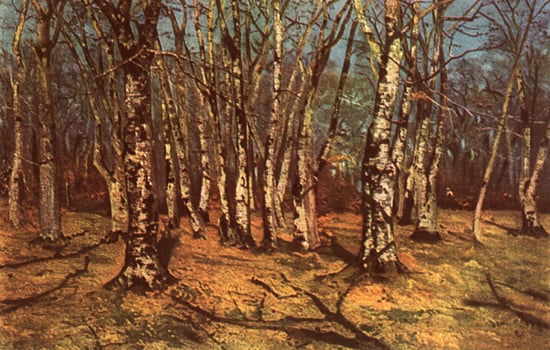
Ion Andreescu’s Beech Forest stands as a masterful example of late 19th-century Realism, specifically within the context of Romanian landscape painting. Andreescu, who studied in Paris and was deeply influenced by the Barbizon school, brought a refined, intimate naturalism to the forests of his homeland. In this work, he captures the quiet majesty of a beech grove with meticulous attention to the interplay of light, texture, and atmosphere.
Significance within Realism and Romanian Art:
-
Faithful Representation of Nature: True to Realist principles, Andreescu forgoes idealization. The composition focuses on the dense, vertical rhythm of beech trunks, their bark rendered with subtle tonal variations that suggest age and moisture. The forest floor is detailed with scattered leaves and dappled sunlight, grounding the scene in observable reality rather than romantic drama.
-
Mastery of Light and Space: Andreescu’s handling of light is particularly significant. He filters sunlight through the canopy, creating shifting patterns of luminosity that accentuate depth and evoke a specific time of day. This technique, while rooted in Realism, anticipates the more atmospheric concerns of Impressionism—a duality that marks Andreescu as a transitional figure in Eastern European art.
-
National Identity in Landscape: Beech Forest is not just a generic woodland; it is distinctly Romanian. Andreescu’s choice of beech trees—common to the Carpathian foothills—along with the earthy ochre, green, and brown palette, roots the work in a specific regional identity. At a time when Romanian art was seeking its own voice, Andreescu demonstrated that national sentiment could be expressed through quiet, faithful landscapes rather than overt symbolism.
-
Technical Precision with Emotional Restraint: The brushwork is controlled, each stroke serving the structure of bark or the softness of foliage. Yet there is an underlying calm, almost meditative quality, inviting the viewer into the forest’s silence. This balance of rigorous observation and emotional subtlety makes Beech Forest a landmark of Romanian Realism—a work that values truth to nature as both a scientific and poetic act.
In summary, Beech Forest is significant for its synthesis of Barbizon-inspired realism with a distinctly Romanian sensibility, its nuanced treatment of natural light, and its role in elevating landscape painting as a vehicle for national artistic identity. Andreescu’s forest is not merely a backdrop; it is a living, breathing subject, rendered with the quiet authority of an artist who saw the profound in the ordinary.
Visivamente simili
20 opere con composizione e palette affini
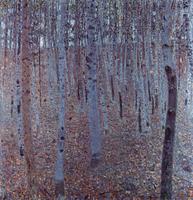
Buchenhain
Gustav Klimt
BIRCHES AT LUCSIVNA-FURDO
Marianne Stokes
Голубая Весна
Vitold Byalynitsky-Birulya
Birch Forest
Gustav Klimt
In the Country
Konstantin Gorbatov
Birches
Nicholas Roerich
Spring. Martyshkino
Konstantin Somov
A Birch Grove
Arkhyp Kuindzhi
Beech Grove I
Gustav Klimt
Birches. Petrovskoye
Konstantin Yuon
Winter
Igor Grabar
April in Algonquin Park
Tom Thomson
Spring in a Birch Forest
Konstantin Gorbatov
The Beech Forest
Ferdinand Hodler
Birch grove
Isaac Levitan
A Birch Grove. Spots of sunlight
Arkhyp Kuindzhi
Pine forest in winter
Koloman Moser
Birch trunks in front of red farmstead
Paula Modersohn-Becker
Autumn Birches, Central Park
Robert Julian Onderdonk
Evening, Canoe Lake
Tom Thomson