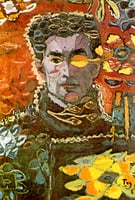
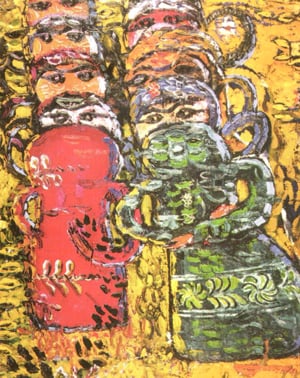
Composition Wtih Dolls
Analisi esperta di Composition Wtih Dolls di Ion Tuculescu
Stile: Expressionism · Genere: figurative
Expert Analysis: "Composition With Dolls" by Ion Țuculescu
Ion Țuculescu’s “Composition With Dolls” is a striking example of Expressionism executed within a figurative mode, a combination that reveals the artist’s unique position in mid-20th-century Romanian modernism. The work’s significance lies in how Țuculescu harnesses the expressive distortions of Expressionism not merely to evoke subjective emotion, but to transform a seemingly innocent subject—dolls—into a vehicle for psychological depth and cultural memory.
Expressionist Language: True to the Expressionist impulse, Țuculescu prioritizes emotional truth over naturalistic representation. The dolls are likely depicted with exaggerated proportions, jarring colors, and coarse, dynamic brushwork. Their faces may be mask-like or distorted, trading sentiment for a sense of unease or raw vitality. This manipulation of form—stretching, flattening, or fragmenting the figures—serves to externalize inner states: anxiety, nostalgia, or a childlike world tinged with the grotesque. The composition itself (the “composition” in the title) is probably non-traditional, with crowded or asymmetrical arrangements that heighten tension.
Figurative Grounding: Despite these Expressionist liberties, the work remains firmly figurative. The dolls are recognizable as humanoid forms, preserving a direct link to the viewer’s lived experience. This figuration prevents the piece from dissolving into pure abstraction, anchoring its emotional charge in familiar imagery. The artist thereby creates a dialogue between the recognizable and the uncanny—a hallmark of Țuculescu’s broader oeuvre, where folk motifs and vivid color are often fused with psychological introspection.
Significance within Țuculescu’s Career and Expressionism: Ion Țuculescu (1882–1960) was a pivotal figure in Romanian modernism, shifting from an early academic style to a deeply personal Expressionism influenced by folk art, Byzantine iconography, and the primal energy of nature. “Composition With Dolls” is significant because it exemplifies his mature phase: a synthesis of folkloric primitivism (the dolls may recall rural toys or ritual objects) and modernist emotional intensity. In this work, the dolls are not passive playthings but charged symbols—perhaps representing lost innocence, the artifice of childhood, or the human condition as a kind of puppet show.
Within the broader Expressionist movement, Țuculescu’s treatment of the dolls stands out for its restrained yet potent symbolism. Unlike some Expressionists who favored overt agony or ecstasy, Țuculescu often marries dissonance with a luminous, almost decorative palette (in his other works, deep reds, blues, and golds dominate). If “Composition With Dolls” reflects this, then the piece achieves a rare balance: it disturbs the viewer with its formal aggression while seducing the eye with its coloristic richness.
Conclusion: “Composition With Dolls” is a masterful demonstration of how Expressionism can transform a humble, figurative subject into a window onto the psyche. Its significance lies in Țuculescu’s ability to blend the raw emotion of Expressionism with the recognizable human form, creating an image that is at once intimate and unsettling, personal and archetypal. In the context of Eastern European Expressionism, this work stands as a testament to the power of art to find the extraordinary within the ordinary—and to make the familiar strange.
Genere
Stile
Visivamente simili
20 opere con composizione e palette affini
Totem on the Field
Ion Tuculescu
Beginning of the Song
George Stefanescu
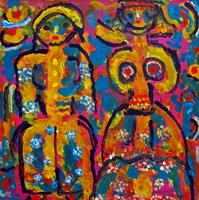
Wedding Ornaments
George Stefanescu
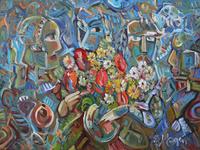
Fantasy
Evan Magar
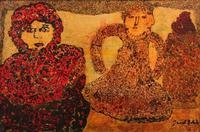
Three Vases
Janet Sobel
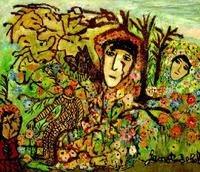
Disappointment
Janet Sobel
Apocalypse
Ion Tuculescu
Heat
Ion Tuculescu
Untitled
Janet Sobel
Blue Totem
Ion Tuculescu
Serpentine
Evan Magar
Yellow’s Secret (Allegory)
George Stefanescu
Bird's-eye view
Pierre Alechinsky
Hjärter dam visande tornet sin senaste metamorfos
Max Walter Svanberg
The walk
Marc Chagall
Sky love
Evan Magar
La famille
Paul Guiragossian
Peasant Women in a Church
Kazimir Malevich
Pierrots bleus au bouquet
Georges Rouault
The Town
George Stefanescu