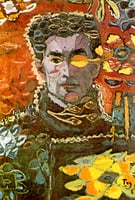
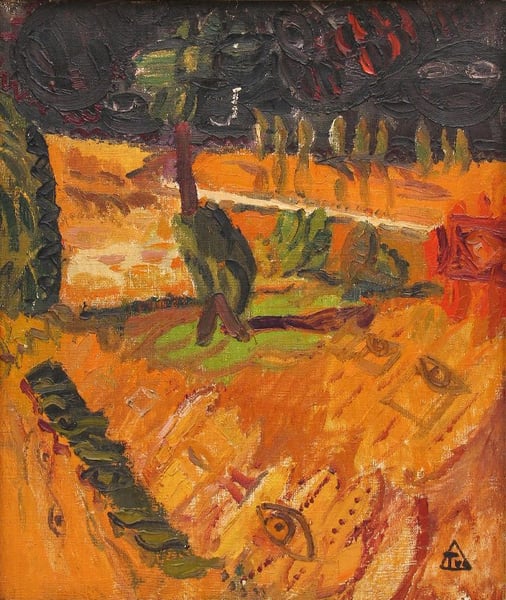
Landscape with Tree
Ion Tuculescu sanatçısının Landscape with Tree eseri hakkında uzman analizi
Tarz: Expressionism · Tür: landscape
Expert Analysis: "Landscape with Tree" by Ion Tuculescu
Ion Tuculescu (1910–1961) was a Romanian painter whose work bridges Expressionism with a deeply personal, almost mystical vision of nature. In Landscape with Tree, the artist distills the genre of landscape into a raw psychological terrain, characteristic of the Expressionist impulse to prioritize emotional truth over optical reality.
Significance within Expressionism:
What makes this work notable is its radical synthesis of two often opposing forces: the organic vitality of the Romanian countryside and the existential angst of mid-century European painting. Tuculescu’s tree is not a botanical specimen but a charged, almost anthropomorphic presence — its contorted branches and truncated trunk suggest struggle, resilience, or a silent scream against an unforgiving sky. This aligns with Expressionism’s core mission to externalize inner states through distorted natural forms, as seen in the works of Edvard Munch or Emil Nolde.
Stylistic execution:
Though we lack visual details, Tuculescu’s known technique — thick, turbulent brushstrokes; a palette that veers from earthy browns to acidic greens and fiery oranges — would have transformed the landscape into a field of emotional vectors. The “Tree” likely dominates the composition, its roots gripping the earth like veins, while the surrounding terrain dissolves into patches of pure color. This erases the boundary between figure and ground, mirroring the artist’s belief in the unity of all living things.
Cultural and historical context:
Tuculescu worked during a period when Romanian art was caught between Western avant-garde movements and a desire to express national identity. His landscapes often carry a folkloric intensity — the tree becomes a totem, the landscape a sacred space. In this, Landscape with Tree stands as a bridge between Expressionism’s universal emotional language and a specifically Eastern European sensitivity to land and myth.
In summary, the artwork’s significance lies in how it uses a simple, universal motif (a tree in a landscape) to express profound disquiet and vitality, marking Tuculescu as a distinctive voice within Expressionism — one who could make a lone tree hold the weight of a world.
Tür
Stil
Görsel olarak benzer
İlişkili kompozisyon ve renk paletine sahip 20 eser
Bela Czobel Szentendrei Taj 1928
Bela Czobel
A Girl with an Umbrella
Stanley Pinker
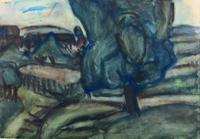
Paysage Au Grand Arbre
Bela Czobel
From Húsafell, Mt. Strútur, West Iceland
Asgrimur Jonsson
Paysage De Saint Tropez Au Crépuscule
Henri Matisse
Cagnes Landscape
Pierre-Auguste Renoir
PAYSAGE DU MIDI
Pinchus Kremegne
Landscape, Study for 'Paradise'
Marcel Duchamp
Bela Adalbert Czobel , Passage
Bela Czobel
Madame Matisse in the Olive Grove
Henri Matisse
Landscape with Road
Janos Mattis-Teutsch
Poplars
Andre Derain
Midday Landscape
Chaim Soutine
the Sun, Crimea
Robert Falk
Transylvanian landscape
Istvan Nagy
The olive
Henri Matisse
Landscape near Lyons
Matthew Smith
Egry József, Balatoni Táj
Egry József
View of the beach at Bellangenai
Paul Gauguin
Cornish Landscape
Matthew Smith