Relations in Orange
Analisi esperta di Relations in Orange di Ion Tuculescu
Stile: Expressionism · Genere: abstract
Expert Analysis of "Relations in Orange" by Ion Tuculescu
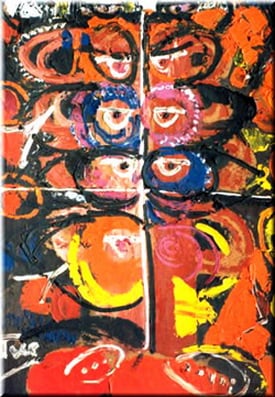
Ion Tuculescu’s "Relations in Orange" is a striking example of Expressionist abstraction, a genre in which the artist moves beyond literal representation to evoke raw emotional and psychological states through form and color. The work’s significance lies in how it crystallizes the core tenets of mid‑20th-century Expressionism—specifically its rejection of naturalism in favor of subjective intensity—while simultaneously pushing the boundaries of abstract composition.
The title itself is revealing: “Relations” suggests a dynamic interplay of shapes, lines, or spatial tensions, while “Orange” anchors the piece in a single, forceful hue. In Expressionist practice, color is not merely decorative but a primary vehicle for mood. Orange, with its simultaneous warmth and agitation, becomes the emotional engine of the canvas. Tuculescu uses this charged chromatic field to create a sense of visual friction—perhaps between organic and geometric impulses, or between stillness and motion. The abstraction frees the viewer from identifying objects, instead forcing attention on the pure relational energies of the painting’s elements: contrasts of scale, rhythm of brushstroke, and the push‑and‑pull of positive and negative space.
Within the context of Tuculescu’s own career and the broader Expressionist movement, “Relations in Orange” demonstrates a refinement of the artist’s personal language. While many Expressionists relied on distorted figuration (e.g., Munch, Kirchner), Tuculescu’s fully non‑objective approach here aligns him with the more radical wing of the movement—artists like Kandinsky or Pollock—who sought to make painting itself an emotional event. The work’s significance thus lies in its successful marriage of Expressionist passion with the formal discipline of abstraction: it is neither a random explosion of color nor a cold geometric exercise, but a controlled, resonant structure that communicates directly through painterly means. In this, “Relations in Orange” stands as a testament to Tuculescu’s ability to distill feeling into pure visual relationship.
Visivamente simili
20 opere con composizione e palette affini
Vikings
David Michael Hinnebusch
Les deux mandarins
Charles Lapicque
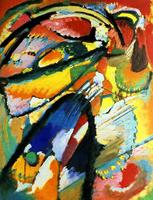
An angel of the Last Judgement
Wassily Kandinsky
Palabras sueltas
Lilia Carrillo
Palabras perdidas
Lilia Carrillo
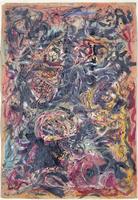
Pattern
Jackson Pollock
Crescendo
Ernst Wilhelm Nay
Eidos Floating
Willi Baumeister
L'Île Rouge
Jean Degottex
Le bonheur de Matisse
Bram van Velde
Estoril Five II, from the Circuits series
Frank Stella
Detras de las palabras
Lilia Carrillo
Untitled
Will Barnet
Untitled
Will Barnet
Axum
Alexander Boghossian
Abstracción N°5
Alfredo Teofilo Cuello
Yellow Predominance
Hans Hofmann
Abstract Composition 6
Aurel Cojan
Satire to the Blue Rider
August Macke
La tribu erre
Corneille