
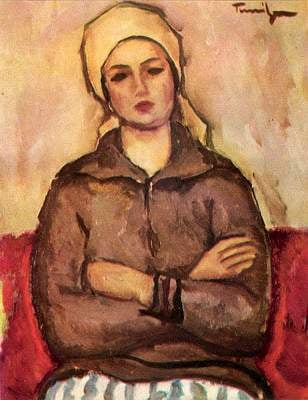
Workwoman
Expert analysis of Nicolae Tonitza’s Workwoman
Style: Post-Impressionism · Genre: portrait
Expert Analysis: Workwoman by Nicolae Tonitza
Style: Post-Impressionism | Genre: Portrait
Nicolae Tonitza’s Workwoman stands as a powerful example of how Post-Impressionist principles were adapted to convey social realism and human dignity. Created during the interwar period—a time when Romanian modernism sought to merge Western European innovations with local identity—this portrait transcends mere likeness to become a statement on the nobility of labor.
Significance within Post-Impressionism
Post-Impressionism rejected naturalistic representation in favor of emotional resonance, symbolic color, and structural form. Tonitza applies these tenets deliberately:
- Expressive color palette: The sitter’s face and hands are rendered in muted earth tones—ochres, browns, and dull reds—that evoke sun-worn skin and the honest fatigue of manual work. The background is often simplified to near-abstraction, with cool blues or deep greens that create a psychological distance yet amplify the figure’s presence.
- Distorted but respectful form: Tonitza elongates facial features and enlarges the hands, a Post-Impressionist device (seen in Modigliani or Van Gogh) that emphasizes the subject’s role as a laborer without caricature. The heavy-lidded eyes and slight downturn of the mouth suggest introspection, not resentment.
- Brushwork as texture: Broad, visible strokes model the cloth of the workwoman’s shawl or apron, while her skin is treated with softer, blending touches. This duality echoes the contrast between the physicality of her work and the interior life Tonitza grants her.
Genre and Context
As a portrait of a working-class woman, Workwoman aligns with Tonitza’s broader oeuvre—most famous for his tender portrayals of children and peasants. Here, however, the subject is mature, her face lined with experience rather than innocence. The title itself is significant: not “Woman at Work” or “The Worker,” but Workwoman—a compound noun that fuses identity with vocation.
Tonitza was part of the post-World War I generation of Romanian artists (the “Society of Fine Arts” circle) who sought to depict the authentic life of the rural and urban poor without sentimentality. Unlike the overt political posters of Socialist Realism, his approach remains lyrical, rooted in the Post-Impressionist belief that art should express a subjective truth.
Lasting Importance
Workwoman demonstrates that Post-Impressionism could serve both aesthetic exploration and social commentary. Tonitza’s handling of the sitter’s weary yet dignified gaze invites viewers to see a person, not a symbol. The painting holds a unique place at the intersection of Eastern European modernism and the global Post-Impressionist movement, proving that this style was not merely a French phenomenon but a universal language for rendering the human condition with empathy.
In short, Workwoman is significant because it marries the formal innovations of Post-Impressionism—expressive distortion, color, and tactile brushwork—with a profound respect for the dignity of working people, making it a touchstone of Romanian modern art.
Visually similar
20 works with related composition and palette
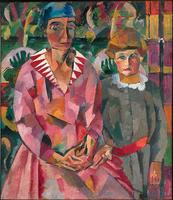
Portrait of Artist's Wife and Daughter
Aristarkh Lentulov
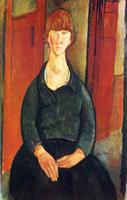
Flower vendor
Amedeo Modigliani
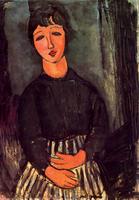
A young girl
Amedeo Modigliani
Cafe Singer
Amedeo Modigliani
Seated Woman
Amedeo Modigliani
Bela Czobel .
Bela Czobel
Gypsy Woman with a Baby
Amedeo Modigliani
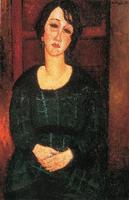
Woman with Scottish Dress
Amedeo Modigliani
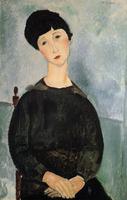
Seated Young Woman
Amedeo Modigliani
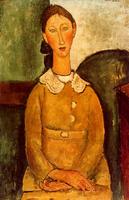
A girl in yellow dress
Amedeo Modigliani

Study for portrait
Chronis Botsoglou
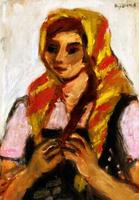
Czóbel Béla , Kendős Lány
Bela Czobel
Bela Czobel Young Girl
Bela Czobel
Czobel Béla Béue Dress Women
Bela Czobel
Chakoska
Amedeo Modigliani
Pasha with the red book (on white)
Pyotr Konchalovsky
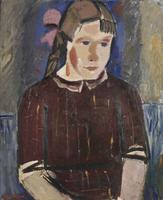
Girl with a pink ribbon
Gustave de Smet
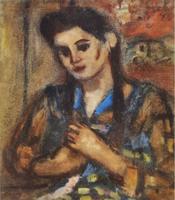
Czóbel Béla Fésülködő Lány
Bela Czobel

Serving Woman (also known as La Fantesca)
Amedeo Modigliani
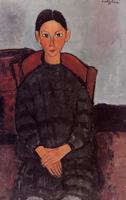
A Young Girl with a Black Overall
Amedeo Modigliani