Icarus
Analisi esperta di Icarus di Sabin Balasa
Stile: Surrealism · Genere: symbolic painting
Expert Analysis of "Icarus" by Sabin Balasa
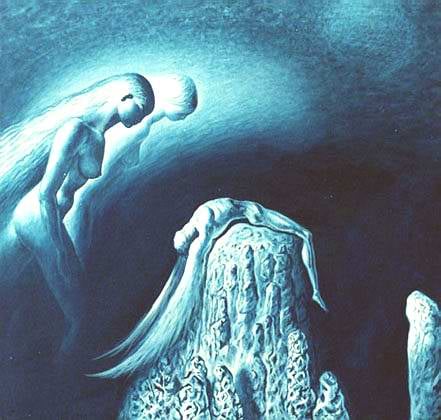
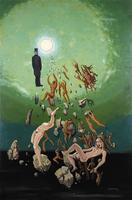
As a Surrealist symbolic painting, Sabin Balasa’s Icarus reimagines the classic mythological narrative through the lens of dreamlike irrationality—a hallmark of the Surrealist movement. Balasa, a Romanian artist deeply influenced by the metaphysical and oneiric traditions, transforms the tragic flight of Icarus into a richly layered meditation on human ambition, transgression, and fallibility.
Significance within Surrealism and Symbolic Painting
-
Surrealist Distortion of Myth – Unlike Renaissance depictions that emphasize dramatic action (e.g., Bruegel’s Landscape with the Fall of Icarus), Balasa subverts realism by merging the human form with abstract, fluid landscapes. The figure of Icarus likely dissolves into or emerges from organic, biomorphic shapes, a classic Surrealist technique that blurs the boundaries between body and environment, conscious and subconscious.
-
Symbolic Ambiguity – The painting’s symbolism operates on multiple levels: the wax wings (ambition’s fragile construct), the sun (authority or enlightenment), and the sea (oblivion or the unconscious). Balasa’s treatment of these symbols is deliberately ambiguous—typical of Surrealism’s rejection of fixed meanings. The viewer is invited to interpret the fall not as punishment but as a necessary dissolution into a deeper psychic reality.
-
Dreamlike Composition – Balasa employs soft, flowing lines and ethereal color gradients, evoking the hazy logic of dreams. This technique aligns with the Surrealist goal of accessing the unconscious through automatic and irrational forms. The absence of a clear horizon or gravity reinforces the sensation of suspended time and space—a hallmark of Surrealist symbolic painting.
Art-Historical Significance
Balasa’s Icarus stands out for its synthesis of classical myth with the Surrealist vocabulary of metamorphosis. It carries on the legacy of artists like Max Ernst, Yves Tanguy, and Remedios Varo, who used mythological allegory as a vehicle for exploring inner psychic landscapes. The work is also significant for its contribution to Romanian Surrealism, a vital but often overlooked branch of the movement that maintained a strong symbolic and philosophical orientation.
In summary, Icarus by Sabin Balasa is a compelling example of how Surrealism can breathe new life into ancient myth, transforming a cautionary tale into a luminous, open-ended symbol of the human condition. Its power lies in its refusal to resolve—leaving the viewer suspended between flight and fall, reason and dream.
Visivamente simili
20 opere con composizione e palette affini
The Exodus Towards Light
Sabin Balasa
Dream of a Memory
Sabin Balasa
Wedding Travelling in Space
Sabin Balasa
The Nymphs of the Woods
Sabin Balasa
Universe of Love
Sabin Balasa
The Crystal
Sabin Balasa
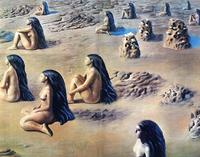
The Morning of the Planet
Sabin Balasa
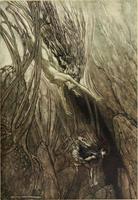
Seize the despoiler
Arthur Rackham
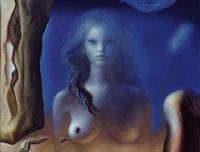
Teleportation
Sabin Balasa
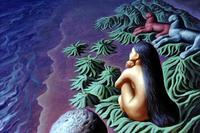
Waiting
Sabin Balasa
The Souls of the Mountain
Remedios Varo
Levitation
Sabin Balasa
The Archipelago of Love
Sabin Balasa
Daughters of the Sea
Sabin Balasa
The Winged Lover
Sabin Balasa
Crystal amoureux
Jacques Hérold
The Return
Sabin Balasa
The Dawn
Sabin Balasa
Hypergenese de la reapparition
Victor Brauner
Mock away! Mock! The Niblungs make for you Toy!
Arthur Rackham