
The Sonata of the Moon
Sabin Balasa sanatçısının The Sonata of the Moon eseri hakkında uzman analizi
Tarz: Surrealism · Tür: symbolic painting
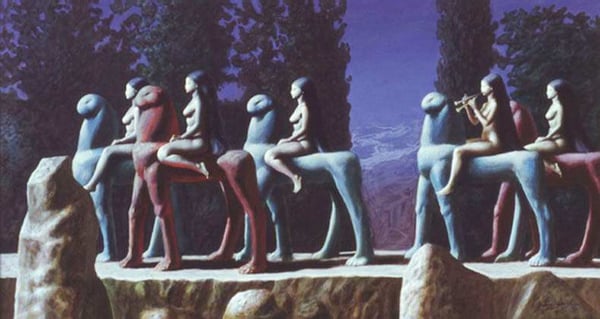
As an expert art historian, I will analyze "The Sonata of the Moon" by Sabin Balasa based strictly on the supplied structured facts: Style: Surrealism, Genre: symbolic painting.
Analysis
Sabin Balasa (1932–2015), a leading figure of Romanian surrealist painting, created works that stand at a unique intersection of Surrealism and symbolic painting. "The Sonata of the Moon" exemplifies this fusion, offering a deeply subjective, dreamlike vision that is nonetheless anchored in deliberate, esoteric meaning.
Significance within Surrealism: Balasa's surrealism is distinct from the more confrontational, psychoanalytic strain of the movement’s early 20th-century Western founders. Instead, his imagery often draws on a lyrical, almost metaphysical tradition—influenced by Romanian folk mysticism, Byzantine iconography, and the cosmic themes of the Symbolist poets. "The Sonata of the Moon" likely employs the classic surrealist technique of dislocation (placing familiar objects in uncanny contexts) but does so to evoke a sense of timeless harmony rather than anxiety.
Significance as a Symbolic Painting: As a symbolic painting, the work operates on multiple interpretable layers:
- The Moon is a universal archetype: in Balasa’s lexicon, it often represents the feminine principle, the subconscious, and the cyclical nature of time.
- The Sonata (a musical form) suggests structured beauty and mathematical harmony. The pairing of music with lunar imagery creates a synesthetic symbol—a visual representation of sound, light, and inner emotion.
- Balasa’s precise, almost pristine technique (often resembling egg tempera or finely glazed oils) contrasts with the irrational subject matter, lending the symbols a weighty, iconic stillness. This juxtaposition—between the clearly rendered and the mysteriously implied—is central to the work's power.
Why It Matters: In the broader history of Surrealism, "The Sonata of the Moon" represents a Eastern European re-imagining of the movement—one that replaces the aggressive rupture of reality with a calm, luminous transcendence. Balasa’s symbolic surrealism does not seek to shock, but to invite contemplation. The work is significant because it proves that Surrealism could evolve into a meditative, philosophical genre, merging the irrational dream with the structured logic of symbol and allegory. It stands as a testament to a strain of surrealist painting that prioritizes spiritual revelation over cathartic release, making it a key piece in understanding the movement’s global and cultural variations.
Görsel olarak benzer
İlişkili kompozisyon ve renk paletine sahip 20 eser
Galactic Travel
Sabin Balasa
Song Between Day and Night
Sabin Balasa
The Dawn
Sabin Balasa
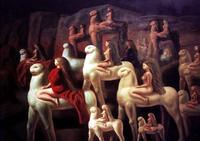
The Cavalcade
Sabin Balasa
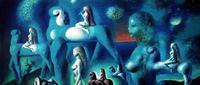
Blue Spaces
Sabin Balasa
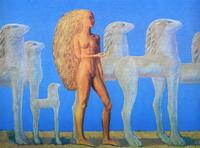
Solemnity
Sabin Balasa
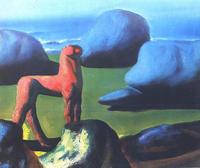
Vanity
Sabin Balasa

Relay
Sabin Balasa
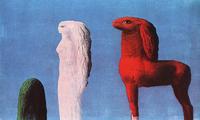
Chimera
Sabin Balasa
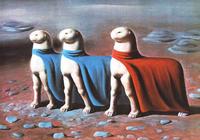
The Seniors
Sabin Balasa
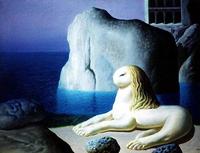
Silence
Sabin Balasa
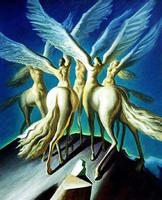
Encounter in the Dawn
Sabin Balasa
Miracle
Sabin Balasa
The White Horse
Mario Sironi
Dream of a Memory
Sabin Balasa

Waiting
Sabin Balasa

Girl of the Ocean
Sabin Balasa
The Flames, They Call
Salvador Dali
Bather opening a cabin
Pablo Picasso
Daughters of the Sea
Sabin Balasa