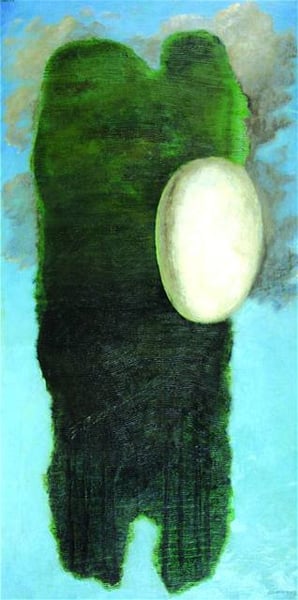
Expert analysis of Josef Sima’s Vejce
Style: Abstract Art, Surrealism · Genre: symbolic painting
Expert Analysis of Josef Šíma’s Vejce (The Egg)
Josef Šíma’s Vejce (The Egg) stands as a compelling synthesis of Abstract Art and Surrealism, executed within the tradition of symbolic painting. The work’s significance lies in how it harnesses the egg—a primordial, cross-cultural symbol of origin, mystery, and potential—and transforms it into a purely painterly, non-representational motif that bridges the subconscious and the cosmic.
Šíma, a Czech-born Surrealist who spent most of his career in France, was deeply influenced by the movement’s interest in automatic processes, dream imagery, and alchemical symbolism. In Vejce, the egg is not rendered naturalistically but distilled into an abstract, often ovoid form that floats in an indeterminate, luminous space. The composition typically employs muted earth tones, soft halos of light, and a sense of organic growth—reminiscent of a cell dividing or a world germinating. This aligns with Šíma’s broader exploration of “cosmic landscapes,” where geological, botanical, and bodily forms merge into a unified, mystical whole.
What makes Vejce particularly significant within the Surrealist and Abstract canon is its quiet intensity. Unlike the jarring juxtapositions of Dalí or the biomorphic fantasies of Miró, Šíma’s egg evokes a meditative, almost hermetic solitude. The painting invites contemplation of beginnings: the birth of a thought, a world, or a self. As a symbolic painting, it operates on multiple levels—personal (the artist’s own creative genesis), universal (the egg as archetype), and formal (the reduction to essential shape and color).
In the context of Šíma’s oeuvre, Vejce exemplifies his move away from figurative Surrealism toward a spiritual abstraction that anticipates postwar Lyrical Abstraction and Tachisme. It demonstrates how Surrealist symbolism could be internalized and translated into a non-objective language, making the invisible visible through paint. The work thus occupies a unique position: it is at once deeply surreal (in its dreamlike suspension of reality) and rigorously abstract (in its focus on pure form and color as carriers of meaning).
Ultimately, Vejce is significant because it achieves what the best symbolic art does: it makes a single, simple form infinitely resonant, turning an egg into an entire universe of potential—born from the subconscious, held in the tension of paint and light.
Visually similar
20 works with related composition and palette
Landscape with Rock in the Shape of a Triumphal Arch
Salvador Dali
Variation: Glorreicher Abend - Sommersegen II
Alexej von Jawlensky
Day
Mikalojus Konstantinas Ciurlionis
Spring
Georgia O'Keeffe
Untitled
Zdzislaw Beksinski
Untitled
Vangel Naumovski
The Spectre and the Phantom
Salvador Dali
Dream of one sentenced to death
Roberto Aizenberg
Infinity Field, Lefkada Series
Theodoros Stamos
The Yellow Curtain
Henri Matisse
Untitled
Zdzislaw Beksinski
Design for the Film 'Spellbound' (1)
Salvador Dali
Cruel Game of Chess
Jean David
UNTITLED
Alexander Calder
Clouds
Arkhyp Kuindzhi
The Echo of the Vold
Salvador Dali
Warship, widow and wind
Giacomo Balla
Vert soleil rose
Marcelle Loubchansky
Washington, D.C., October #8, 1964
Edward Corbett
Månglitter
Sven Jonson