Expert analysis of Richard Pousette-Dart’s Opaque Harmony
Style: Abstract Expressionism · Genre: abstract
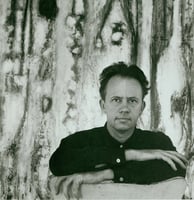
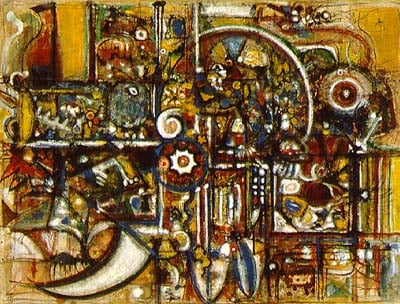
Expert Analysis of "Opaque Harmony" by Richard Pousette-Dart
Richard Pousette-Dart, a founding member of the New York School and a pioneer of Abstract Expressionism, created works that merge mystical symbolism with the gestural energy of the movement. Opaque Harmony exemplifies his distinctive approach within Abstract Expressionism: rather than relying solely on spontaneous brushwork, Pousette-Dart layered dense, impasto surfaces with intricate, almost calligraphic marks, embedding a sense of ritual and transcendence.
The title itself—Opaque Harmony—points to a core tension in his practice. “Opaque” suggests the physical density of his paint application, often built up in thick, crusted layers that resist transparency. Yet “harmony” implies a balanced, meditative resolution. This juxtaposition reflects Pousette-Dart’s debt to Jungian psychology and Native American art, where opposing forces (light/dark, material/spiritual) are reconciled through symbolic form.
Significantly, Pousette-Dart was among the first Abstract Expressionists to incorporate non-Western visual languages—such as the dot, the cross, and the mandala—into an otherwise abstract field. In Opaque Harmony, these motifs likely appear as fragmented, repeating shapes that pulse across the canvas, inviting contemplation rather than narrative reading. The work’s significance lies in its bridge between early Action Painting (Pollock’s all-over drip, de Kooning’s slashing line) and the later Color Field sensibility (Rothko’s floating rectangles, Newman’s zips). Pousette-Dart’s textured, luminous surfaces foreshadow the spiritual aspirations of abstract art while grounding them in a gritty, material presence.
As a key figure who never achieved the same popular recognition as his peers, Pousette-Dart’s Opaque Harmony reminds us that Abstract Expressionism was not monolithic: it housed artists who prioritized philosophical synthesis over pure emotional discharge. This work stands as a testament to the movement’s capacity for quiet power—a harmony born from opacity.
Genre
Visually similar
20 works with related composition and palette
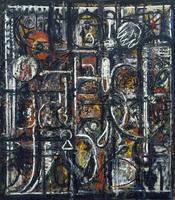
Palimpsest
Richard Pousette-Dart
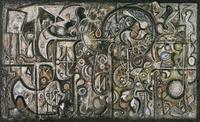
Symphony No. 1, The Transcendental
Richard Pousette-Dart
Abstract Eye
Richard Pousette-Dart
Portrait of Pegeen
Richard Pousette-Dart
Fugue Number 2
Richard Pousette-Dart
Untitled
Richard Pousette-Dart
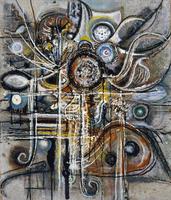
The Center
Richard Pousette-Dart
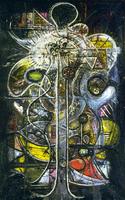
Comprehension of the Atom, Crucifixion
Richard Pousette-Dart
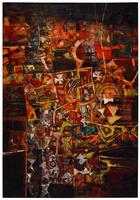
Axum
Alexander Boghossian
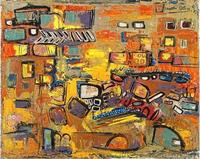
Abstract Composition
Walter Battiss
Desert
Richard Pousette-Dart
Bird in the Wind
Richard Pousette-Dart
Composition
Alexandre Istrati
Untitled (Abstract Composition)
Alexander Boghossian
Peruvian Wall
Willi Baumeister
Animated Landscape
Willi Baumeister
Figure
Richard Pousette-Dart
Composition
Alexandre Istrati
Male and Female
Jackson Pollock
Maya Wall
Willi Baumeister