Analisi esperta di Interior and Silence di Jimmy Ernst
Stile: Abstract Expressionism · Genere: abstract
Expert Analysis: "Interior and Silence" by Jimmy Ernst
Style: Abstract Expressionism | Genre: Abstract
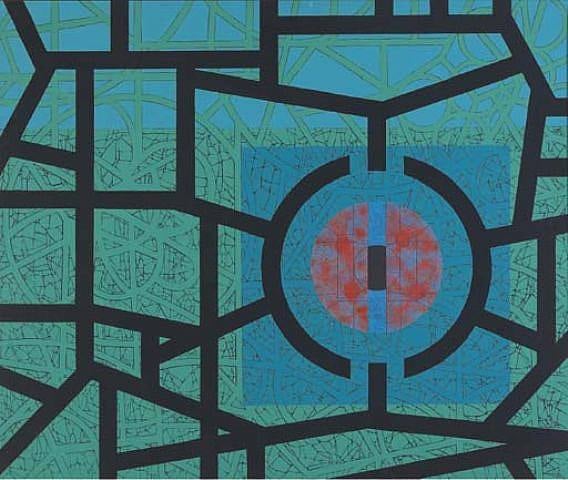
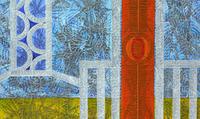
Jimmy Ernst’s "Interior and Silence" stands as a compelling testament to the introspective undercurrents within Abstract Expressionism—a movement often celebrated for its explosive gesture and visceral energy. While many of his peers (e.g., Pollock, de Kooning) pursued external, kinetic drama, Ernst here redirects the viewer’s gaze inward, using abstraction to evoke a meditative, almost architectural quietude.
Significance within Abstract Expressionism:
-
A Shift from Action to Contemplation – The title itself—“Interior and Silence”—announces a departure from the “Action Painting” model. Rather than capturing instinctual motion, Ernst builds a spatial field of restrained hues and subtle geometries. This work is significant for proving that Abstract Expressionism could embrace poetic stillness as powerfully as it could embrace chaos.
-
Synthesis of Line and Atmosphere – Although purely abstract, the composition suggests a room’s interior: a horizon line or threshold, muted tonal blocks, and veils of color that seem to absorb sound. This interplay between structure (the implied interior) and dissolution (the silence) mirrors the movement’s core tension between control and accident. Ernst achieves a delicate equilibrium, where paint reads simultaneously as surface and as psychological space.
-
Lyrical Color Field Tendencies – In its softer, layered washes of color and reduced gestural complexity, "Interior and Silence" anticipates the Color Field wing of Abstract Expressionism (Rothko, Newman). Yet Ernst retains a subtle linear scaffolding—a reminder of his Surrealist heritage (via his father Max) and his own interest in the subconscious as a navigable, not merely chaotic, interior.
Why It Matters – This artwork is significant because it expands the emotional range of Abstract Expressionism. It demonstrates that the movement’s radical freedom could be exercised not only through explosive energy but through hushed concentration. "Interior and Silence" invites viewers to listen to the spaces between marks—a profound contribution to an era more often defined by its noise.
Visivamente simili
20 opere con composizione e palette affini
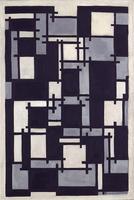
Composition X
Theo van Doesburg
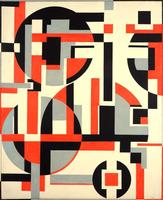
Untitled
Sandu Darie
Untitled
Greta Freist
Twice
Jimmy Ernst
Untitled
Lennart Rodhe
Composition with Oval in Color Planes II
Piet Mondrian
Future Plans
Vasyl Yermylov
Untitled
Sandu Darie
Tekers-MC
Victor Vasarely
Bortnyik Sándor, Kompozició
Sandor Bortnyik
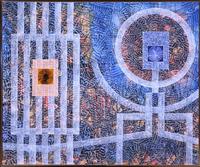
Exile
Jimmy Ernst
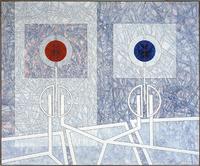
Lumiere
Jimmy Ernst
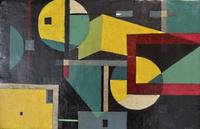
Untitled
Sandu Darie
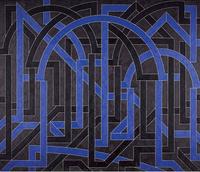
Manetta
Valerie Jaudon
Multivisión espacial
Sandu Darie
Signal series
Yuri Zlotnikov
Untitled
Ad Reinhardt
Games Mysteries
Oleksandr Aksinin
Epilogue
Jimmy Ernst
Untitled (Columna Espacial)
Sandu Darie