Expertenanalyse zu Robert Rymans Untitled
Stil: Minimalism · Genre: abstract
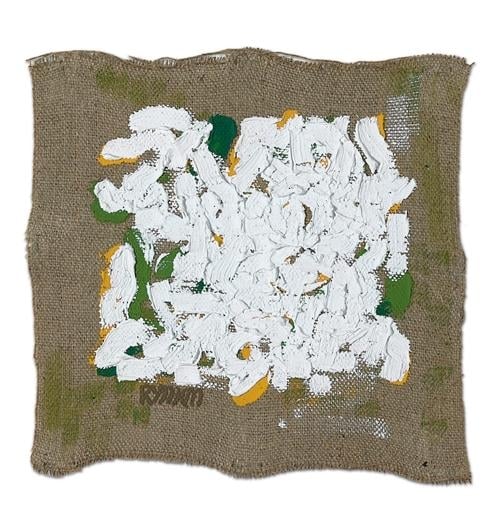
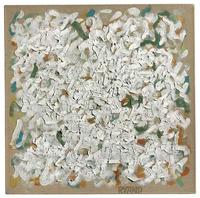
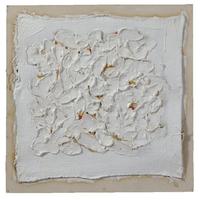
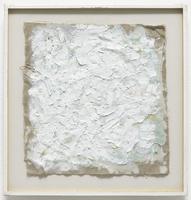
Robert Ryman’s Untitled (c. 1960s–1990s, typical of his lifelong series) is a defining example of Minimalist abstraction, yet it transcends the movement’s typical geometric austerity by turning painting into a study of its own physical and sensory conditions. Ryman, often called a “painter’s painter,” worked almost exclusively in white, but his white is never neutral—it is a vehicle for exploring light, texture, surface, and process.
Significance within Minimalism and Abstraction:
-
Materiality over Image: Ryman rejects representation, narrative, and even color as content. Instead, the artwork is about the act of painting itself: the scrape of a brush, the weave of canvas, the viscosity of paint. In this Untitled, the white oil or acrylic is applied in visible, gestural strokes that reveal the hand of the artist, contravening the impersonal finish often associated with Minimalism (e.g., Judd’s boxes). This introduces a tension between Minimalist reduction and expressive mark-making.
-
Interaction with the Wall: Ryman treats the support—canvas, paper, or board—as a ground, but he also considers the wall as part of the composition. The edges of his works are often raw, with paint continuing onto the sides or left unprimed. The white surface catches and reflects ambient light, making the piece change with the viewer’s position and the gallery’s illumination. This situates Untitled within “Systemic” or “Perceptual” abstraction, where the viewer’s experience completes the work.
-
The “White” Paradox: While white is often seen as empty, Ryman’s white is dense, varied, and chromatic in its subtlety. He uses cool whites, warm whites, matte and glossy finishes. In this Untitled, the paint’s texture creates micro-shadows and highlights, turning the flat surface into a topographical field. This deconstructs the illusionistic space of traditional painting, offering a literal, present-tense object.
-
Anti-Composition: Unlike many Minimalist works that rely on stark geometry or repetition, Ryman’s compositions are deliberately ad hoc—often determined by the size of the brush, the width of the panel, or the application method. This “non-relationship” of parts draws attention to the physical properties of the medium, aligning him with the legacy of Abstract Expressionism (especially the all-over approach of Jackson Pollock) but stripped of heroic gesture.
In short, Robert Ryman’s Untitled is significant because it pushes Minimalism to its logical extreme: a painting that is nothing but itself. It asks us to see paint as a material, not a symbol, and to find richness in apparent emptiness. It remains a key work for understanding how abstraction can be both radically reduced and inexhaustibly complex.
Visuell ähnlich
20 Werke mit ähnlicher Komposition und Farbpalette
Untitled #36
Robert Ryman
Untitled
Robert Ryman
Untitled
Robert Ryman
Untitled
Robert Ryman
Untitled
Robert Ryman
Neigeoliale
Marcel Barbeau
Mostly Mozart
Jules Olitski
Abstract Composition
Vilen Barsky
Stranger 2
Marc Vaux
Spring Dance Nov 11
Dan Goorevitch
Untitled
Olga Albizu
Fraction #1245
Larry Bell
Untitled
Edward Avedisian
Orange Edge, Yellow & Green Box: Acropolis Remnant
Gary Wragg
Untitled
Charlotte Posenenske
Horses Upside Down
Sam Gilliam
Von Goldfarben und Blau
Ernst Wilhelm Nay
Number 1
Bradley Walker Tomlin
Untitled (The Void No. II)
Forrest Bess
Untitled
John Ferren