Milton Avery sanatçısının Bicycle Rider by the Loire eseri hakkında uzman analizi
Tarz: Expressionism · Tür: portrait
Expert Analysis: Milton Avery’s Bicycle Rider by the Loire
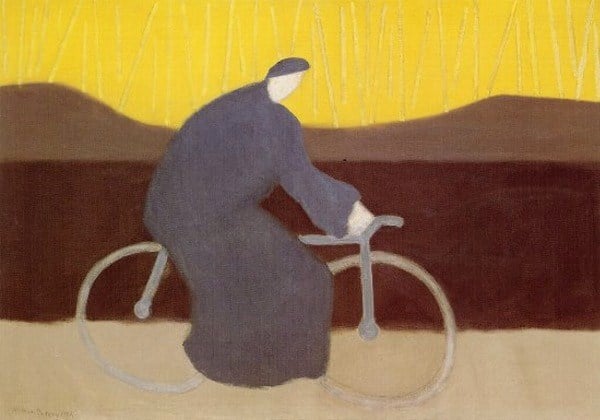
Milton Avery’s Bicycle Rider by the Loire (c. 1950s) exemplifies his distinctive contribution to American Expressionism—a style that prioritizes emotional resonance and formal simplification over literal representation. Though classified as a portrait, the work expands the genre beyond conventional likeness to become a study of atmosphere, color, and the intimate relationship between figure and environment.
Significance Within Expressionism and Avery’s Oeuvre
1. Radical Simplification of Form
Avery reduces the bicycle rider to a silhouette-like profile, the figure flattened into a series of broad, sweeping shapes. The bicycle’s wheels become near-circles, the rider’s body a column of muted tone—scarcely more detailed than the landscape. This deliberate abstraction distills the essence of motion and solitude, letting the emotional weight of the scene—serenity, perhaps quiet contemplation—emerge through shape alone.
2. Color as Emotional Language
True to Expressionist principles, Avery employs color not to mimic reality but to evoke mood. The Loire River is rendered in deep, almost liquid blues; the sky and bank in ochres, greens, and soft purples. These palette choices transcend topographic accuracy, instead creating a gentle, lyrical harmony that mirrors the calm of a riverside ride. The rider’s unmodulated figure—often a key feature in Avery’s portraits—acts as a foil to the landscape’s chromatic richness, anchoring the viewer’s eye.
3. A Bridge to Color Field Abstraction
While Expressionism often conveys emotional intensity through distorted forms, Avery’s version is notably serene. His broad, uninflected areas of color and the near-elimination of shadow prefigure the later Color Field painters (e.g., Rothko, Newman, Gottlieb) who he directly influenced. In Bicycle Rider by the Loire, the landscape and figure coexist as flattened, luminous planes, each hue bleeding subtly into the next—a technique that elevates color itself into the primary subject.
4. The Portrait as a Mood Map
Though the work is a “portrait,” the rider remains anonymous—a generic figure whose identity is less important than the spatial and emotional dialogue with the Loire. This approach aligns with Avery’s broader practice of using the human figure as a vehicle for exploring balance, composition, and the poetry of everyday stillness. The rider does not command the scene; rather, he becomes part of the landscape’s quiet rhythm, a presence that harmonizes with the flowing river.
Legacy and Context
Milton Avery’s Bicycle Rider by the Loire stands as a quiet manifesto of his mature style: unassuming yet radical, deeply personal yet universally accessible. In a period dominated by Abstract Expressionism’s heroic angst, Avery’s softer, more meditative variant of Expressionism offered an alternative path—one that foregrounds color, clarity, and the sublime in the mundane. The work is significant exactly because it demonstrates how Expressionism, in Avery’s hands, could be gentle rather than turbulent, and how portraiture could dissolve into pure visual music—a legacy that would reshape American painting.
Görsel olarak benzer
İlişkili kompozisyon ve renk paletine sahip 20 eser
Girl riding a Bicycle
Volodymyr Loboda
Cyclist dressed up (with traditional Greek costume) and a temple on the right corner
Yiannis Tsaroychis
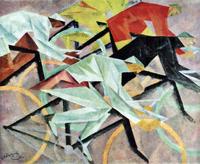
The Bicycle Race
Lyonel Feininger
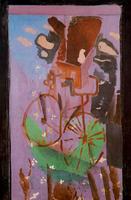
The Bicycle
Georges Braque
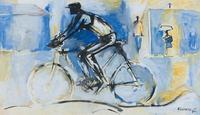
THE CYCLIST
Gerard Sekoto
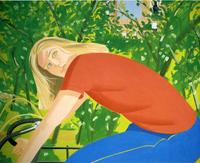
Bicycling in Central Park
Alex Katz
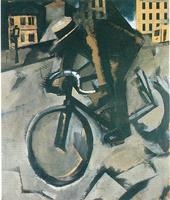
The Cyclist
Mario Sironi
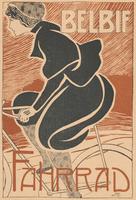
Sketch to a Poster
Alfred Roller
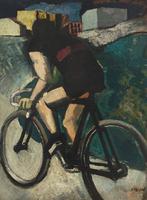
The Cyclist
Mario Sironi
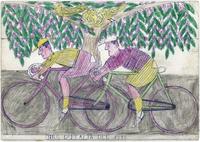
GIRO D'ITALIA DEL 1975
Giovanni Abrignani
Untitled
Roger Raveel
AP 1906 Boy Leading A Horse
Anthony Padgett
Cyclist
Natalia Goncharova
Drawing
M.F. Husain
Maine, Girl with Bicycle and Recumbent Man
Louisa Matthiasdottir
Le cirque: Acrobate à la bicyclette
Bernard Buffet
Marche Des Bicyclistes
Theophile Steinlen
Cegos de Madrid
Julio Pomar
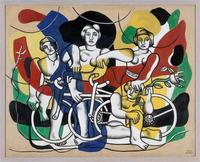
The four cyclists
Fernand Leger
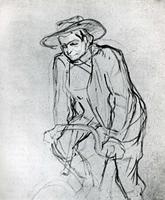
Aristide Bruant on His Bicycle
Henri de Toulouse-Lautrec