Expert analysis of Milton Avery’s Shapes of Spring
Style: Abstract Art · Genre: landscape
Expert Analysis: "Shapes of Spring" by Milton Avery
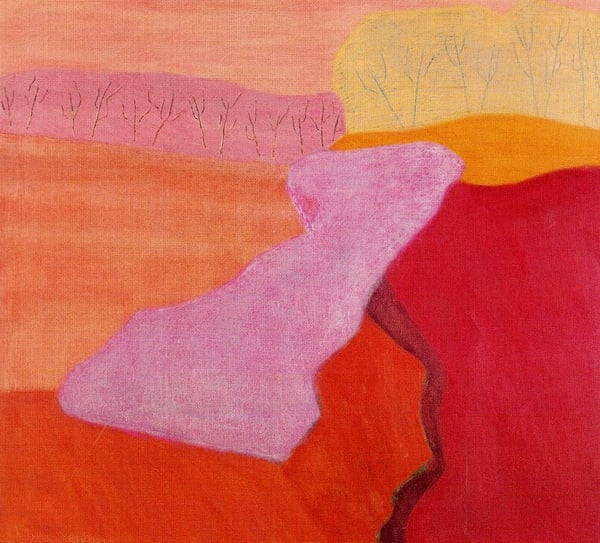
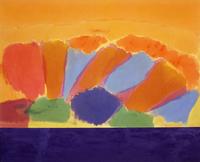
Milton Avery’s "Shapes of Spring" is a significant work within the evolution of American Abstract Art, specifically demonstrating his unique ability to distill a landscape into its essential formal elements while retaining a deep sense of place and mood. Though categorized under abstract art, the painting remains firmly rooted in the tradition of landscape; Avery never fully abandoned representation, instead using radical simplification to amplify emotional and aesthetic impact.
Key Artistic Significance:
-
Bridging Figuration and Abstraction: Avery stands as a pivotal figure between the realist traditions of the Ashcan School (with which he briefly associated) and the later, fully non-objective Color Field painters (like Mark Rothko and Adolph Gottlieb, who admired him). In "Shapes of Spring," trees, hills, and sky are reduced to flat, interlocking blocks of color. The recognizable scene of a vernal landscape (likely inspired by his travels or the New England countryside) is translated into a composition where shape and color become the primary subjects, yet the painting never loses its lyrical, atmospheric connection to nature.
-
Mastery of Color as Structure: Avery’s hallmark is his use of luminous, often unexpected color harmonies. In "Shapes of Spring," the palette likely moves from soft greens to warm ochres and pale blues, applied in thin, even washes that allow the canvas to breathe. These colors are not merely descriptive; they define space and light. Avery rejected the dramatic impasto or gestural energy of Abstract Expressionism, instead achieving a quiet, meditative resonance through carefully equilibrated hues. This approach directly influenced the chromatic emphasis of later movements.
-
Flatness and Spatial Ambiguity: The work exemplifies Avery’s rejection of traditional linear perspective. Foreground, midground, and background are compressed into a single plane. A dark green shape might stand for a distant hill, while a lighter patch of blue sits as sky, yet they share the same visual weight. This flattening creates a tension between illusionistic depth and the physical reality of the painted surface—a central concern of modern art.
-
"Abstract" as Essence, Not Ornament: For Avery, abstraction was a tool to reveal the inner truth of a landscape—its rhythm, its color-saturated atmosphere, its emotional temperature. "Shapes of Spring" is significant because it demonstrates that an abstract painting can still feel deeply rooted in a specific time of year and place. The title itself—“Spring”—evokes renewal and a soft, diffused light, all of which Avery translates not through detail but through the interaction of simplified shapes.
Conclusion:
"Shapes of Spring" is a masterclass in reduction. Milton Avery’s genius lies in making the viewer feel the essence of a spring landscape through pure form and color, without the clutter of narrative or naturalistic detail. It stands as a crucial link in the lineage of American landscape painting, showing how the genre could be radically reimagined for the modern age while retaining its intimate, poetic soul. Its significance lies not in revolution, but in quiet, profound transformation.
Visually similar
20 works with related composition and palette
Paysage
Roger Bissière
Red Heart
Friedel Dzubas
Earth
Artin Demirci
Legend of the Orient
Jock Macdonald
Only One
Georgia O'Keeffe
Current
Friedel Dzubas
Uriel
Ronnie Landfield
Creation of the World IV
Mikalojus Konstantinas Ciurlionis
Infinity Field, Lefkada Series
Theodoros Stamos

Untitled
Etel Adnan
Colored Rhythm: Study for the Film
Leopold Survage
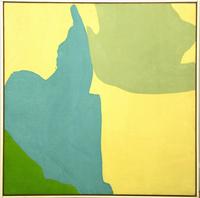
Flowering #2
Friedel Dzubas
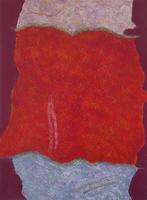
Infinity Field, Lefkada Series I
Theodoros Stamos

Middle East
Frederick Hammersley
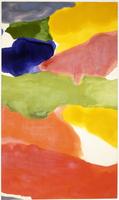
Tutti-Fruitti
Helen Frankenthaler
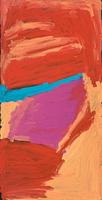
Dibirdibi Country
Sally Gabori
Tempe-jal-tzen-baykin (City of mobster Ja Lama)
Nicholas Roerich

XVI
Serge Poliakoff
Pendulum
Helen Frankenthaler
Lanscape II
Karlo Zvirynsky