Expertenanalyse zu Franklin Carmichaels La Cloche Panorama
Stil: Art Nouveau (Modern) · Genre: landscape
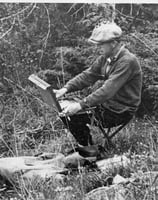
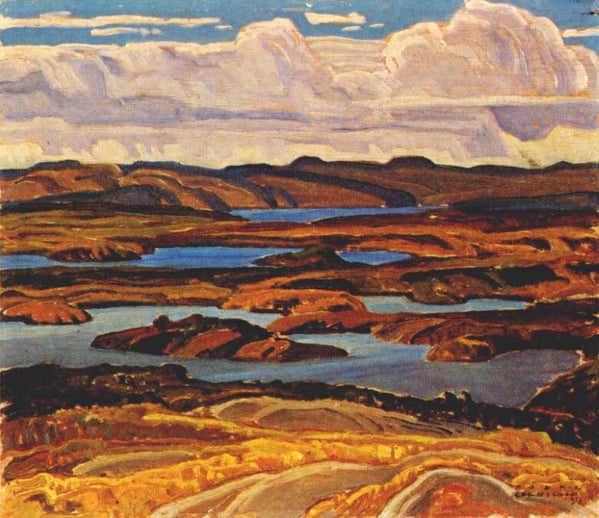
Expert Analysis: "La Cloche Panorama" by Franklin Carmichael
Franklin Carmichael’s "La Cloche Panorama" stands as a remarkable fusion of Art Nouveau’s organic dynamism with the traditional landscape genre—a pairing that challenges conventional expectations of both movements. Painted during Carmichael’s tenure as a founding member of the Group of Seven, this work typically reflects his fascination with the rugged Canadian wilderness, but here it is filtered through the sinuous, decorative lens of Art Nouveau modernism.
Significance within Art Nouveau and Modern Landscape
Art Nouveau is rarely associated with expansive natural vistas; it is more commonly known for architectural ornament, poster art, and intimate decorative objects. Carmichael’s "La Cloche Panorama" expands the style’s vocabulary by applying its characteristic flowing lines and curvilinear rhythms to a sweeping panoramic view. The composition is structured not by rigid perspective, but by interlaced, undulating forms—clouds, hills, and water—that echo the movement of a vine or a peacock feather. This transforms the landscape into a living, breathing organism, aligning with Art Nouveau’s core belief that nature’s structures should inform all art.
The work is significant because it demonstrates how modern artists could absorb Art Nouveau’s principles while breaking away from its more decorative, two-dimensional applications. Carmichael uses the style’s emphasis on asymmetry, whiplash curves, and flat colour planes to reinterpret the Canadian Shield’s iconic granite outcroppings and pine forests. The result is a landscape that feels both monumental and fluid—a meditation on the unity of earth, sky, and water as a continuous, rhythmic whole.
Art Nouveau (Modern) Context
As a "Modern" artwork, "La Cloche Panorama" rejects academic naturalism in favour of stylized expression. Carmichael strips away extraneous detail, leaving pure colour and line to carry emotional weight. This aligns with Art Nouveau’s goal of creating a total aesthetic experience, where every element—even untamed wilderness—is harmonized through a deliberate, decorative order. The painting thus becomes a bridge between the organic idealism of Art Nouveau and the rugged national identity of early 20th-century Canadian landscape painting.
Conclusion
"La Cloche Panorama" is significant because it proves that Art Nouveau could transcend its typical boundaries to animate the vast, untamed landscape. Carmichael’s synthesis of sinuous formalism with a panoramic genre creates a unique visual language that celebrates both the decorative and the sublime. It remains a vital example of how a modern style can reinvent a classical subject, leaving an indelible mark on the evolution of landscape art.
Visuell ähnlich
20 Werke mit ähnlicher Komposition und Farbpalette
Karelia
Nicholas Roerich
Bay of Islands
Franklin Carmichael
Ladoga. Karelian landscape.
Nicholas Roerich
Morning rider
Nicholas Roerich
Afternoon Sun, Lake Superior
Lawren Harris
Mountain Lake
Nicholas Roerich
A River Estuary
Albert Bierstadt
Lake Hyumpola
Nicholas Roerich
Sydney Heads
Eugene von Guerard
Sydney Heads
Eugene von Guerard
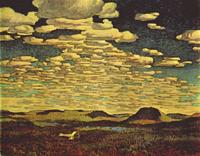
The Fire Ranger
Frank Johnston
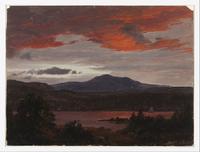
Turner Pond with Pomola Peak and Baxter Peak, Maine
Frederic Edwin Church
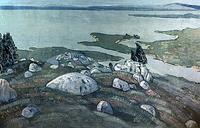
Giant's tomb
Nicholas Roerich
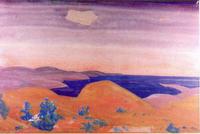
Morocco
Nicholas Roerich
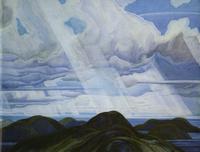
Snow Flurries, North Shore of Lake Superior
Franklin Carmichael
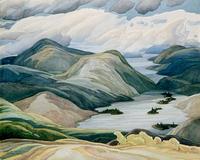
Grace Lake
Franklin Carmichael
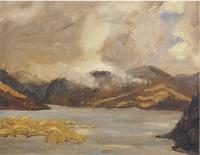
Loch on the Duke of Sutherland's Estate
Winston Churchill
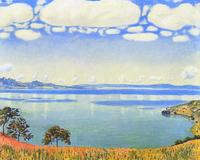
View of Lake Leman from Chexbres
Ferdinand Hodler
Frood Lake
Franklin Carmichael
Battle in the Heavens
Nicholas Roerich