Expertenanalyse zu Andre Massons L'homme emblématique
Stil: Cubism, Surrealism · Genre: symbolic painting
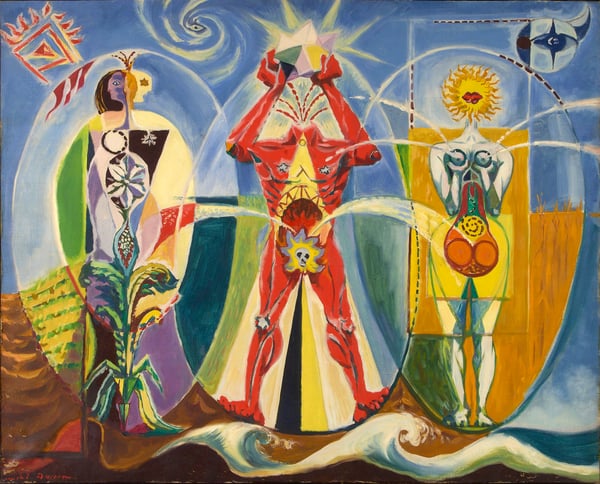
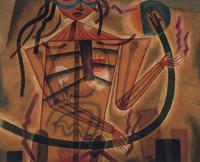
André Masson’s L’homme emblématique stands as a pivotal work that bridges two revolutionary movements: Cubism and Surrealism. Its significance lies in how it fuses the analytical fragmentation of Cubist form with the symbolic, dream-like language of Surrealism, creating a distinctly modern symbolic painting.
The title itself—The Emblematic Man—signals the work’s ambition to move beyond mere visual representation. Within the Cubist tradition, Masson decomposes the human figure into geometric planes and shifting perspectives, denying a single, stable viewpoint. Yet unlike orthodox Cubism, which often remained tied to still-life or portraiture, Masson injects a deeply psychological and archetypal dimension. The “emblematic” quality suggests that this fragmented figure is not a specific individual but a universal symbol—a cipher for the human condition, torn between rational form and irrational impulse.
This synthesis is what makes the painting particularly significant: it demonstrates how Surrealism could appropriate Cubism’s structural innovations to unlock the subconscious. Masson’s use of automatic drawing techniques (a hallmark of Surrealism) likely informs the lyrical, flowing lines that interweave with Cubist facets, producing an image that hovers between deliberate construction and spontaneous expression. The resulting symbolic imagery—perhaps alluding to birth, conflict, or metamorphosis—invites multiple interpretations, a key aim of Surrealist art.
In the broader context of art history, L’homme emblématique exemplifies the crossroads at which Masson, like few others, stood. It proves that Cubism and Surrealism were not mutually exclusive; rather, their marriage could yield a potent language for exploring the psyche. As a symbolic painting, it challenges the viewer to read the figure not as a portrait but as an emblem—a visual hieroglyph of modern humanity’s fractured yet meaning-seeking nature.
Visuell ähnlich
20 Werke mit ähnlicher Komposition und Farbpalette
Acrobats Macro and Microcosms
Maruja Mallo
Untitled
Andre Masson
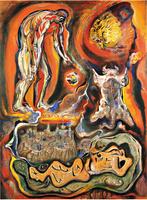
Iconic views of Toledo
Andre Masson
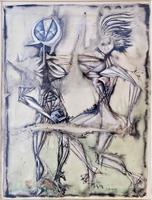
Personnages écorchés
Jacques Hérold
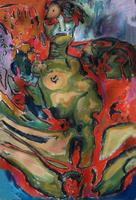
Amour de feu
Cricorps
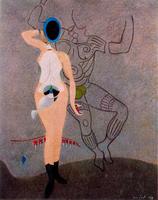
The Return of the Beautiful Gardener (Homage to women)
Max Ernst
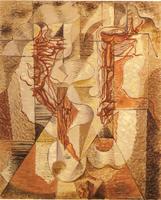
Untitled
Andre Masson
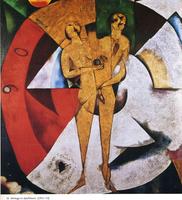
Homage to Apollinaire
Marc Chagall
Kondor Béla, Két Kerub
Kondor Béla
Kondor Béla, Angyal
Kondor Béla
Tensiunea inaltimii
Constantin Blendea
Creation
Frantisek Kupka
Creștere (Că intrăm să ospătăm...)
Constantin Flondor
Mimicry synoptic': the sky-woman
Giacomo Balla
Apollo - Copernicus' Solar System
Stanisław Wyspiański

Le Papillon
Mauricio Paz Viola
Lied I
Albert Bloch
Composition with Five Figures
Janos Mattis-Teutsch
Personaje
Carlos Orozco Romero
Ña Diáfana
Xul Solar