Analisi esperta di Femme Cheval di Wifredo Lam
Stile: Cubism, Surrealism · Genere: portrait
Artwork Analysis: "Femme Cheval" by Wifredo Lam
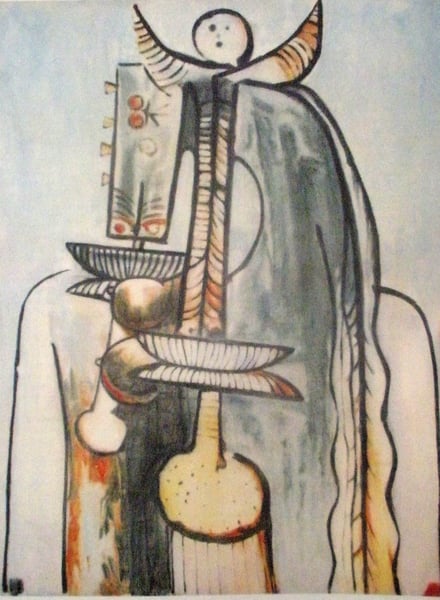
Wifredo Lam’s Femme Cheval (Woman-Horse) stands as a pivotal work that bridges the formal innovations of Cubism with the subconscious dreamscapes of Surrealism, while redefining the traditional portrait genre through a distinctly non-Western lens. Created during Lam’s mature period in the 1940s–1950s, the painting exemplifies his signature synthesis of European avant-garde techniques and Afro-Caribbean spiritual iconography.
Stylistic Significance: Cubism and Surrealism Converged
Lam’s Cubist inheritance is evident in the fractured, angular planes that construct the figure’s face and body. Rather than a naturalistic rendering, the portrait is built from interlocking geometric shapes—sharp cheekbones, a segmented torso, and flattened, mask-like features. This Cubist deconstruction, however, is not an end in itself; it serves to evoke the ritualistic and totemic presence of Afro-Cuban santería deities. The Surrealist dimension surfaces in the hybrid anatomy: the subject’s head merges distinct human and equine attributes—a snout-like nose, elongated jaw, and stiff, forward-pointing mane—creating a dreamlike chimera that defies rational classification. Lam’s palette of earthy browns, off-whites, and stark blacks heightens the ritualistic, nocturnal atmosphere, while the coarse, expressive lines recall both African sculpture and Surrealist automatic drawing.
Genre: Portrait as Spiritual Manifestation
Though nominally a portrait, Femme Cheval subverts the Western portrait tradition’s emphasis on individual identity and psychological interiority. Instead, Lam presents a composite, archetypal figure that embodies the spirit of a caballo (horse)—a term used in Afro-Caribbean religions to describe a human possessed by an orisha. The “horse” is ridden by the divine; thus Lam’s subject is not a specific woman but a vessel, a threshold between the human and the supernatural. This aligns with Lam’s larger project: to reclaim the visual language of his Cuban heritage (where African masks and rituals were long suppressed) and fuse it with modernist forms to articulate a postcolonial worldview.
Significance within Its Context
Femme Cheval is significant because it transcends mere stylistic hybridity to become a political and metaphysical statement. At a time when Surrealism often exoticized the “primitive,” Lam—a mixed-race Afro-Cuban who studied in Europe under Picasso and was friends with André Breton—inverted that gaze. He used European modernism not to appropriate but to elevate the spiritual and formal vocabulary of the African diaspora. The portrait’s disquieting fusion of human and animal, organic and geometric, challenges colonial hierarchies of rational versus irrational, civilized versus savage. In doing so, Femme Cheval stands as a landmark of transcultural modernism, a work where Cubist structure serves Surrealist mystery, and a portrait becomes an invocation.
Genere
Stile
Visivamente simili
20 opere con composizione e palette affini
Ibaye
Wifredo Lam
Totem 1
Istvan Molnar
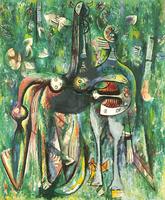
Le Sombre Malembo, Dieu du carrefour
Wifredo Lam
Senoufo
George Ebrin Adingra
Miss Ever Ready
Adja Yunkers
Musketeer with pipe
Pablo Picasso
Earth Traces
George Stefanescu
Carnival Sorcerer
Rene Portocarrero
Untitled
Artin Demirci
Horizons chauds
Wifredo Lam
The sound of Kora ensures dreams with no comparison
George Ebrin Adingra
African potter lady at work, talking to her material
George Ebrin Adingra
Three Figures
Elmer Bischoff
Naturaleza Muerta
Maria Blanchard
Still Life
Marcel Janco
Untitled
Artin Demirci
Looking at the sky
George Ebrin Adingra
Lying female nude
Pablo Picasso
Woman sitting in an armchair
Pablo Picasso
Mofumbe
Wifredo Lam