
Analisi esperta di Split Beat di Gene Davis
Stile: Color Field Painting · Genere: abstract
Expert Analysis: Split Beat by Gene Davis
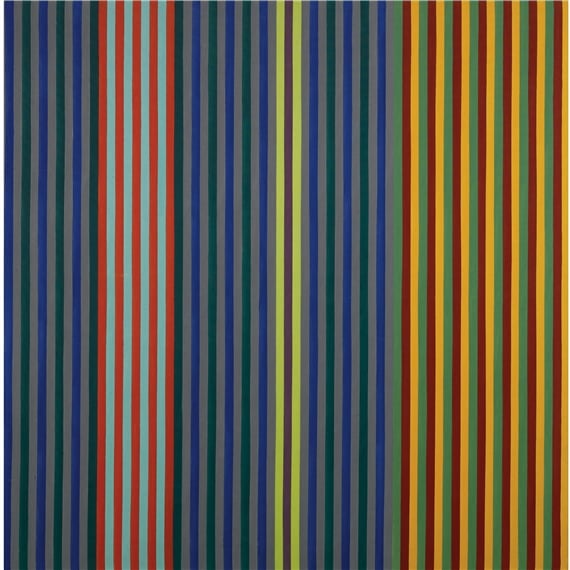
Gene Davis’s Split Beat (c. 1970) stands as a quintessential example of Color Field Painting, a movement that emerged in the 1960s and emphasized large, flat expanses of color as the primary vehicle for emotional and visual impact. Davis, a leading figure in the Washington Color School, is celebrated for his rhythmic, all-over stripe compositions, and Split Beat perfectly encapsulates his signature approach.
What makes Split Beat significant within Color Field Painting:
-
The “Stripe” as a Signature Device
Davis reduced his formal vocabulary to a single, repeated motif: parallel vertical stripes of varying widths and colors. In Split Beat, this repetition creates a pulsating, optical rhythm that pulls the viewer’s eye across the canvas, mimicking the beat of its title. Unlike the immersive, monochromatic fields of Rothko or the staining technique of Helen Frankenthaler, Davis used tightly controlled, even-edged bands of acrylic paint applied directly to unprimed canvas, allowing the fabric’s texture to interact with the pigment. -
Pure Color as Subject
The work’s meaning lies entirely in the relationships between adjacent colors—often hot, contrasting hues (e.g., neon pink against deep purple or lime green against black). Davis avoided narrative, symbolism, or representational content, pushing Color Field’s core idea that color alone can generate profound sensory and emotional experiences. In Split Beat, the “split” may refer to how a sudden change in stripe width or hue disrupts the pattern, creating a visual syncopation that keeps the composition from becoming monotonous. -
Optical Vibration and Seriality
Davis’s stripes often produce a flickering, moiré-like effect due to the high contrast and close placement of colors. This aligns Color Field with Op Art’s interest in perceptual phenomena, but Davis maintained a lyrical, almost musical structure rather than pure illusion. The title Split Beat evokes jazz or minimalist music—Davis was deeply influenced by the improvisational yet structured quality of jazz, and the painting’s measured intervals of color feel like notes on a staff. -
Scale and Physical Presence
Many of Davis’s stripe paintings are large (often 6–10 feet wide), enveloping the viewer in a field of color. Split Beat likely follows this scale, making the stripes feel less like decoration and more like an environment. The evenness of the stripes also flattens pictorial depth, insisting on the surface as a literal, two-dimensional object—a hallmark of Color Field’s rejection of illusionistic space.
Conclusion:
Split Beat is significant because it demonstrates how a single, reductive formal element—the stripe—can be infinitely varied through color, spacing, and rhythm to produce a vibrant, non-representational visual experience. It stands as a masterwork of the Washington Color School, proving that abstraction need not be chaotic to be dynamic; instead, order and repetition can generate their own kind of emotional intensity.
Visivamente simili
20 opere con composizione e palette affini
Circus Sounds
Gene Davis
Orange Twitter
Gene Davis
Zebra
Gene Davis
Lemon Ice
Gene Davis
Equinox
Gene Davis
Red Witch
Gene Davis
Yankee Doodle
Gene Davis
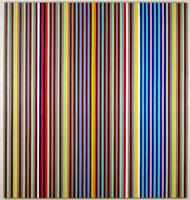
Untitled (P280)
Gene Davis
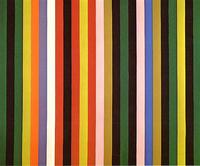
Ferris Wheel
Gene Davis

Gothic Jab
Gene Davis
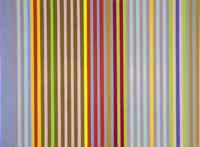
Apricot Ripple
Gene Davis
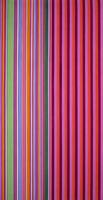
Red Baron
Gene Davis
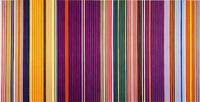
Dr. Peppercorn
Gene Davis
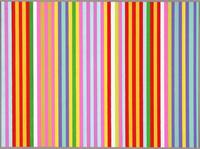
Powwow
Gene Davis
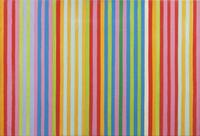
Red Chatterbox
Gene Davis
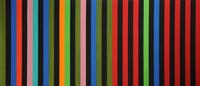
Firebox
Gene Davis
Black Popcorn
Gene Davis
Hot Beat
Gene Davis
King Kong
Gene Davis
Citadel
Gene Davis