
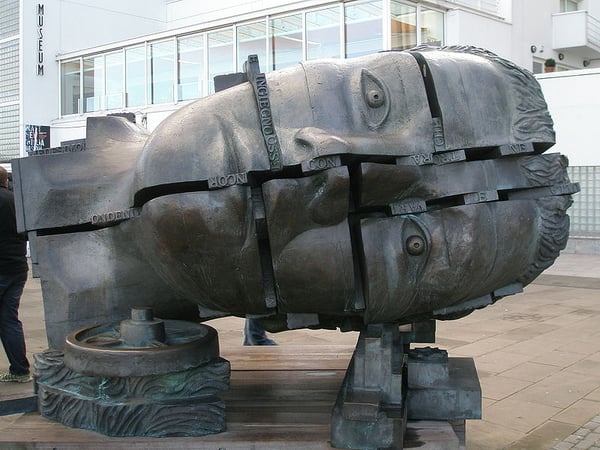
Eduardo Paolozzi の Head of Invention の専門的な分析
ジャンル:sculpture
Expert Analysis of "Head of Invention" by Eduardo Paolozzi
Eduardo Paolozzi’s Head of Invention stands as a quintessential example of post-war British sculpture that fuses the human form with the language of industrial machinery. Created in the mid-1970s, this bronze work belongs to a series where Paolozzi reimagined the classical portrait bust through a lens of mechanical fragmentation and assembly.
Significance within Style and Period
-
Bridging Pop Art and Assemblage
Paolozzi, a founding figure of British Pop Art, consistently drew inspiration from consumer culture, technology, and mass production. Head of Invention directly translates the logic of collage and assemblage—central to his early print work—into three dimensions. The head appears built from overlapping, machine-like components—gears, vents, grilles, and mechanical joints—rather than carved from a single block. This approach echoes the Dadaist and Surrealist tradition of objet trouvé (found objects), while simultaneously anticipating the cyborg and post-humanist themes of later contemporary art. -
Commentary on Industrial Humanity
The title Head of Invention is deliberately ironic: the “invention” is a humanoid machine, suggesting that humanity’s greatest creation is its own mechanized replacement. In the context of the 1970s—a period of growing unease about automation, nuclear power, and technological alienation—Paolozzi presents a bust that is both monumental and dehumanized. The work’s fragmented surfaces and obsessive detail mirror the anxiety of a society overwhelmed by industrial progress. -
Technical Mastery of Bronze
Paolozzi’s use of bronze is essential to the work’s impact. By casting disparate, often sharp-edged mechanical forms in a traditional noble material, he creates a tension between the ancient (bronze statuary) and the modern (machine parts). The meticulously textured surface catches light unevenly, emphasizing the sense of disassembly and reassembly. This technique aligns with the broader post-war trend of “assemblage sculpture” practiced by artists such as Jean Tinguely and Robert Rauschenberg. -
Influence on Public Art and Monumentality
Head of Invention is not only a gallery work but a precursor to Paolozzi’s large-scale public sculptures, most notably his celebrated Newton (1995) in the British Library forecourt. The head’s cubistic, grid-like geometry and its fusion of human and machine directly informed that later piece. Thus, Head of Invention marks a crucial transitional moment between Paolozzi’s earlier Pop imagery and his mature monumental style.
Conclusion
Head of Invention is significant because it encapsulates Paolozzi’s lifelong investigation of the relationship between man and machine, while also summarizing key concerns of post-war sculpture: the rejection of pure abstraction, the embrace of industrial materials and methods, and the critique of modernity. It remains a powerful, unsettling icon of an era grappling with the implications of its own technological prowess.
ジャンル
視覚的に類似
構図やパレットが近い作品 20 件

The face of genius
Rene Magritte

Made From Blocks
Nina Tokhtaman Valetova

Pluralidad
Teddy Cobeña
Michelangelo's 'David'
Eduardo Paolozzi

Multiple Portrait
Alina Szapocznikow

We the People (detail)
Danh Vō
Dresdner Frauen-Karla
Georg Baselitz
Sleeping Muse II
Constantin Brâncuși
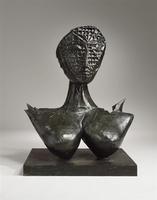
La Femmoiselle
Jacques Hérold
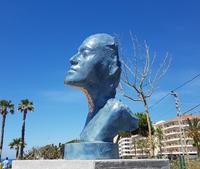
Everything is born within you
Teddy Cobeña

Dame de Baigneuse
Etienne Hajdu
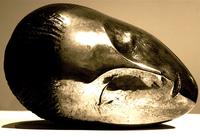
Colette
Constantin Brâncuși
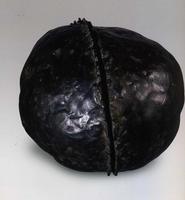
Concept Spatiale
Lucio Fontana
The double secret
Rene Magritte

Rind
M.C. Escher
Algorithm Mind Maps #35
Joseph Pace

The Well
Enrique Martínez Celaya

Atom Piece (Working Model for Nuclear Energy)
Henry Moore

Two Piece Reclining Figure No. 5
Henry Moore
748 One of Five Seamen
Friedensreich Hundertwasser