Expertenanalyse zu Max Bills Komposition
Stil: Concretism · Genre: abstract
Expert Analysis of Max Bill's Komposition (Concretism)
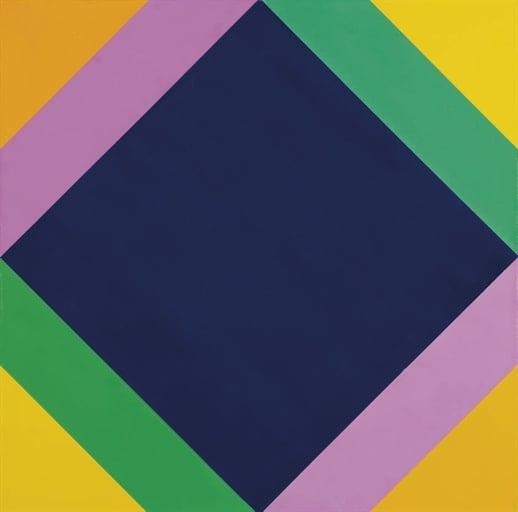
Max Bill’s Komposition is a quintessential example of Concretism, a rigorous offshoot of geometric abstraction that emerged in the 1930s. Unlike abstract expressionism’s emotional spontaneity, Concretism insists on pure, self-referential form—art derived entirely from its own material and mathematical logic, free of symbolic or naturalistic references.
In this work, Bill demonstrates the movement’s core tenets:
- Geometric precision – The composition likely relies on modular grids, circles, or rectangles arranged with mathematical exactitude, reflecting Bill’s background as a Bauhaus-trained artist and his fascination with visual harmony through proportion.
- Color as structure – Hues are chosen not for mood but for their optical relationships (e.g., complementary contrasts or sequential gradients), creating a dynamic equilibrium that feels both rational and perceptual.
- Rejection of illusionism – The flat, unmodulated surface affirms the painting as an object in its own right, not a window onto an imagined space. This aligns with Concretism’s manifesto (Theunissen, 1930) demanding “works that are the expression of the human spirit, based on pure relations of color and form.”
Significance within Concretism:
Bill’s Komposition serves as a bridge between Interwar Constructivism and Post-War Concrete Art. By focusing on serial variations and systematic permutations (a hallmark of his later work, like 15 Variations on a Theme), Bill elevated Concretism from a theoretical stance to a generative creative method. Here, the “composition” is not a fixed aesthetic arrangement but a demonstration of universal visual order—an idea that resonated with the era’s desire for clarity and renewal in the wake of World War II.
As a pioneer of the Zurich School of Concrete Art, Bill insisted that art should be “constructible” like mathematics or architecture. Komposition embodies this ethos, making it a key work that redefined abstract art as a tool for rational contemplation rather than emotional expression. Its legacy influences minimalist and conceptual practices to this day.
Visuell ähnlich
20 Werke mit ähnlicher Komposition und Farbpalette
Untitled
Max Bill

Radiazone bleu
Max Bill
Red Nuclear
Max Bill
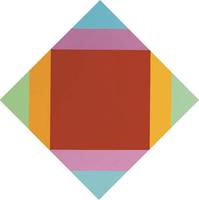
Zerstrahlung aus Rotem Kern
Max Bill
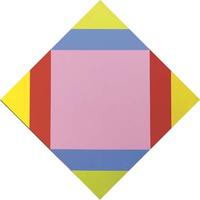
Radiazoneduplicate
Max Bill
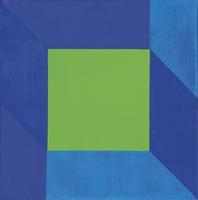
Helles zentrum
Max Bill
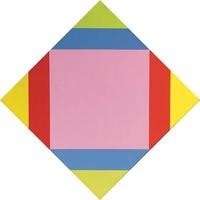
Radiation of Pink
Max Bill
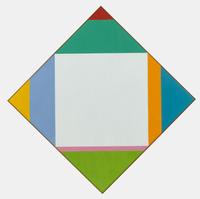
Expansion in Four Directions
Max Bill
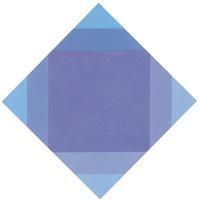
Auflösung von lila
Max Bill

Blau-violettes horizontal-vertikal-quadrat
Max Bill
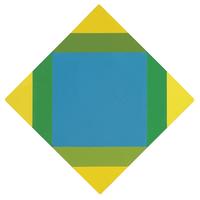
Strahlung zu gelb
Max Bill
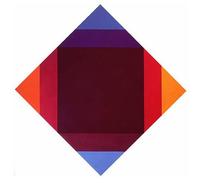
Verdichtung zu caput mortuum
Max Bill
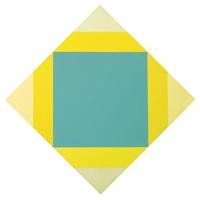
Verdichtung aus Gelb
Max Bill
White Square
Al Held
Untitled
Verena Loewensberg
#8
Paul Reed
Radiation of Purple
Max Bill
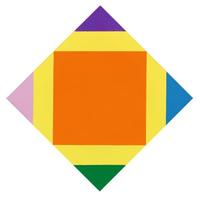
Untitled
Max Bill
Extent
Kenneth Noland
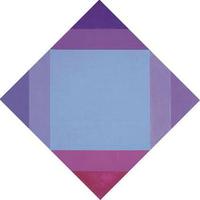
Radiazone violeta
Max Bill