Expert analysis of Max Bill’s Untitled
Style: Concretism · Genre: abstract
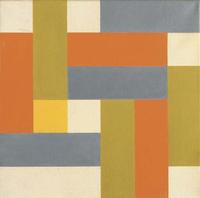
Expert Analysis: "Untitled" by Max Bill
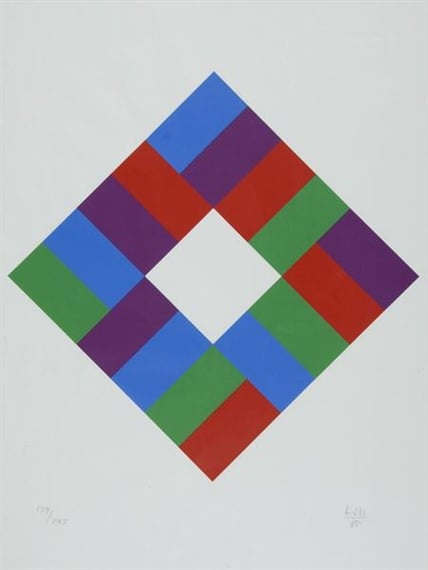
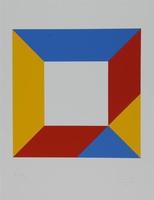
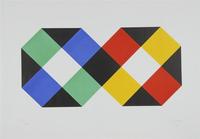
Max Bill’s “Untitled” (c. 1960s) is a defining work of Concrete Art (Konkrete Kunst), a movement that emerged in the 1930s and gained prominence in post-war Europe. Bill, a Swiss artist, designer, and mathematician, was both a practitioner and leading theorist of this style, which rejects all symbolic, naturalistic, or emotional references in favor of pure, self-referential form.
Formal and Technical Significance
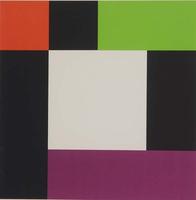
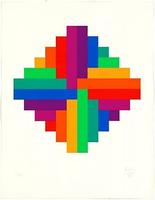
The painting exemplifies the core tenets of Concretism: precise geometric shapes (circles, squares, or irregular polygons), flat, unmodulated colors (often primary hues plus black and white), and rigorously calculated compositions. Bill’s works are typically constructed according to mathematical ratios or serial progressions—such as the golden section or rhythmic rotations—yielding a visual order that feels both inevitable and dynamic. This piece likely features a balanced interplay of positive and negative space, where each line and color occupies a discrete, non-illusionistic plane, affirming the work’s identity as a concrete object rather than a window onto another world.
Historical and Conceptual Significance
-
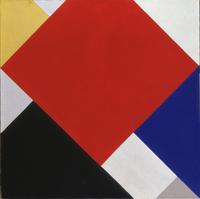
Intellectual Purity: Bill’s approach was deeply influenced by his Bauhaus training (he studied under Kandinsky and Albers) and his friendship with Dutch De Stijl artist Theo van Doesburg. Van Doesburg’s 1930 manifesto defined concrete art as “absolutely spiritual,” yet Bill added a rationalist, almost scientific rigor. “Untitled” demonstrates how art can be a visual proof of mathematical harmony—a neutral, universal language unclouded by personal emotion or narrative.
-
Legacy of Seriality: Bill’s systematic variations of form (seen throughout his “serielle” works) prefigure postwar Minimalism and Op Art. His emphasis on the viewer’s perceptual experience—where slight shifts in angle or attention reveal hidden symmetries—makes the work an early instance of “timeless” abstraction that actively engages the eye.
-
Material as Meaning: The fact that the painting is titled “Untitled” is itself significant. It refuses descriptive or metaphorical labels, forcing the viewer to confront the work on its own terms: as a physical arrangement of color and shape that exists solely to be seen, not interpreted.
Why It Matters
Max Bill’s “Untitled” is a landmark because it fully realizes the Concrete art ideal: a rigorously orchestrated composition that achieves visual harmony through pure reason. It stands as a counterweight to mid-century Abstract Expressionism’s emotional excess, championing instead a cool, objective beauty that is both intellectually satisfying and sensually vibrant. Bill’s insistence that art should be “the result of a mathematical construction, not a sentimental one” reaches its apotheosis in this work, making it a cornerstone of geometric abstraction and a direct antecedent to later movements from Minimalism to computational art.
Visually similar
20 works with related composition and palette
Untitled
Max Bill
Untitled
Max Bill
Untitled
Max Bill
Untitled
Max Bill
Konstruktion um das thema 3-4-5
Max Bill
Diamond Pinwheel
Ronald Davis
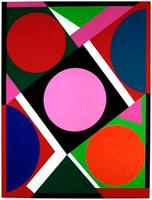
Cause
Auguste Herbin
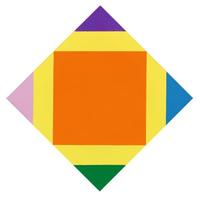
Untitled
Max Bill
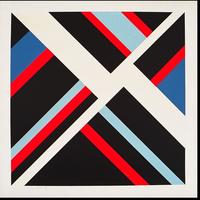
Black Diamond
Ilya Bolotowsky
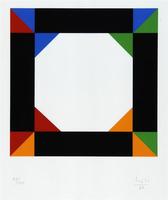
Untitled
Max Bill
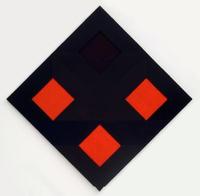
Black Painting
Ralph Hotere
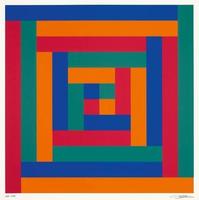
Progression von Sechs Gleichen Gruppen von 1-11
Richard Paul Lohse
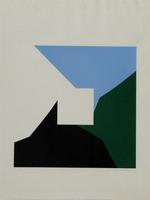
Untitled
Verena Loewensberg
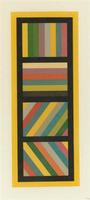
Bands of Color in Four Directions
Sol LeWitt
Three Colours Surrounded by Equal Amounts of Black and White
Max Bill
Serigrafia
Max Bill
Counter composition V
Theo van Doesburg
Untitled
Kenneth Noland
Farbenergien in vier Richtungen
Richard Paul Lohse
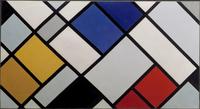
Contra-Composition of Dissonances, XVI
Theo van Doesburg