
Expertenanalyse zu Dan Christensens Crux
Stil: Abstract Expressionism, Color Field Painting · Genre: abstract
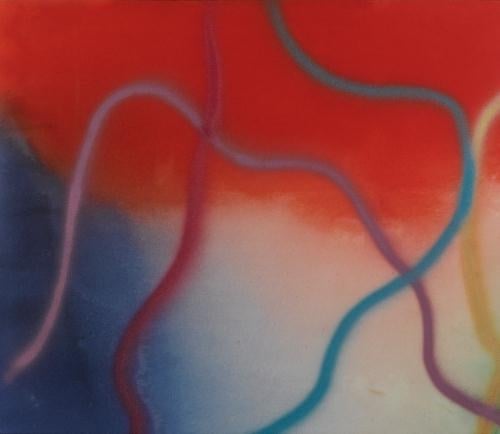
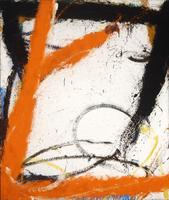
Dan Christensen’s Crux (1972) stands as a compelling synthesis of two defining mid-century American movements—Abstract Expressionism and Color Field painting—while also signaling the artist’s distinctive departure from both. Executed in the early 1970s, at the height of Christensen’s celebrated “ribbon” and “spray” series, the work exemplifies his signature technique of layering thinned acrylic paints through airbrush and staining, creating luminous veils of color that seem to float and intertwine.
Significance within Abstract Expressionism & Color Field Painting
-
Gesture Transformed into Light – Where first-generation Abstract Expressionists like Pollock or de Kooning relied on visceral, often aggressive brushstrokes, Christensen substitutes a fluid, airy gesture. In Crux, the titular “cross” form emerges not from thick impasto but from delicate webs and trails of sprayed pigment, suggesting a new kind of organic mark-making. This retains the spontaneity and emotional intensity of Abstract Expressionism while shifting its material presence from physical action to optical sensation.
-
Expanding Color Field’s Vocabulary – As a second-generation Color Field painter, Christensen inherited the flat, all-over composition and saturated hues championed by Helen Frankenthaler and Morris Louis. Yet Crux resists pure stain: Christensen often combined staining with manual drawing—using a brush or a roll of paper soaked in paint—to produce sinuous, calligraphic lines that crisscross the canvas. This reintroduces a linear, almost architectural structure to the color-saturated field, bridging the gap between the lyrical flow of Color Field and the bravura gesture of Abstract Expressionism.
-
The “Crux” as Formal and Conceptual Anchor – The painting’s title suggests a pivotal moment—a crossing point. Visually, this translates to intersecting arcs and spirals that converge near the composition’s center. Rather than a fixed cruciform shape, Christensen’s lines are ephemeral, created by the accidental overlap of spray and sweep. This ambiguity is key: the “cross” is felt as much as seen, an emblem of the artist’s central concern—how color and line can suggest both motion and stillness, chaos and order. In this way, Crux captures the very tension that defined post-war American abstraction: the desire to reconcile expressive freedom with formal discipline.
-
Technical Innovation – Christensen’s use of airbrush and thinned acrylic was groundbreaking in the late 1960s–early ’70s. Crux showcases a masterful control of atomized paint, allowing colors to bleed and interact on raw canvas with a softness that prefigures later “lyrical abstraction” and even aspects of 1980s neo-expressionist stain painting. The work thus occupies a transitional moment where the heroic scale and all-over composition of classic Color Field meet a more personal, intimate sense of mark-making.
In sum, Crux is significant because it does not merely replicate the achievements of Abstract Expressionism or Color Field but recombines their core principles—gesture, color, opticality, and structure—into a fresh, elegant vocabulary. It stands as a mature example of Christensen’s ability to make the air itself seem to move across the canvas, inviting the viewer into a shimmering, weightless space where painting becomes a phenomenon of light and atmosphere.
Visuell ähnlich
20 Werke mit ähnlicher Komposition und Farbpalette
Chevade
Dan Christensen
Serpens
Dan Christensen
Untitled
Dan Christensen
Kaitos
Dan Christensen
The Attended
Brice Marden
1932 (painting)
Ben Nicholson
Epitaph Painting 5
Brice Marden
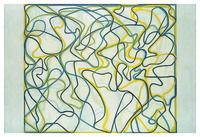
Third Letter
Brice Marden
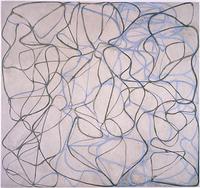
Vine
Brice Marden
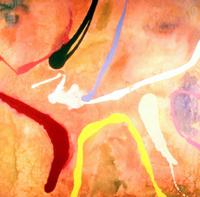
Sarah Rose
Ronnie Landfield
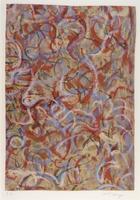
Flame of Colors
Mark Tobey
For Becky
Ronnie Landfield
Serpentine
Ronnie Landfield
New York Summer Landscape
John Ferren
Almanac
Hiroyuki Tajima
Pejzaż morski, 2 VII
Wladyslaw Strzeminski
Överlagrat
Rune Jansson
Untitled
Mark Tobey
Labyrinth
Hans Richter
Waterloo
Norman Bluhm