
Expert analysis of Judy Chicago’s Optical Shapes #3
Style: Minimalism · Genre: abstract
Expert Analysis: "Optical Shapes #3" by Judy Chicago (Minimalism, Abstract)
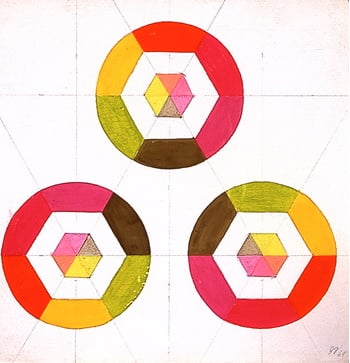
Judy Chicago’s Optical Shapes #3 is a compelling example of her early engagement with Minimalism—a movement historically dominated by male artists—and it stands out for its rigorous exploration of perceptual experience through geometric abstraction. Created during a period when Chicago was deliberately stripping her work to its most essential visual components, this piece aligns with Minimalism’s core tenets: seriality, industrial precision, and the elimination of narrative or symbolic content. Yet Chicago brings a distinct, quietly subversive sensibility to the genre.
Where many Minimalist works (e.g., by Donald Judd or Frank Stella) emphasize hard edges and monolithic presence, Optical Shapes #3 introduces a dynamic tension between flatness and optical illusion. The composition likely features repeated geometric forms—perhaps circles, squares, or ovals—arranged in a grid or sequence that pushes against the picture plane. Chicago’s use of subtly modulated color or contrasting values creates a flickering effect, forcing the viewer’s eye to oscillate between figure and ground. This “optical” quality, hinted at in the title, gestures toward Op Art but remains anchored in Minimalism’s preoccupation with the literal surface.
Significantly, this work defies the era’s gendered expectations. In the 1960s, Minimalism was often framed as a masculine pursuit of rationality and objectivity. Chicago, by contrast, was concurrently developing a feminist consciousness (which would fully flower in works like The Dinner Party). In Optical Shapes #3, she subverts Minimalist dogma by reintroducing a sensory, almost immersive experience—a quality that later critics would recognize as proto-feminist in its insistence on the body’s relationship to perception.
The work’s importance lies in its bridging of two worlds: it is both a rigorous exercise in Minimalist form and an early indicator of Chicago’s desire to imbue abstraction with personal and political resonance. Optical Shapes #3 reminds us that Minimalism was not monolithic, and that artists like Chicago expanded its vocabulary by foregrounding the viewer’s active, embodied gaze.
Visually similar
20 works with related composition and palette
The Fourth 'Book of Schemes'. Album #1, the Third Folder
Valerii Lamakh
Pasadena Lifesavers Red #5
Judy Chicago
Charlotte Tokayer (from the Purple Series)
Frank Stella
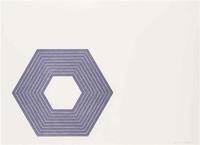
Sidney Guberman, from Purple series
Frank Stella
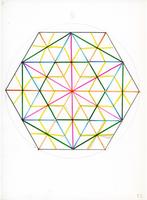
The Fourth 'Book of Schemes'. Album #2, the First Folder
Valerii Lamakh
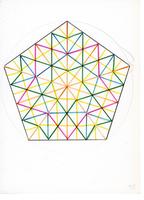
The Fourth 'Book of Schemes'. Album #2, the First Folder
Valerii Lamakh
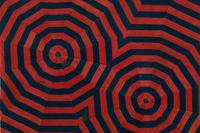
Untitled
Louise Bourgeois
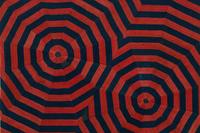
Untitled
Louise Bourgeois

Pasadena Lifesavers Yellow Series #5
Judy Chicago
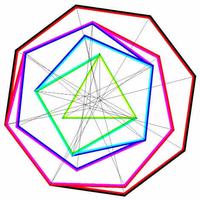
Fifteen Variations on a Single Theme, v. 14
Max Bill
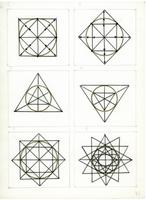
The Fourth 'Book of Schemes'. Album #1, the Third Folder
Valerii Lamakh
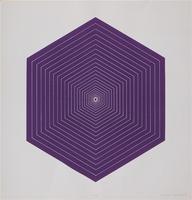
E-35 Dekolta
Tony DeLap
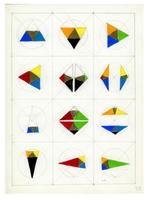
The Fourth 'Book of Schemes'. Album #1, the Third Folder
Valerii Lamakh
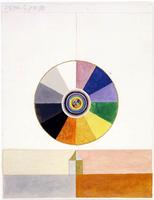
Series VII, No. 7d
Hilma af Klint
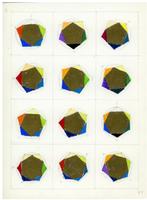
The Fourth 'Book of Schemes'. Album #1, the Third Folder
Valerii Lamakh
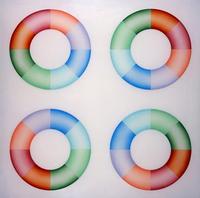
Pasadena Lifesavers Red Series #2
Judy Chicago
The Fourth 'Book of Schemes'. Album #2, the First Folder
Valerii Lamakh
Highlights
Kenneth Noland
Pasadena Lifesavers Yellow Series #2
Judy Chicago
The Fourth 'Book of Schemes'. Album #2, the First Folder
Valerii Lamakh