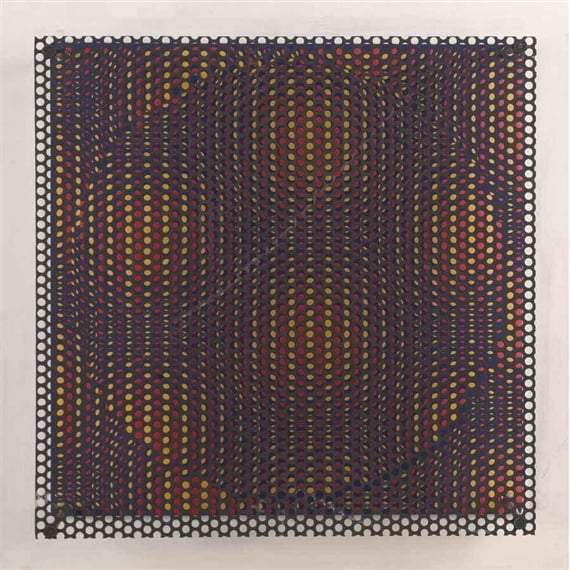
Expertenanalyse zu Antonio Asiss Círculo rojo y amarillo
Stil: Op Art · Genre: abstract
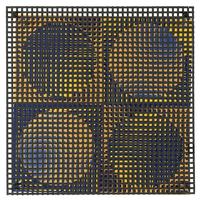
Expert Analysis: "Círculo rojo y amarillo" by Antonio Asis
Antonio Asis, a key figure in the Op Art and Kinetic Art movements of the mid‑20th century, created Círculo rojo y amarillo as a distilled study in chromatic vibration and perceptual ambiguity. The work exemplifies the core tenets of Op Art—an abstract style that deliberately exploits the eye’s responses to color, contrast, and pattern to generate illusions of movement, depth, or shimmer.
Formal Significance
The composition is reduced to a fundamental geometric motif: a circle (the “círculo” of the title) rendered in only two hues—red and yellow. Despite this stark simplicity, Asis achieves remarkable optical complexity. The juxtaposition of warm, high‑chroma red and yellow—both colors that appear to advance in the visual field—creates a tension at their boundary. The viewer’s retina struggles to maintain a stable edge, producing an effect of flickering or pulsing. This is a hallmark of Op Art: the artwork “activates” the viewer’s physiological vision rather than relying on narrative or symbolic content.
Contextual Importance
Within the broader Op Art movement (which peaked in the 1960s with artists like Victor Vasarely and Bridget Riley), Asis’s work is distinguished by its directness and minimalism. He often employed simple, repeating forms—here a single circle—to maximize perceptual phenomena. Círculo rojo y amarillo can be seen as an exploration of Josef Albers’ color theories (the interaction of colors) taken into the realm of kinetic illusion. The painting is static yet feels alive; its significance lies in proving that even the most elementary abstract shapes, when paired with carefully selected pure colors, can defy the static nature of the canvas and engage the eye in a dynamic, almost hypnotic dance.
Legacy
Asis’s contribution to Op Art is his ability to fuse Constructivist geometry with a Latin American sensibility for vibrant, saturated color. Círculo rojo y amarillo stands as a quintessential example of how Op Art abandoned representation to focus on the very mechanics of seeing—making the act of perception the true subject of the work.
Visuell ähnlich
20 Werke mit ähnlicher Komposition und Farbpalette
Vibration couleur
Antonio Asis
Gocce in gabbia
Alberto Biasi
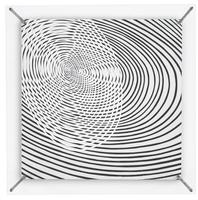
Spirales (Sotomagie) Edition Denise René
Jesus Rafael Soto
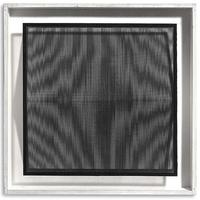
Untitled
Ludwig Wilding
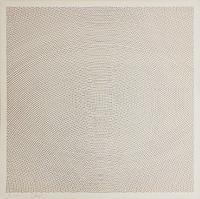
Arcs From Sides or Corners, Grids & Circles
Sol LeWitt
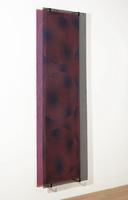
Composition in red
Antonio Asis
Stretcher Frame
Roy Lichtenstein
Single PS 2c
Ludwig Wilding
Untitled from 9x5 Konkret Portfolio
Ludwig Wilding
Mirror #4
Roy Lichtenstein

Symmetrical Structure
Vilen Barsky
Ordination d'une surface, vitesses progressives de rotation
Julio Le Parc
Black Daisy
Julian Stanczak
Optic composition
Ludwig Wilding
Kinetisches Objekt
Ludwig Wilding
Appearance of Crosses 2004-11
Ding Yi
Accumulative
Julian Stanczak
Mirror
Roy Lichtenstein
Pause
Bridget Riley
4 - cuadrados 4 - círculos
Antonio Asis