
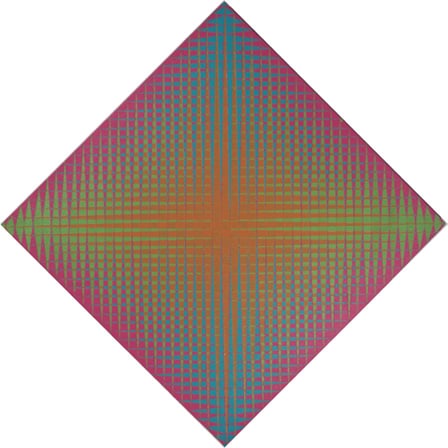
Expertenanalyse zu Christopher Willards Tikaku - Vicinity
Stil: Neo-Geo · Genre: abstract
Expert Analysis: "Tikaku - Vicinity" by Christopher Willard
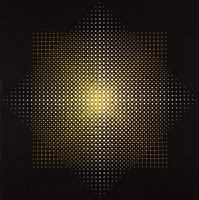
Christopher Willard’s "Tikaku - Vicinity" is a compelling example of the Neo-Geo aesthetic—a movement that emerged in the 1980s as a deliberate, cerebral counterpoint to the raw emotionalism of Neo-Expressionism. As an abstract work, it strips away representational content to foreground pure geometry, systematic composition, and a cool, almost industrial precision.
Significance within Neo-Geo
-
Rejection of Expressionist Subjectivity – Neo-Geo artists like Willard embrace rational, hard-edged forms over gestural brushwork. "Tikaku - Vicinity" likely employs crisp lines, flat planes, and modular repetition, evoking the logic of computer graphics or architectural blueprints. This places the work in dialogue with the movement’s interest in simulation and hyperreality—a reflection of a society increasingly mediated by screens and systems.
-
Abstraction as Conceptual Game – The genre of abstraction here is not about emotional resonance but about visual mechanics. The title “Vicinity” suggests spatial relationships, while “Tikaku” (perhaps a coined or appropriated term) hints at a personal code or system. The work’s significance lies in how it forces the viewer to engage with the inner logic of geometry rather than seeking narrative or symbolism.
-
Dialogue with Modernism & Commercial Culture – Neo-Geo often critiques and borrows from earlier geometric abstraction (e.g., Mondrian, Albers) while infusing it with the slick, mass-produced look of consumer society. Willard’s painting likely inhabits this tension: pristine surfaces and mathematical order echo both utopian modernist ideals and the sterile aesthetics of corporate logos or digital interfaces.
Conclusion
"Tikaku - Vicinity" is significant not for what it depicts, but for how it enacts the core principles of Neo-Geo: a cool, analytical approach to abstraction that interrogates the boundaries between art, design, and simulation. Willard’s work exemplifies the movement’s ambition to make painting a system of thought—precise, detached, and endlessly self-referential.
Visuell ähnlich
20 Werke mit ähnlicher Komposition und Farbpalette
Heavy Rain
Christopher Willard
The Fourth of the Three
Richard Anuszkiewicz
Sandy's Cell
Christopher Willard
Serie 26D, No. 1-3 3-1, 3-1 1-3
Julio Le Parc
Grand Treasure
Richard Anuszkiewicz
Cross
Edna Andrade
Transept
Julian Stanczak
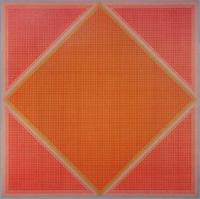
Lunar
Richard Anuszkiewicz
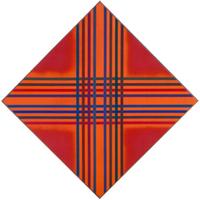
Interlock Color
Kenneth Noland
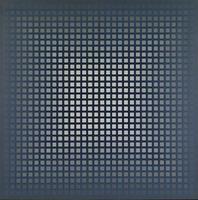
Shimmer
Julian Stanczak
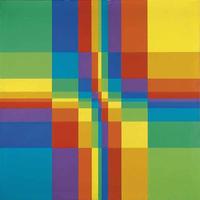
Neun systematische Farbreihen mit horizontaler und vertikaler Verdichtung
Richard Paul Lohse
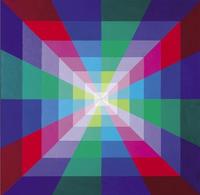
Perspective chromatique
Martha Boto
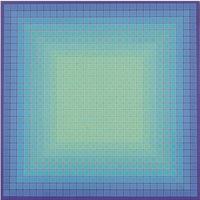
Conservative Green: Minus
Julian Stanczak
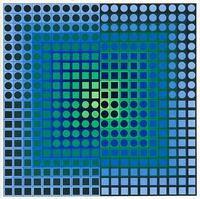
Zoeld V
Victor Vasarely
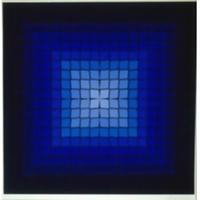
Quasar
Victor Vasarely
Disegno ottico dinamico
Dadamaino
Pal-Ket
Victor Vasarely
Contrastes chromatiques
Gregorio Vardanega
Deep Magenta Square
Richard Anuszkiewicz
Two Squares
Almir Mavignier