Analisi esperta di Lake Albano (Italy) di George Inness
Stile: Tonalism · Genere: landscape
Expert Analysis: “Lake Albano (Italy)” by George Inness
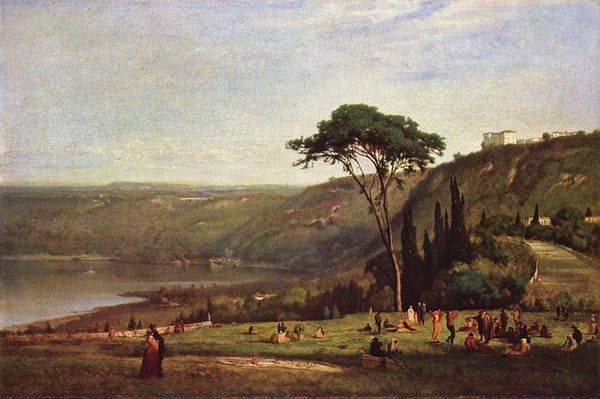
Within the context of late 19th-century American landscape painting, George Inness’s “Lake Albano (Italy)” stands as a quintessential example of Tonalism—a style that prioritized mood, atmosphere, and a subdued, harmonious palette over topographical accuracy. Inness, a leading figure in this movement, created works that were deeply spiritual and meditative, moving away from the detailed, heroic vistas of the Hudson River School toward a more introspective and poetic vision of nature.
Significance within Tonalism and the Landscape Genre
-
Atmospheric Unity: In Tonalism, the artist often used a limited range of soft, muted colors—grays, browns, soft greens, and hazy blues—to create a sense of enveloping light and air. In “Lake Albano,” this technique unifies sky, water, and land into a single, hushed tonal harmony. The lake itself becomes a mirror for an overcast or twilight sky, dissolving hard edges and inviting the viewer into a contemplative, almost reverent state.
-
Spiritual Interiority: Inness was influenced by the philosophy of Emanuel Swedenborg, who believed that nature was a symbol of the divine. This work transcends mere topography: the distant Italian hills, the still water, and the soft, diffused light are not just a record of a specific place but a vehicle for a transcendent experience. The landscape is rendered as a mood—a calm, eternal moment that suggests the presence of something greater than the physical scene.
-
Transitional Mastery: Painted during or after Inness’s travels in Italy, “Lake Albano” reflects his mature synthesis of European Barbizon influences (with their emphasis on tonal values and intimate scale) and his own evolving American sensibility. It marks a departure from narrative or dramatic naturalism toward a more abstract, atmospheric composition that foreshadows early 20th-century modernism.
-
Genre as Philosophy: As a landscape, the work does not seek to instruct or awe through scale or anecdotal detail. Instead, it exemplifies Tonalism’s core belief that a landscape could evoke profound emotion and spiritual insight through subtle gradations of color and light. Inness’s Lake Albano is not merely a beautiful view; it is a window into a tranquil, unified cosmos—a hallmark of the movement’s most significant contributions to American art.
In summary, “Lake Albano (Italy)” is significant because it encapsulates George Inness’s pivotal role in shifting American landscape painting from objective description to subjective, tonal expression. It remains a masterful demonstration of how color, light, and form can transform a real location into a timeless, meditative vision—the very heart of Tonalism.
Museum / Gallery
Visivamente simili
20 opere con composizione e palette affini
Italian Scene Composition
Thomas Cole
Lake Albano
Joseph Wright
A View of the Tiber with Rome in the Distance
Richard Wilson

Childe Harold
J.M.W. Turner

Lake Nemi
Joseph Wright
The Lake Geneva seen from Montreux
J.M.W. Turner
Lago di Nemi
Sanford Robinson Gifford
Alban Hills
Louis Gurlitt
The Pont de Narni
Camille Corot
The Old Feodosia
Ivan Aivazovsky
Il Penseroso
Thomas Cole
View of the Lake of Nemi
Joseph Wright
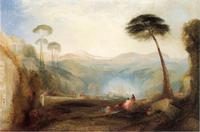
Golden Bough (after Joseph Mallor William Turner)
Thomas Moran
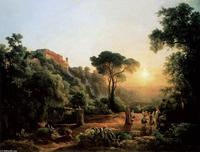
Landscape Near Tivoli With Vintager Scens
Károly Markó the Elder
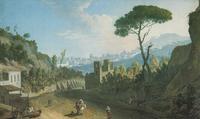
Naples View From the Scudillo
Saverio della Gatta
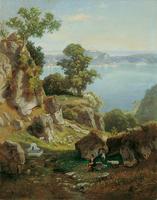
At the lake of Nemi
Carl Gustav Rodde
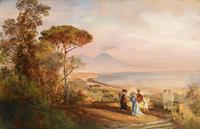
The Bay of Naples
Oswald Achenbach
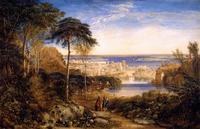
Carthage. Aeneas and Achates
David Cox
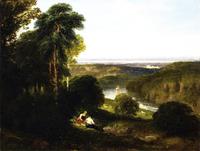
The Wyndcliff, River Wye
David Cox
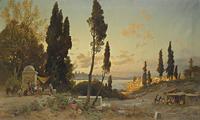
Views Across the Bosphorus, Constantinople
Hermann David Salomon Corrodi