
Expert analysis of Brice Marden’s Untitled (e) From Five Plates
Style: Minimalism · Genre: abstract
Expert Analysis: "Untitled (e) From Five Plates" by Brice Marden (1973)
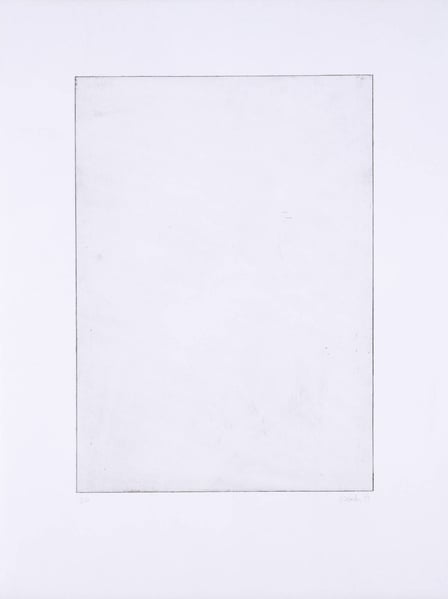
This etching is a quintessential example of Brice Marden’s contribution to Minimalism, a movement defined by its rejection of expressive content in favor of pure form, material, and perceptual experience. As part of a series of five plates, Untitled (e) embodies Marden’s rigorous exploration of the grid, monochrome surface, and the tactile presence of the print medium.
Significance within Minimalism:
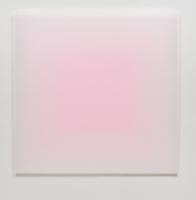
Marden was one of the few Minimalist artists who worked extensively in printmaking, and this series demonstrates his ability to translate the painterly concerns of his iconic monochrome panels into the graphic realm. The work reduces composition to a single, centered rectangle on a field of white paper — a self-contained object that asserts its own material flatness. The grid structure (implied by the plate’s edge and the hand-drawn quality of the rectangle) is not a window onto illusionistic space, but a literal, physical boundary that forces the viewer to confront the paper’s surface and the ink’s weight.
Process and Materiality:
The “five plates” refer to separate copper plates used to build layers of subtle, tonal variation. In Untitled (e), Marden likely combined different ink densities or wiped the plate selectively to create a nuanced field of gray — neither purely black nor white. This attention to the tactile quality of ink and the pressure of the press aligns with Minimalism’s insistence on the “objecthood” of the artwork. The slight irregularities in the plate’s mark — the soft edges, minute variations in tone — become the only “content,” inviting prolonged, meditative looking.
Historical Context:
Created in 1973, this work appears at the height of Marden’s first mature period, when he was refining his vocabulary of simple, rectangular forms. It connects the legacy of Abstract Expressionism’s allover composition (Jackson Pollock, Barnett Newman) with the anti-illusionist, reductive stance of Minimalists like Donald Judd and Robert Ryman. Yet Marden’s touch remains uniquely poetic: the etching’s gray surface seems to breathe, oscillating between a literal stain and an atmospheric field.
Why It Matters:
Untitled (e) From Five Plates is a key example of how Minimalist principles can be applied to printmaking without losing the medium’s own inherent qualities. It demonstrates that “less” is not merely empty, but dense with perceptible decisions about edge, surface, and light. The work rewards slow, close viewing — revealing that Marden’s reduction is not a lack of information, but a distillation of the very act of making a mark. In the context of Minimalism, this piece stands as a quiet but powerful argument for the endurance of drawing and print as rigorous, conceptual art forms.
Visually similar
20 works with related composition and palette
Untitled
Brice Marden
"Ohne Titel "
Kosakov Dimitrij
Untitled (from Seven Aquatints)
Robert Ryman
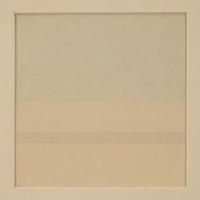
Spazio Luce
Antonio Calderara
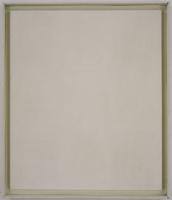
Untitled
Ad Reinhardt
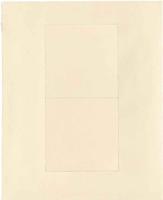
Untitled
Brice Marden
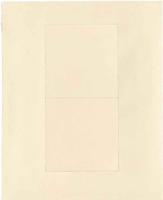
Untitled
Brice Marden
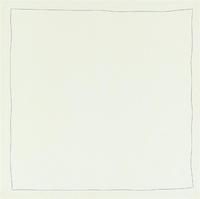
Bent Line Drawing
Robert Ryman
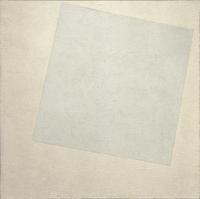
Suprematist Composition: White on White
Kazimir Malevich
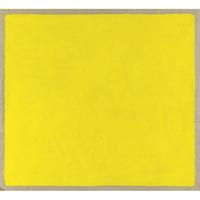
Untitled
Mario Schifano
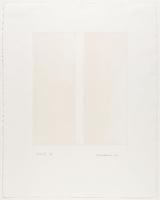
Canto I
Barnett Newman
30 July 1973
Anne Truitt
Untitled
Anne Truitt
Snow
Anne Appleby
Record
Robert Ryman
Spazio Luce
Antonio Calderara
"Cool" Series No. 2 (Yellow over Tan)
Perle Fine
Red Bird
Agnes Martin
Two Whites
Ellsworth Kelly
Big Pink Square
Peter Alexander