13 Painted Forms
Romul Nutiu sanatçısının 13 Painted Forms eseri hakkında uzman analizi
Tarz: Art Informel · Tür: installation
Expert Analysis: "13 Painted Forms" by Romul Nutiu
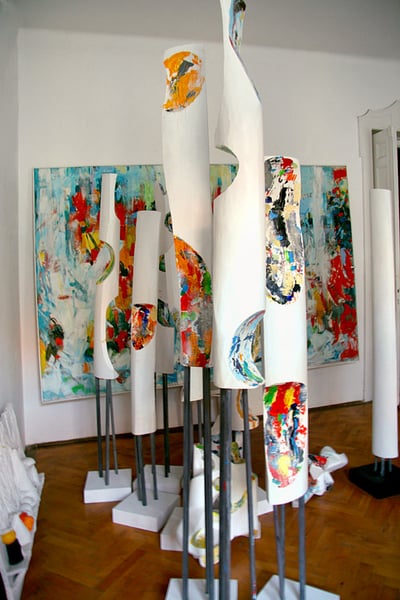
Romul Nutiu’s 13 Painted Forms stands as a provocative synthesis of Art Informel’s gestural spontaneity with the spatial ambitions of installation art. In the context of mid-20th-century Romanian avant-garde, this work marks a radical departure from traditional painting by reimagining the canvas not as a flat surface but as a series of three-dimensional, painterly objects.
Why It Is Significant
-
Materializing Informel Gesture: Art Informel—championed by artists like Jean Fautrier and Wols—emphasized raw, intuitive mark-making and the physicality of paint. Nutiu takes this ethos off the wall: each of the thirteen painted forms is a freestanding or suspended object, its surface encrusted with layered, impasto strokes. The number “13” may reference a serial, almost musical structure, while the irregular, biomorphic shapes evoke organic growth or decay, making the act of painting tactile and spatial.
-
Pioneering Romanian Installation: In a period when Eastern European art was often constrained by Socialist Realist orthodoxy, Nutiu’s embrace of abstract, non-representational forms was audacious. By placing these painted objects in a room, he transformed the gallery into an environment that the viewer must navigate. This immersive quality—a hallmark of installation—antedates much later Western “object-painting” hybrids. The work invites kinetic engagement; as one moves around the forms, shadows and reflections alter the experience, echoing Informel’s interest in chance and process.
-
Dialogue Between Painting and Sculpture: 13 Painted Forms dissolves traditional boundaries. Each form is both a painting (coated with expressive color and texture) and a sculpture (possessing mass, volume, and presence). Nutiu’s strategy prefigures the “expanded field” of painting explored by artists like Lygia Clark or Lucio Fontana, yet remains rooted in the visceral, anti-compositional energy of Informel.
-
Cultural Bridge: As a Romanian artist in the late 1950s–1960s, Nutiu connected Western Informel (with its existential, post-war angst) to local modernist traditions. 13 Painted Forms can be read as a response to the tensions of the Cold War—raw, uncontained forms resisting ideological neatness—while also celebrating the materiality of paint as a liberating force.
In summary, 13 Painted Forms is significant because it expands Art Informel into space, challenges categorical purity, and represents a bold, historically crucial moment when Eastern European abstraction asserted its own path toward conceptual and installation-based practices. Nutiu’s work remains a touchstone for understanding how gestural abstraction can transcend the frame and inhabit our physical world.
Görsel olarak benzer
İlişkili kompozisyon ve renk paletine sahip 20 eser
The Column of Memory
Agustin Cardenas
Rendez-vous Aquatique
Martha Boto
PAINTING IN SPACE
Yervand Kochar
Lui
Agustin Cardenas
Branch
Fernand Leger
Plant Antillaise
Agustin Cardenas
Sail Shape
Noguchi Isamu
Peinture Dans L’espace
Yervand Kochar
Rzeźba Abstrakcyjna I
Katarzyna Kobro
PAINTING IN SPACE
Yervand Kochar
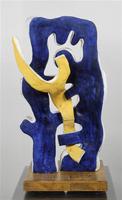
Branch
Fernand Leger
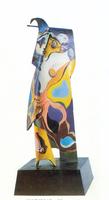
PAINTING IN SPACE
Yervand Kochar
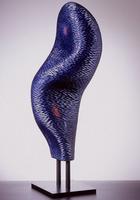
Sveva
Lino Tagliapietra
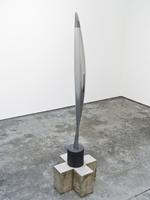
Bird In Space Prototype for MACH 10 Hypervelocity Test
Inigo Manglano-Ovalle
Stargazer
Alexander Liberman
View of exhibition installation in the Peridot Gallery 1950
Louise Bourgeois
«Sprout»
Ludwiga Nesterovich
Untitled
Katsuhito Nishikawa
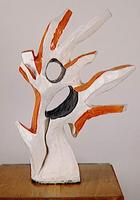
Rockefeller branch
Fernand Leger
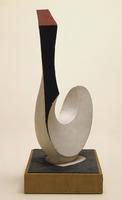
Chicken and Egg
Kurt Schwitters