Composition
Analisi esperta di Composition di Nicolas de Staël
Stile: Art Informel · Genere: abstract
Expert Analysis of Nicolas de Staël’s "Composition" (c. 1950–1952)
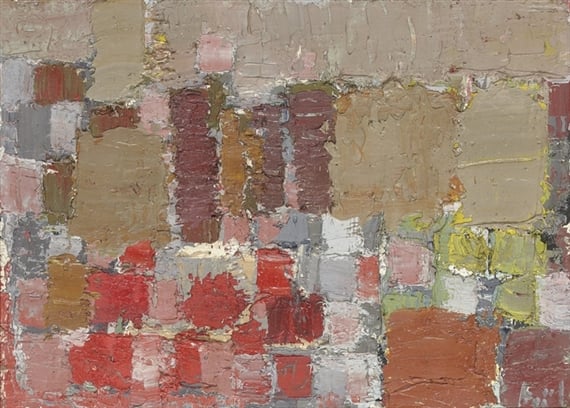
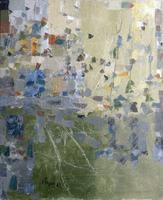
Nicolas de Staël’s "Composition" stands as a pivotal work within the Art Informel movement—a postwar European style that rejected rigid geometric abstraction in favor of spontaneity, gesture, and raw materiality. Created during de Staël’s transition from pure abstraction toward a more tangible, almost “landscape-like” imagery, this painting exemplifies the artist’s signature balance between controlled structure and unrestrained expression.
Significance within Art Informel
Unlike the hard-edged abstraction of his contemporaries, de Staël’s "Composition" embraces the dialectic between chaos and order. The work is built from thick, knife-applied impasto—dense slabs of oil paint that seem to collide and layer across the canvas. These ragged, block-like forms recall masonry or geological strata, yet they pulse with a vibrant, emotional energy. This tension between the physicality of paint and the suggestion of space is the hallmark of Art Informel: the artist’s gesture is the subject.
Stylistic Highlights
- Impasto and Light: De Staël’s palette in this piece—often a rich juxtaposition of cobalt, ochre, white, and muted grays—captures Mediterranean light through the sheer density of pigment. The paint itself becomes a source of luminescence, a feature that would later influence his celebrated seascapes.
- Between Abstraction and Figuration: Though nominally abstract, "Composition" hints at horizons, walls, or landscapes. This ambiguity is deliberate; de Staël believed that pure abstraction could be “too easy,” and he aimed to preserve a memory of the physical world while stripping it of narrative. The painting’s fractured surfaces feel both monumental and intimate, like a wall weathered by time.
- Postwar Resilience: Created in the shadow of WWII, the work reflects a European impulse to rebuild meaning from rubble. De Staël’s dense, almost violent application of paint mirrors a world in flux—chaotic yet charged with the will to recompose.
Lasting Impact
"Composition" is significant as a bridge between geometric abstraction (e.g., Mondrian) and the lyrical abstraction of the 1950s (e.g., Soulages, Rothko). De Staël’s unique synthesis of texture, color, and spatial tension directly influenced the development of Tachisme and European Abstract Expressionism. In this work, he proves that abstraction can be both raw and refined, making it a cornerstone of Art Informel’s legacy.
Visivamente simili
20 opere con composizione e palette affini
Kaleidos
Hans Hofmann
NYC
Melissa Meyer
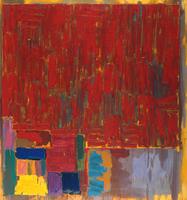
Saracen
John Hoyland
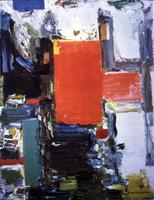
Bird Cage Variation II
Hans Hofmann
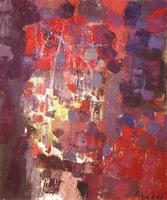
Incendix
Camille Bryen
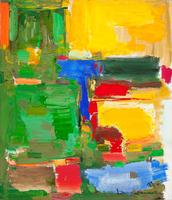
Dew and Dusk
Hans Hofmann
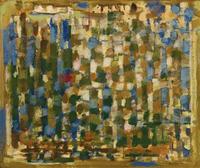
Composition in Blue
Roger Bissière

August Light
Hans Hofmann
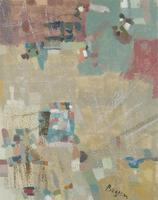
Fusée diffusée
Camille Bryen
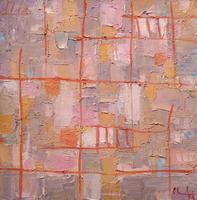
(Abstract)
Bui Xuan Phai
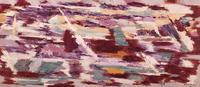
Hollande
Jean Rene Bazaine
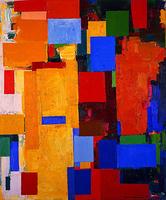
Equinox
Hans Hofmann
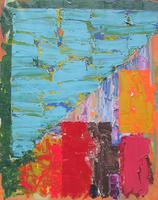
25.4.78
John Hoyland
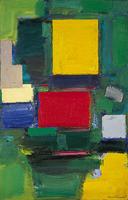
The Gate
Hans Hofmann
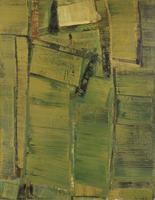
Figure vert-jaune
Olivier Debre
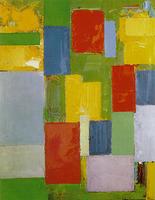
Abstract Euphony
Hans Hofmann
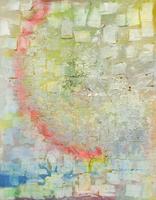
Sacha Jason Guyana Dreams
Frank Bowling
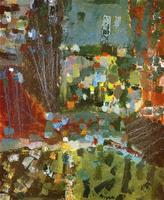
Univéronique
Camille Bryen
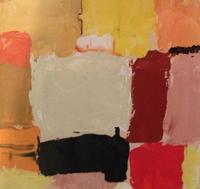
Vrij Geometrisch
Eugene Brands
Détachement
Camille Bryen