
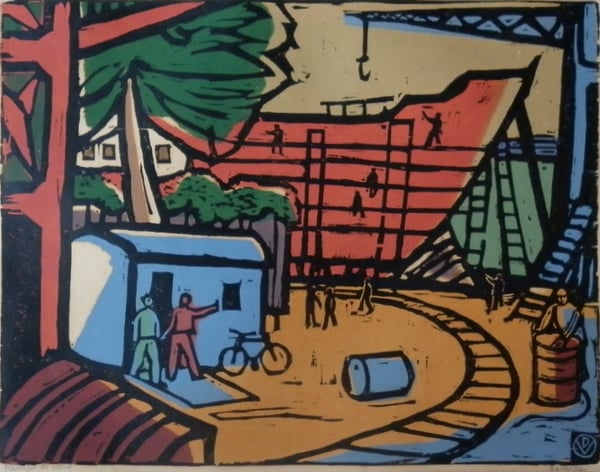
Red Cargo, Naval Shipyard
Analisi esperta di Red Cargo, Naval Shipyard di Vasile Dobrian
Stile: Expressionism, Social Realism · Genere: cityscape
Expert Analysis: “Red Cargo, Naval Shipyard” by Vasile Dobrian
Vasile Dobrian’s “Red Cargo, Naval Shipyard” stands as a compelling synthesis of two seemingly divergent movements—Expressionism and Social Realism—within the genre of the cityscape. Its significance lies in how it harnesses the emotional charge of Expressionist color and form to serve the documentary and ideological aims of Social Realism, creating a work that is both a visceral experience and a statement on industrial labor.
Expressionist Energy Meets Social Realist Purpose
Dobrian employs the hallmark traits of Expressionism—distorted perspective, exaggerated scale, and a raw, often jarring palette—to convey the monumental power of the shipyard. The title’s “Red Cargo” is not merely descriptive; the dominant reds, oranges, and ochres likely flood the scene with a sense of urgency, heat, and even danger. This intense coloration goes beyond naturalism to evoke the physical and emotional weight of industrial toil. At the same time, the composition anchors these expressive elements in a recognizable, working-class environment—a naval shipyard—aligning the work with Social Realism’s commitment to depicting the lives and dignity of labor. The shipyard is not a picturesque backdrop but a protagonist: cranes, hulls, and docks are rendered with a muscular, almost aggressive line, emphasizing human effort and industry over passive scenery.
Significance within Romanian and Transnational Art
Dobrian’s careful balancing act speaks directly to the cultural pressures of post-war Eastern Europe, where Socialist states demanded art that was accessible and uplifting for the proletariat, yet many artists resisted purely propagandistic formulas. By infusing Social Realist content with Expressionist subjectivity, Dobrian retains a degree of personal artistic voice while honoring the prescribed thematic focus on industrial progress. In the context of Romanian modernism, “Red Cargo, Naval Shipyard” exemplifies how artists could negotiate between state ideology and modernist experimentation—a tension that marks much of the region’s mid-20th-century art. Internationally, the work recalls the earlier “proletarian Expressionism” of German artists like Otto Dix or George Grosz, but Dobrian shifts their critical pessimism toward a more ambivalent, celebratory energy, reflecting the Marxist ideal of building a new world through labor.
Cityscape as Social Document
As a cityscape, the artwork transforms urban-industrial space into an arena of collective human agency. Rather than depicting a serene vista, Dobrian presents a dynamically fractured view—perhaps from a low angle or through stacked, overlapping forms—that forces the viewer into the midst of the yard. The “red cargo” itself (likely iron ore, scrap metal, or unfinished hulls) becomes a symbol of raw potential, awaiting transformation by the workers who are implied but perhaps not directly shown. This absence of individual figures makes the environment itself the subject: the shipyard is alive, breathing, and charged with the promise of production. It is a landscape of becoming, not of static existence.
Conclusion
“Red Cargo, Naval Shipyard” is significant because it resists easy categorization. It is at once a document of industrial life, a formal experiment in Expressionist color, and a subtle negotiation between artistic freedom and political expectation. Dobrian demonstrates that even within the constraints of Social Realism, a painter could produce work that is emotionally potent, structurally inventive, and deeply engaged with its historical moment. This painting is a testament to the power of the cityscape to articulate not just a place, but the very forces—economic, social, psychological—that shape that place.
Genere
Visivamente simili
20 opere con composizione e palette affini
Todd Shipyard
Alexander Calder
Boats of Jewish Immigrants (Hamaapilim)
Jean David
PIireaus
Dimitris Mytaras
Boat and Grain Elevators
Ralston Crawford
Everyday life of the shipyard
Sergey Ryabchenko
Cranes and Ships, Glasgow Docks
L. S. Lowry
Boats at Rest in Mount's Bay
Alfred Wallis

Elle
Carlos Lagos

Barques
Jean Hugo
Port Scene
Jean David
Ship at Palestrina
Max Gubler
John H Amos 2
Billy Childish
The Big Fish
Antonio Corpora

Nine Ships in Harbour
Alfred Wallis

Nine Ships in Harbour
Alfred Wallis

Bodinnick, Cornwall
Frances Hodgkins
Boats at Rest in Mount’s Bay
Alfred Wallis

Breton Boat
Richard Spare
Ship under Repair
Benito Quinquela Martin
Loading Timber at Southampton Docks
C. R. W. Nevinson