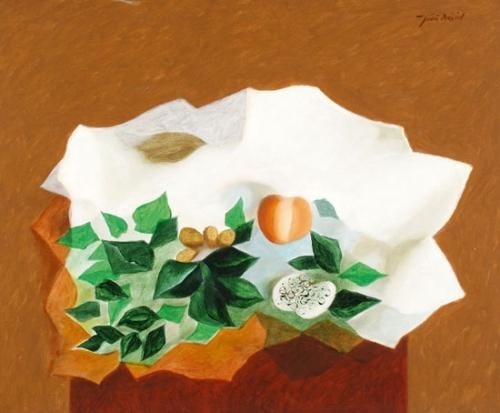
Still Life and Fruit
Analisi esperta di Still Life and Fruit di Jean David
Stile: Cubism · Genere: still life
Expert Analysis of "Still Life and Fruit" by Jean David
Jean David’s Still Life and Fruit is a compelling example of Cubist still-life painting, a genre that the movement fundamentally redefined. While the Cubist innovations of Picasso and Braque had already shattered traditional perspective by the time David was working, his treatment of fruit and tabletop objects reveals a masterful engagement with the core tenets of the style.
What makes this work significant within Cubism:
-
Fragmentation and Multiple Viewpoints: David deconstructs the fruit, bowl, and surrounding space into geometric facets, presenting them from several angles simultaneously. This disruption of a single, fixed viewpoint—a hallmark of Cubist visual language—forces the viewer to reassemble the image intellectually rather than passively receive it.
-
Spatial Ambiguity and Collage-Like Planes: The background, tabletop, and objects are treated as interlocking, translucent planes that both advance and recede. This flattens the picture surface while paradoxically suggesting depth through overlapping and shading. David’s use of subdued earth tones punctuated by muted greens and ochers creates a tightly unified palette, typical of Analytic Cubism, that emphasizes structure over sensory realism.
-
Everyday Subject Elevated to Icon: By choosing a humble still life of fruit—a classic motif—David aligns himself with the Cubist mission to transform ordinary, domestic subjects into vehicles for radical formal exploration. The arrangement is not about the fruit’s tactile appeal but about how light, line, and plane can be choreographed into a dynamic, almost architectural composition.
-
Bridging Cubism and Later Abstraction: Jean David’s work often synthesizes Cubist fragmentation with a lyrical sense of order. In Still Life and Fruit, the rhythmic repetition of faceted shapes and the careful balance of positive and negative space prefigure his later move toward non-objective abstraction. The painting stands as a testament to Cubism’s enduring ability to renew itself, even in the hands of a second-generation practitioner, by continuing to probe the boundaries between representation and abstraction.
In essence, Still Life and Fruit is significant not merely as a competent Cubist work, but as an example of how the style’s core principles—fractured space, multiple perspectives, and formal autonomy—remained vital tools for reimagining a timeless genre. David’s composition demonstrates that Cubism was not a brief historical moment but a persistent, evolving inquiry into the very nature of visual perception.
Visivamente simili
20 opere con composizione e palette affini
Untitled
Dilek Demirci
Fruit in the Grass
Prudence Heward
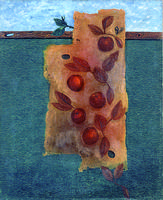
Avant le festin
Georges Papazoff
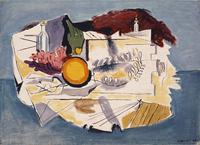
Mementos of the Dead Fiancee
Yiannis Tsaroychis
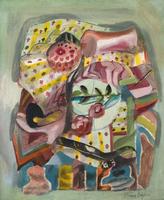
Self Portrait: Still Life
Frances Hodgkins
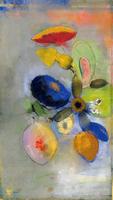
Flowers
Odilon Redon
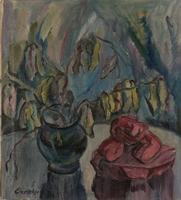
Still Life with Author's Sculpture
Adalbert Erdeli
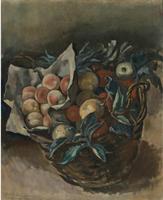
Fruit piece
Zinaida Serebriakova
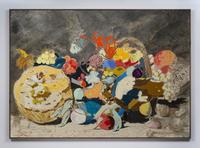
A Noise is Heard from Afar, like the Sound That Fills a Theatre Before the Performance Begins
Marc Horowitz
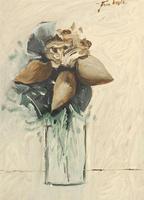
Vase of Flowers
Jean David
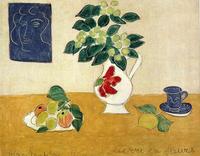
Ivy in Flower
Henri Matisse
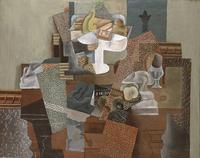
Still Life with Compote and Glass
Pablo Picasso
Two Peaches
Henri Matisse
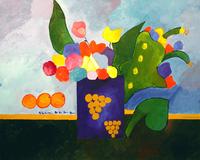
Vase With Flowers and Fruit
Aldemir Martins
still-life of fruit
Jacques de Claeuw
Mauve Still Life
Mary Fedden
Composition IV (Still life)
Theo van Doesburg
Natură statică cu vas și fructe
Ion Pacea
Apples and a Napkin
Paul Cezanne
Nature morte aux poires
Jean Fautrier