Analisi esperta di Der Wolfgangsee di Ferdinand Georg Waldmüller
Stile: Romanticism · Genere: landscape
Expert Analysis: "Der Wolfgangsee" by Ferdinand Georg Waldmüller
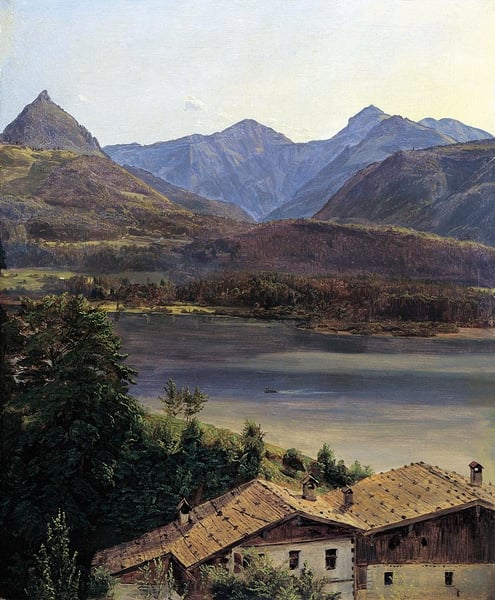
Ferdinand Georg Waldmüller’s Der Wolfgangsee (Lake Wolfgang) stands as a luminous exemplar of Biedermeier Romanticism, a period that prized intimate, idealized depictions of nature and domestic tranquility. Painted with extraordinary precision, the work reveals Waldmüller’s profound commitment to direct observation—a hallmark that distinguishes him from more symbolically charged Romantic contemporaries.
Significance within Romanticism and Landscape Painting:
The painting’s significance lies in its synthesis of Romantic sublimity with proto-Realist fidelity. Waldmüller renders the Alpine lake and surrounding mountains with meticulous detail: the crystalline reflections on the water, the soft gradations of atmospheric perspective, and the varied textures of foliage and rock. Yet the scene is not merely topographical; it evokes an emotional stillness, inviting the viewer into a state of contemplative awe. This marriage of empirical accuracy and emotional resonance prefigures the Realist movement while firmly rooted in Romanticism’s veneration of nature as a source of spiritual renewal.
Technical and Stylistic Mastery:
Waldmüller’s handling of light is exceptional. The diffuse, golden glow—likely a late afternoon or early morning sun—bathes the landscape in a harmonious, almost sacred luminosity. His brushwork is tight but not stiff; the foreground grasses and shore are rendered with crisp precision, while the distant peaks soften into atmospheric haze. This control of focus guides the eye from the intimate foreground to the vast, serene expanse of the lake and mountains, embodying the Romantic tension between the near and the infinite.
Cultural and Artistic Context:
As a leading Austrian painter of the Biedermeier era, Waldmüller championed truth to nature at a time when many Romantics favored dramatic, invented scenes. Der Wolfgangsee celebrates the specific beauty of the Salzkammergut region, reflecting the era’s middle-class desire for accessible, unspoiled nature as a counterpart to urban industrialization. The work’s enduring appeal lies in its ability to capture both the grandeur of the Alps and the quietude of a specific moment, making it a touchstone of Romantic landscape that balances idealism with sharp, loving observation.
Visivamente simili
20 opere con composizione e palette affini
The Walchensee, Serpentine
Lovis Corinth
An Alpine Village
Hermann Ottomar Herzog
Berchtesgaden in Bavaria
Antonietta Brandeis
Charlet in Hilterfingen
Ferdinand Hodler
Farm in front of Garmisch. In the background the Wetterstein Mountains
Heinrich Bürkel
Lake Fuschel with Schafberg
Ferdinand Georg Waldmüller
Courmayeur
Achille Beltrame
Grosse Landschaft am Inn mit Blick auf Kufstein und das Kaisergebirge
Georg Heinrich Crola
Dorf Arzl und der Kalvarienberg von Innsbruck mit Ansicht Schloß Anna, heiligen Wasser, der Waldraster-Spitze und kleinen Stubayer Ferner
Anton Schiffer
Capolago
Cuno Amiet
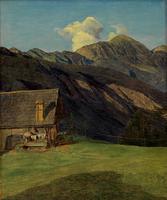
The alpine hut on the Hoisenrad near Ischl
Ferdinand Georg Waldmüller
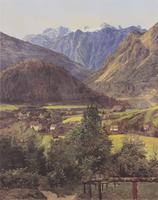
The Dachstein
Ferdinand Georg Waldmüller
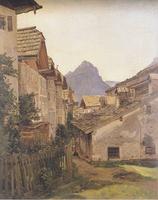
Pfamgasse in St. Wolfgang
Ferdinand Georg Waldmüller
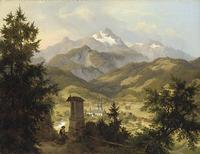
View of Berchtesgarden and the Watzmann, Bavaria
Karl Eduard Biermann
The Radhausberg at Gastein
Ferdinand Georg Waldmüller
Aussicht von Altausseersee gegen Karlseisfeld am Dachstein, den hohen Seirrstein und Ruinen von Pfluigsberg und Baron Zedlitz Haus am Seeufer
Anton Schiffer
Church of Les Houches, Haute-Savoie, France
Clarence Gagnon
Dachstein from the place of Sophie
Ferdinand Georg Waldmüller
House at a Lake with Mountains
Adolf Hitler
Evening at Lake Como
Karl Heinrich Jaeckel