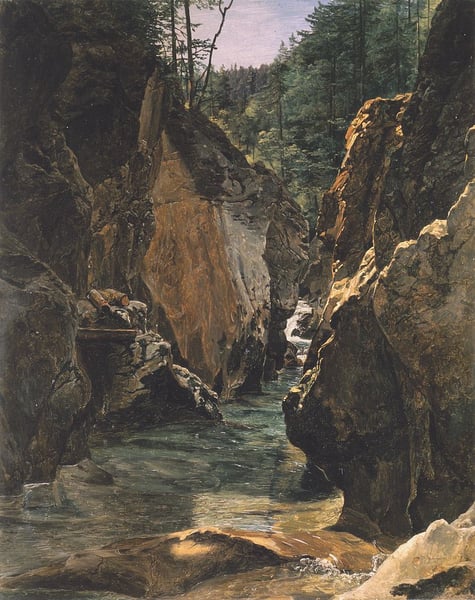
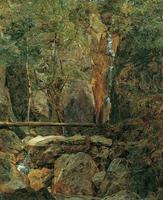
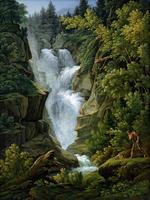
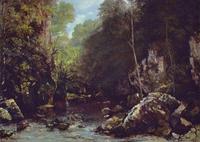
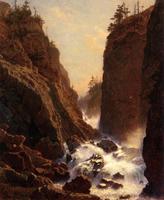
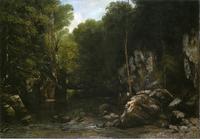
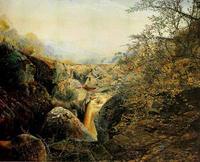
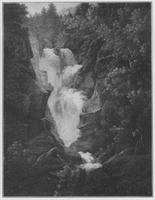
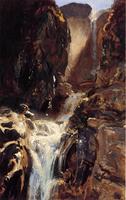
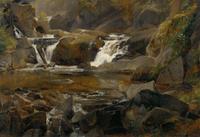
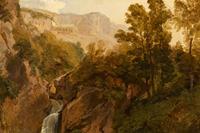
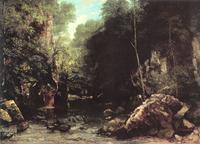
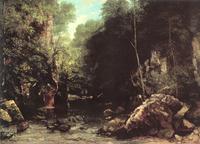
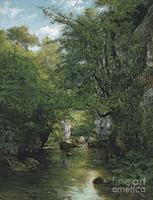
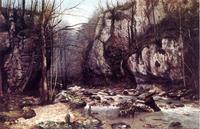
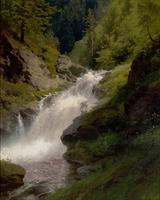
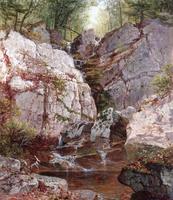
Ferdinand Georg Waldmüller’s Rettenbach-gorge at Ischl stands as a compelling example of Romantic landscape painting, where the artist’s characteristic precision meets the period’s fascination with nature’s sublime power. Created during the height of the Biedermeier era (with which Waldmüller is closely associated), the work demonstrates a synthesis of meticulous observation and emotional resonance. The gorge—a narrow, dramatic chasm—embodies the Romantic ideal of the sublime: a natural force both beautiful and overwhelming, inviting contemplation of humanity’s place within the vast, untamed world. Waldmüller’s signature attention to atmospheric light and texture—evident in the play of sunlight on rock faces and foliage—anchors the scene in tangible reality while elevating its emotional intensity. By capturing a specific, identifiable location (the Rettenbach-gorge near Ischl in Upper Austria) rather than an idealized fantasy, he bridges the Romantic longing for transcendence with a commitment to empirical truth. This dual focus makes the painting significant: it affirms Waldmüller’s role in refining landscape painting away from pure idealism toward a more direct, luminous naturalism—a key transition that anticipates later 19th-century developments in plein-air realism.