Analisi esperta di Truitt 86 di Anne Truitt
Stile: Color Field Painting · Genere: abstract
Expert Analysis of Truitt 86 by Anne Truitt
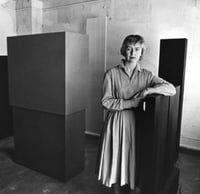
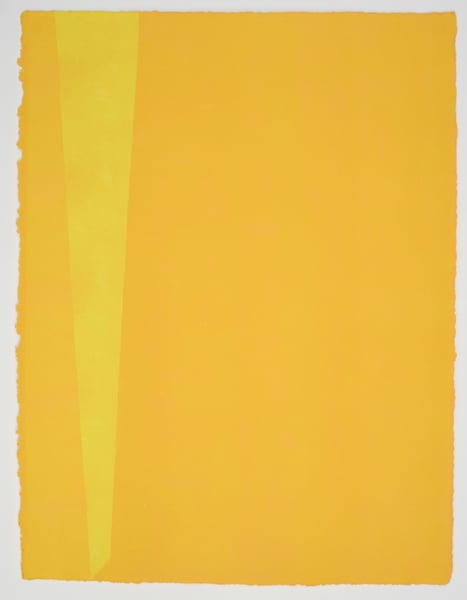
Anne Truitt’s Truitt 86 is a pivotal work within the Color Field tradition, marking a distinctive intersection between painting and sculpture. While Color Field painting is often associated with large, flat, stain-soaked canvases (as seen in the work of Morris Louis or Helen Frankenthaler), Truitt redefines the movement by translating its core concerns—pure color, optical intensity, and spatial immersion—into three-dimensional form.
The significance of Truitt 86 lies in its rigorous, minimalist structure and the artist’s singular approach to color as both physical object and emotional carrier. Truitt constructs her works as freestanding, painted wooden columns or totemic forms, meticulously layered with hand-applied pigment. This process gives the surface a luminous, almost breathing quality—color is not just applied but built. In the context of Color Field painting, where color often dissolves into the canvas, Truitt’s color instead defines volume and edge, creating a dialogue between flatness and depth.
What makes this work particularly important is its defiance of strict categorization. At a time when Color Field painting and Minimalist sculpture were often seen as opposing camps (the former emotive and painterly, the latter cool and industrial), Truitt’s practice forges a third path. Truitt 86 retains the sensual immediacy of Color Field’s chromatic saturation while embracing the non-referential, geometric clarity of Minimalism. Yet, unlike many Minimalist objects, Truitt’s color is never purely formal—it carries psychological weight, evoking memory, place, or even bodily presence.
Within the broader arc of Color Field painting, Truitt 86 demonstrates that the movement’s principles could be extended beyond the picture plane. It asserts that color does not require a flat support to be experienced as expansive or transcendent. Instead, Truitt’s work invites the viewer to move around it, to see how color shifts with light and perspective—a dynamic, lived encounter that redefines the very notion of “field.” This piece thus stands as a crucial contribution to the late 20th-century expansion of abstraction, proving that Color Field’s legacy could be both architectural and deeply personal.
Visivamente simili
20 opere con composizione e palette affini
Untitled
Anne Truitt
The Third
Barnett Newman
Untitled
Mario Schifano
Lost Twin (One)
Doug Ohlson
Broadway
Ellsworth Kelly
Remember No. 5
Anne Truitt
Yellow Painting #14
Joseph Marioni
Orange Yellow Painting
Joseph Marioni
Painting #02-26
Rudolf de Crignis
Canto XV
Barnett Newman
No. 16
Mark Rothko
Canto I
Barnett Newman
Alla libertà
Giulio Turcato
Pale Blue II
Jules Olitski
Untitled
Antonio Calderara
Untitled
Phil Sims
Ochre and Red on Red
Mark Rothko
Untitled
Edward Corbett
Untitled (from Seven Aquatints)
Robert Ryman
Ochre and Red on Red
Mark Rothko