Description
Style: Romanticism, Orientalism · Genre: religious painting
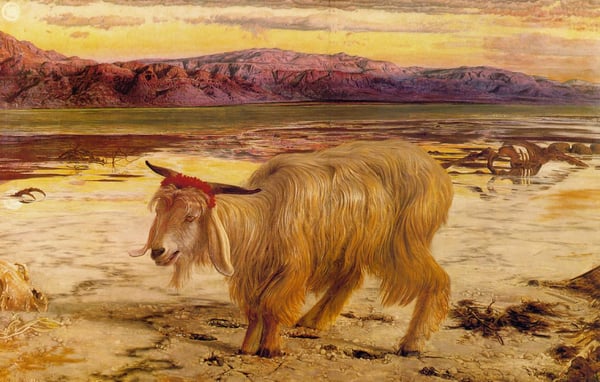
The Scapegoat depicts the "scapegoat" described in the Book of Leviticus. On the Day of Atonement, a goat would have its horns wrapped with a red cloth - representing the sins of the community - and be driven off. He started painting on the shore of the Dead Sea, and continued in his studio in London. The work exists in two versions, a small version in brighter colours with a dark-haired goat and a rainbow, held by Manchester Art Gallery, and a larger version in more muted tones with a light-haired goat held by the Lady Lever Art Gallery in Port Sunlight. The painting was the only major work completed by Hunt during his first trip to the Holy Land, to which he had travelled after a crisis of religious faith. Hunt intended to experience the actual locations of the Biblical narratives as a means to confront the relationship between faith and truth.
Visually similar
20 works with related composition and palette
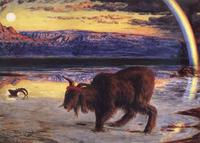
The Scapegoat
William Holman Hunt
Daphnis and Chloe bidding each other goodnight (Design for a decorative panel)
Leon Bakst
Goats
Vincenzo Caprile
Evening landscape with herd of goats
Ferdinand Georg Waldmüller
Goats
Filippo Palizzi
Child with goats
Filippo Palizzi
A Bush Idyll
George Washington Lambert
Italian Pastoral
Thomas Stuart Smith
Alps in May
Giovanni Segantini
The ass in embarrassment
Filippo Palizzi
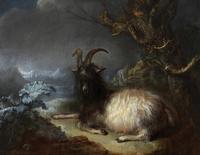
Goat in a Landscape
Gerrit Dou
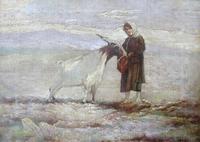
The girl and the goat
Polychronis Lembesis
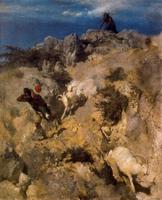
Pan frightening a shepherd
Arnold Böcklin
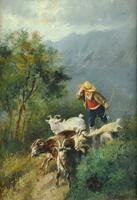
The shepherd boy
Filippo Palizzi
Shepherds resting in the mountains
Rudolf Otto von Ottenfeld
Near the Alleghe Lake
Ettore Tito
Sheep and Goats
Karel Dujardin
Landscape with Cattle and Sheep
Henry William Banks Davis
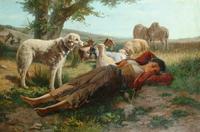
The goatherder's siesta
Carlo Ademollo
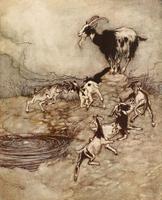
The Seven Kids and their mother capered and danced round the spring in their joy
Arthur Rackham