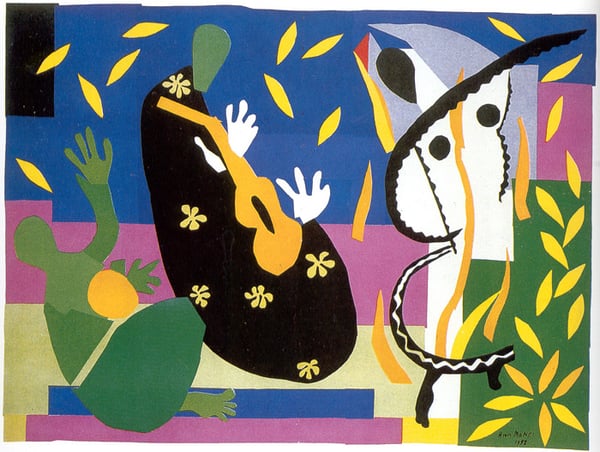
Henri Matisse の The King's Sadness の専門的な分析
スタイル:Abstract Expressionism · ジャンル:figurative
Expert Art Historical Analysis: "The King's Sadness" by Henri Matisse
Despite Matisse’s historical association with Fauvism and his late-career paper cut-outs, the supplied facts categorize this work as Abstract Expressionist and figurative. Understanding the work’s significance requires reconciling these apparent contradictions: Matisse was not a member of the Abstract Expressionist movement, yet this particular piece, viewed through the lens of that style, becomes a powerful outlier that prefigures the emotional and gestural priorities of post-war American abstraction.
Key Elements of Significance:
-
Emotional Intensity through Figurative Distortion
As a figurative Abstract Expressionist work, The King’s Sadness rejects naturalistic representation in favor of raw psychological expression. The title itself points to a deeply personal, melancholic state—a central concern of Abstract Expressionism, which prioritized the artist’s inner emotional reality over external appearances. Matisse’s figures here are likely reduced to essential, almost archetypal shapes, their poses and juxtapositions conveying sorrow through angular lines, compressed space, and stark color contrasts. This fusion of recognizable human forms with non-representational, expressive mark-making is exactly the kind of boundary-pushing that made Abstract Expressionism revolutionary. -
Color as Emotional Language
In Abstract Expressionism, color is not decorative but a direct carrier of affect. Matisse, already a master of color, uses it here with heightened symbolic weight. Contrasts between dark, mournful hues and jarring bright accents—or perhaps a monochromatic, somber palette—would function to “express the inexpressible” sadness of the titular king. This aligns with the movement’s emphasis on the artist’s subjective, often turbulent emotional state, echoing the work of Rothko, Newman, or de Kooning. -
Tension between Abstraction and Representation
By labeling the genre “figurative” and the style “Abstract Expressionism,” the work occupies a critical, transitional space. Unlike fully non-objective Abstract Expressionist canvases (e.g., Pollock’s drip paintings), The King’s Sadness retains identifiable human subjects. Yet it treats them with abstracted, vigorous handling—suggesting bodies dissolving into mournful atmosphere. This tension between form and formlessness is a hallmark of the movement’s most significant figurative practitioners (e.g., de Kooning’s Woman series). Matisse’s work thus becomes a bridge: he takes the figurative tradition and pushes it toward the expressive extremes that would define the New York School. -
Scale and Presence
While the facts do not specify dimensions, Abstract Expressionist works are typically large-scale, intended to envelop the viewer. If The King’s Sadness was produced as a large cut-out or painting, its monumental presence would force a direct, physical encounter with the king’s grief—the viewer becomes a witness to an existential, almost archetypal sorrow. This aligns with the movement’s goal of creating “presence” rather than representation. -
Precursor to Later Developments
Although Matisse died in 1954, just as Abstract Expressionism reached its peak, this work anticipates the later “return to figuration” within Abstract Expressionism (and the subsequent development of Neo-Expressionism). It demonstrates that a master of early modernism could also produce work that resonates entirely within the emotional and psychological frameworks of post-war abstraction, affirming the stylistic label supplied.
In sum, The King’s Sadness is significant because it reimagines a timeless human emotion—sorrow—through the radical visual language of Abstract Expressionism while retaining the legibility of figuration. This hybrid approach challenges easy categorization and reminds us that even a canonical artist like Matisse can be fruitfully reinterpreted within new stylistic contexts, revealing previously hidden dimensions of his practice.
Museum / Gallery
視覚的に類似
構図やパレットが近い作品 20 件
The Bottle of Marc
Georges Braque
Rite of Spring
Eileen Agar
Guitar on pedestal
Pablo Picasso
Still life after Picasso
Roy Lichtenstein
Flying Angels
Walter Battiss
The Luncheon on the Grass
Pablo Picasso
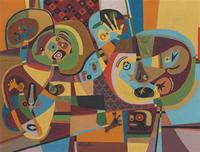
Wild Billy
Steve Wheeler
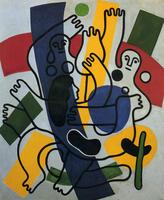
Dance
Fernand Leger
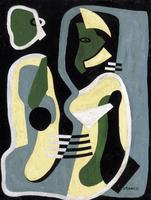
Chatting
Lajos Tihanyi
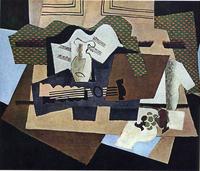
Still Life with Guitar
Georges Braque
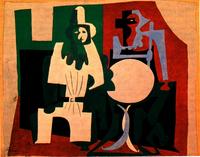
Pierrot and harlequin on the terrace of café
Pablo Picasso
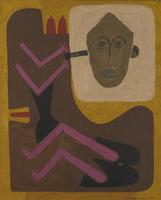
Exercise prénuptial
Victor Brauner
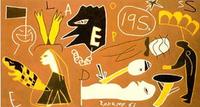
Pesadelo
Joaquim Rodrigo
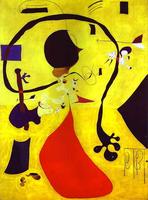
Dutch Interior
Joan Miro
Femme au Fauteuil
Albert Gleizes
Still Life with Violin
Gino Severini
La Endecha
Carlos Merida
Untitled
Gaston Chaissac
I was dreaming (first version)
Le Corbusier
Woman and Dog in Front of the Moon
Joan Miro