Analisi esperta di Asoka's Queen di Abanindranath Tagore
Genere: portrait
Expert Analysis of "Asoka’s Queen" by Abanindranath Tagore
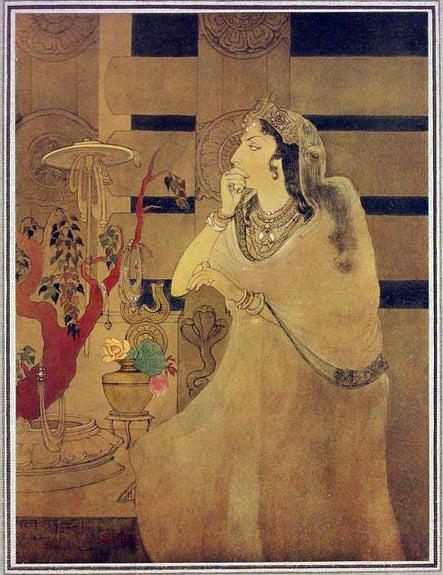
Abanindranath Tagore’s Asoka’s Queen (c. early 20th century) is a seminal portrait that embodies the ideals of the Bengal School of Art—a movement that sought to forge a distinct national identity through a synthesis of Indian historical subjects, Mughal miniature conventions, and Japanese wash techniques. While the genre is a portrait, Tagore elevates it beyond mere likeness into a symbol of cultural revival.
Significance within its Style and Period
-
Nationalist Artistic Vision: The work was created during the Swadeshi movement, when Indian artists rejected Western academic naturalism in favor of indigenous traditions. By choosing a queen from the court of Emperor Ashoka (a ruler central to India’s Buddhist and imperial heritage), Tagore explicitly connects the portrait to a pre-colonial golden age, asserting a proud, autonomous Indian aesthetic.
-
Technical Innovation: The painting demonstrates Tagore’s mastery of the wash technique (totaka), borrowed from Japanese watercolor but applied to Indian themes. Soft, translucent layers create a dreamlike, ethereal atmosphere, while delicate outlines and restrained palette evoke the elegance of Mughal miniatures. This fusion marks a departure from oil-on-canvas realism, emphasizing mood and spirituality over verisimilitude.
-
Symbolism and Composition: The queen is depicted in profile, a convention from Rajput and Persian painting, but with subtle psychological depth. Her introspective gaze, the ornate jewelry, and the lotus-like posture allude to both royal dignity and inner contemplation—a hallmark of Tagore’s tendency to intertwine the human with the sublime. The minimal background focuses attention on the figure, reinforcing the portrait’s role as an icon of idealized Indian womanhood.
-
Influence on Modern Indian Art: Asoka’s Queen stands as a prototype for the Bengal School’s reinterpretation of historical figures. It inspired later artists like Nandalal Bose and Jamini Roy to explore India’s visual heritage as a source of modern expression. The work also signals a shift from colonial mimicry to self-determined artistic language, making it a cornerstone of early Indian modernism.
In sum, Tagore’s portrait is not merely a representation of a queen; it is a manifesto for cultural self-definition, blending technical innovation with deep nationalist sentiment. Its significance lies in its role as a bridge between India’s artistic past and its modern, postcolonial future.
Visivamente simili
20 opere con composizione e palette affini
Siva drinking World Poison
Nandalal Bose
Dream of a betrothed virgin
Sukhvir Sanghal
Layla - from the Picture Book for the Red Cross
Edmund Dulac
Yudhisthira and His Dog, Ascending
Nandalal Bose
Ganesh-janani
Abanindranath Tagore
Devassari Abuntu with birds
Nicholas Roerich
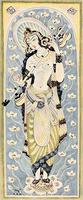
Saraswati
Nandalal Bose
Le Genie Sans Nom. Coree
Paul Jacoulet
This glass was a lover like me
Hossein Behzad
The Woman He Could Not Leave (Stealers of Light by the Queen of Romania)
Edmund Dulac
The Big Cypress
Hossein Behzad
Drink a glass of wine immortality
Hossein Behzad
Prince and hawk
Hossein Behzad
The nightingale and the rose
Charles Robinson
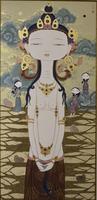
Air of Heart
Enkhnomin
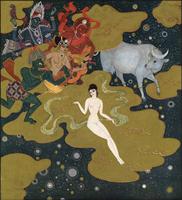
The Pearl of the Cloud, from The Kingdom of the Pearl
Edmund Dulac
Mahakasyapa smiling at the lotus flower
Hishida Shunso
Untitled
Otto Eckmann
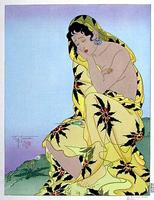
La Perruche Morte. Celebes
Paul Jacoulet
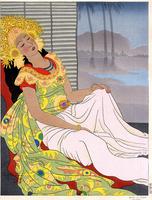
Apres La Danse, Celebes
Paul Jacoulet