Expertenanalyse zu Albert Gleizess Figure Cubiste
Stil: Abstract Art, Cubism · Genre: abstract
Expert Analysis of "Figure Cubiste" by Albert Gleizes
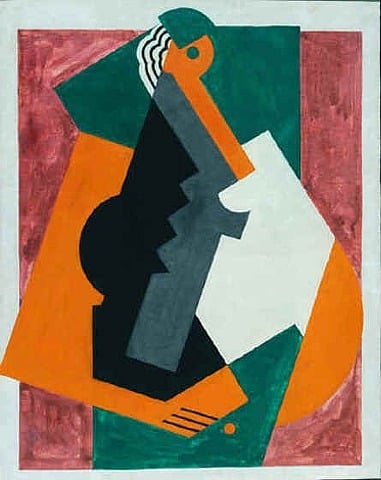
Albert Gleizes’s Figure Cubiste stands as a pivotal work within the evolution of Cubism and the broader shift toward pure abstraction in early 20th-century art. Executed during a period when Gleizes was both a practitioner and a leading theorist of the movement—co-authoring the seminal 1912 treatise Du Cubisme—the painting exemplifies his commitment to dismantling representational conventions while retaining a structural link to the physical world.
Significance within Cubism
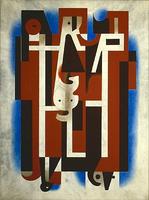
Unlike the more intuitive, fragmenting approach of Picasso and Braque, Gleizes sought a rigorously systematic, almost philosophical method. In Figure Cubiste, the human form is reduced to a dynamic arrangement of intersecting planes, faceted volumes, and rhythmic lines. The title itself is telling: “Cubist Figure” acknowledges the subject (a standing or seated person) yet subordinates it to the abstract geometry of the composition. This balance between recognizable subject and autonomous pictorial structure was a hallmark of Salon Cubism, which Gleizes helped define.
Contribution to Abstract Art
The work is significant as a transitional document between representational Cubism and non-objective art. Gleizes gradually dissolved the figure’s contours, allowing geometric forms—circles, trapezoids, and diagonal shafts—to become the primary visual language. The palette, dominated by muted earth tones punctuated by cooler grays and blues, further abstracts the viewer’s sense of depth, flattening space into a single plane. This prefigures the artist’s later move toward complete abstraction in the 1920s and 1930s.
Theoretical Underpinning
Gleizes believed that art must express the “simultaneity” of multiple viewpoints and the inner rhythm of modern life. Figure Cubiste enacts this belief by suggesting the figure from several angles at once—profile, three-quarter, and frontal views coexist within the same facet. The work thus becomes less a portrait and more a diagram of perception itself, aligning Gleizes with the spiritual and transcendental currents that soon fueled abstract movements like De Stijl and Orphism.
Legacy
As one of the few Cubists who explicitly theorized abstraction, Gleizes made Figure Cubiste a touchstone for understanding how Cubism’s analytical phase inevitably led to a non-representational vocabulary. Its place in the 1912 Salon de la Section d’Or—where Gleizes exhibited alongside Delaunay, Kupka, and the futurists—certified it as a landmark in the rebellion against naturalism. Today, the work is recognized not just as a Cubist canvas but as a blueprint for the abstract art that dominated the century to follow.
Genre
Visuell ähnlich
20 Werke mit ähnlicher Komposition und Farbpalette
Composition
Albert Gleizes
Femme Cubiste
Albert Gleizes
Composizione
Bice Lazzari
Single Element
Mainie Jellette
La lanterne et le petit haricot
Le Corbusier
Taureau XI
Le Corbusier
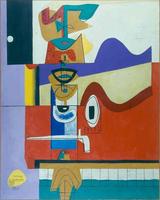
Totem 3
Le Corbusier
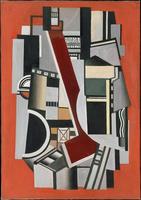
Mechanical Elements on red background
Fernand Leger
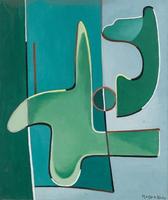
Mystere vert
Alberto Magnelli
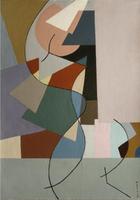
Abstraccion No. 3
Martha Boto
Strolling
Will Barnet
Peinture murale, 35 rue de Sèvres à Paris
Le Corbusier
Icône 3
Le Corbusier
Vertical figure
Gosta Adrian-Nilsson
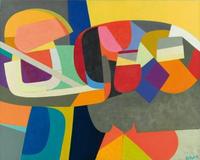
Brouclé
Maurice Esteve
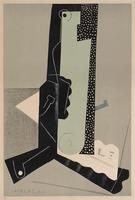
Composition
Henri Laurens
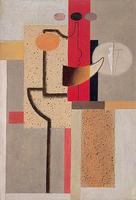
The Sculptor
Willi Baumeister
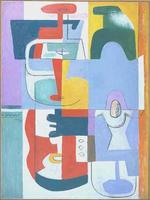
Deux bouteilles et le coquetier
Le Corbusier
The Prodigal Son
Carlos Merida
Summer Studio #2
Perle Fine