Analisi esperta di Landscape with Bridge and Viaduct di Albert Gleizes
Stile: Cubism · Genere: landscape
Expert Analysis: "Landscape with Bridge and Viaduct" by Albert Gleizes
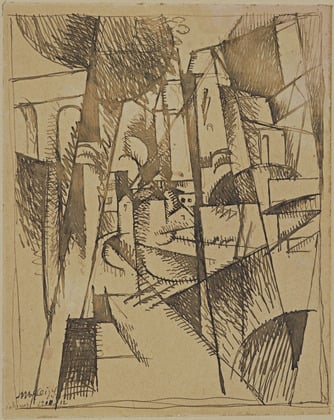
Albert Gleizes’s Landscape with Bridge and Viaduct is a seminal work that exemplifies the radical transformation of landscape painting within the Cubist movement. As a co-author of the 1912 treatise Du Cubisme, Gleizes was not merely a participant in Cubism but a theorist who helped define its principles. This painting is significant because it applies Cubism’s core innovations—fragmentation, multiple perspectives, and the synthesis of form and space—to the traditional genre of landscape, moving beyond the still lifes and portraits that dominated early Cubism.
Stylistic and Formal Innovation:
The composition dissolves the bridge, viaduct, and surrounding topography into a network of interlocking planes and geometric facets. Gleizes rejects a single, fixed viewpoint; instead, he presents the scene from multiple angles simultaneously, allowing the viewer to perceive the structure’s height, depth, and breadth in a single flattened picture plane. The bridge and viaduct become architectural rhythms—repeated arcs, diagonals, and verticals—that echo the industrial and modernizing landscape of early 20th-century France. This treatment transforms the natural scene into an autonomous visual language, where color (often muted earth tones punctuated by cooler hues) serves to modulate spatial relationships rather than describe local color.
Significance within Cubism:
What makes this work particularly notable is its demonstration that Cubism could reinterpret the landscape genre—traditionally associated with atmospheric perspective and naturalistic depiction—without abandoning legibility. Gleizes balances abstraction with recognizable motifs: the bridge still reads as a bridge, the viaduct as a viaduct, yet they are rebuilt from abstract, crystalline forms. This synthesis aligns with Gleizes’s theoretical goal of creating a “objective” art that reveals the underlying structure of reality, not its superficial appearance. Landscape with Bridge and Viaduct stands as a key example of Synthetic Cubism’s move toward greater flatness and rhythmic organization, prefiguring the later work of artists like Robert Delaunay and the Orphist movement. In the context of Gleizes’s career, it marks a crucial step in his journey from early Picasso/Braque-influenced Cubism toward a more personal, almost architectural style that would define his mature output.
Visivamente simili
20 opere con composizione e palette affini
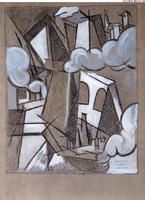
Vers le port
Albert Gleizes
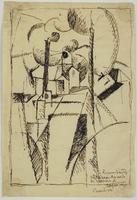
Landscape with Chimneys
Albert Gleizes
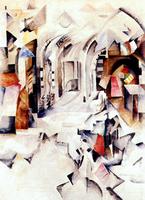
Genoa
Aleksandra Ekster
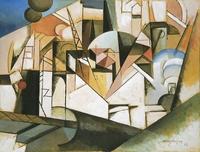
Paysage
Albert Gleizes
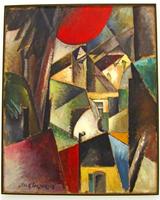
Landscape with Mill
Albert Gleizes
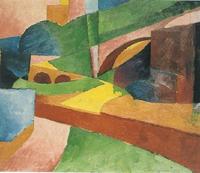
Untitled (Landscape with Bridge)
Morton Schamberg
Untitled
Albert Gleizes
Bureau and Room
Kazimir Malevich
L’intérieur D’une Maison
Jacqueline Lamba
The lady at the piano
Kazimir Malevich
Cubist landscape city
Lyubov Popova
Red Factory
Sandor Bortnyik
Landscape of Olympia
Yiannis Tsaroychis
Cubo-Futurist Composition
Kazimir Malevich
Untitled
Hans Hofmann
Costruzione spaziale - paesaggio
Enrico Prampolini
Window opened to the street Penthieure
Pablo Picasso
Rush Hour
Max Weber
Landscape of Casola Valsenio
Carloluigi Colombo
Water Valley
Karl Knaths