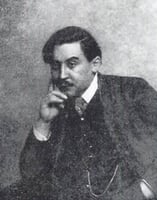
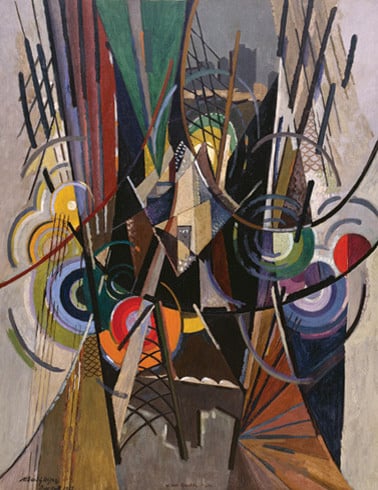
Analisi esperta di On Brooklyn Bridge di Albert Gleizes
Stile: Orphism · Genere: cityscape
As an expert art historian, I can analyze "On Brooklyn Bridge" by Albert Gleizes based on the structured facts provided. This work is a cityscape executed in the Orphism style, a significant movement within early 20th-century modernism.
Significance within Orphism and the Period
Albert Gleizes was a pivotal figure in the development of Cubism, and his turn to Orphism—a more colorful, lyrical offshoot pioneered by Robert Delaunay—marks an important evolution in his career. "On Brooklyn Bridge" exemplifies Orphism's core ambition: to move beyond the muted, analytical geometry of early Cubism toward a dynamic, rhythmic abstraction powered by vibrant color.
-
Orphism’s Emphasis on Color and Light: Orphism rejected the monochromatic palette of Analytical Cubism in favor of prismatic, simultaneous contrasts of hue. In this cityscape, the Brooklyn Bridge is not depicted realistically but is deconstructed into interlocking planes of intense color. These planes create a sense of optical vibration, or "simultaneity," capturing the modern experience of movement and energy—a hallmark of Orphism.
-
Modern Subject as a Catalyst for Abstraction: The choice of the Brooklyn Bridge—an icon of modern engineering and urban life—is deeply significant. Orphists were fascinated by modern cities and technology. By rendering this structure in fragmented, luminous shapes, Gleizes translates the physical bridge into a purely pictorial symphony of form and color, suggesting the dynamic rhythm of New York City itself. This aligns with the period's fascination with speed, light, and the sensory overload of the modern metropolis.
-
Transitional Position in Gleizes’s Oeuvre: While the work retains structural echoes of Cubism’s grid (the bridge’s cables and towers), the dominance of non-local color and the centrifugal, spiraling composition push it firmly into Orphist territory. This painting demonstrates Gleizes’s role as a bridge between the more restrained Cubism of 1910–12 and the fully abstract, luminous experiments that defined the Orphist moment.
In summary, "On Brooklyn Bridge" is significant as a prime example of Orphism’s synthesis of Cubist structure with Fauvist color, applied to a quintessentially modern subject, thereby capturing the energy and abstraction of contemporary urban life.
Visivamente simili
20 opere con composizione e palette affini
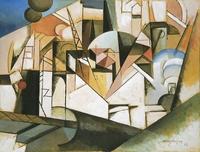
Paysage
Albert Gleizes
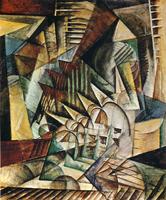
Rush Hour
Max Weber
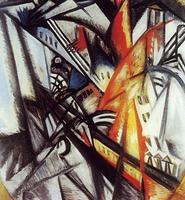
City on Fire
Olga Rozanova
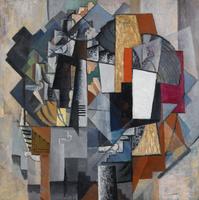
Bureau and Room
Kazimir Malevich
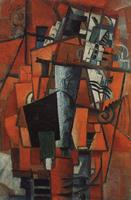
The lady at the piano
Kazimir Malevich
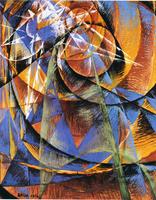
Planet Mercury passing in front of the Sun
Giacomo Balla
Landscape of Olympia
Yiannis Tsaroychis
Propellers 2nd state
Fernand Leger
Cin-Zin
Karl Knaths
Composition, Landscape at Ceret
Auguste Herbin
Russian Ballet
Max Weber
Machinerie
DIDIER DOIGNON
Theseus
Françoise Gilot
Jeanne d'Arc traversant la Loire
Charles Lapicque
Vertical Construction
M. H. Maxy
Pink Vine Pergola
Graham Sutherland
The Cathedral
Artin Demirci
The factory and the bridge
Olga Rozanova
Composition
Georges Valmier
Small dream in red
Wassily Kandinsky