
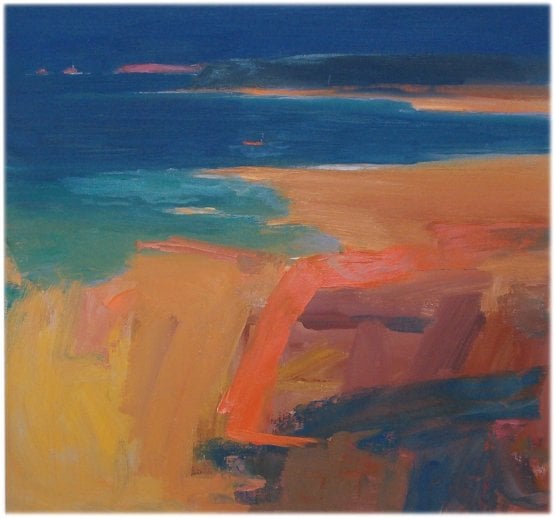
Godrevy Lighthouse
Analisi esperta di Godrevy Lighthouse di John Miller
Stile: Contemporary Realism · Genere: marina
Expert Art Historical Analysis: Godrevy Lighthouse by John Miller
Within the framework of Contemporary Realism, John Miller’s Godrevy Lighthouse operates as a compelling intersection of traditional maritime iconography and the nuanced observational clarity of the present-day realist movement. The painting’s significance lies in its deliberate engagement with a classic marina genre—the depiction of sea, coast, and nautical structure—while adhering to the core tenets of Contemporary Realism: meticulous attention to light, atmosphere, and verisimilitude filtered through a modern, often subjective, lens.
Stylistic Alignment with Contemporary Realism
The work is a testament to how Contemporary Realism revives and reinterprets the academic traditions of 19th-century realism (e.g., the Barbizon School or the American Luminists) for a contemporary audience. Miller’s choice of Godrevy Lighthouse—a well-known landmark off the Cornish coast—strikes a balance between topographical accuracy and a heightened sensitivity to transient effects of light and weather. In this context, the painting is significant for demonstrating that realism need not be a nostalgic retreat but can instead serve as a rigorous discipline for capturing the ephemeral realities of the natural world.
Genre and Symbolic Resonance
As a marina, the composition aligns with a long lineage of seascape and harbor scenes—from Turner to Homer—yet Miller’s approach updates the genre through a restrained palette and a focus on the quiet interplay between the lighthouse’s solid geometry and the ever-shifting sea. Godrevy Lighthouse itself carries cultural weight (famously linked to Virginia Woolf’s To the Lighthouse), but in Miller’s hands, the structure becomes a neutral anchor for exploring surface, reflection, and spatial depth. The painting’s significance within Contemporary Realism is its ability to make the familiar feel both immediate and timeless, inviting the viewer to contemplate not just a specific location, but the very act of seeing.
Technical and Conceptual Importance
Without specific details on brushwork or composition, the work’s genre and style nonetheless imply a mastery of controlled painterly technique. The “contemporary” aspect likely manifests in subtle departures from strict photorealism—perhaps an emphasis on color saturation, a slightly cropped viewpoint, or the inclusion of modern atmospheric phenomena (e.g., hazy light from diffuse pollution or seasonal shifts). Such choices reinforce the artwork’s significance as a bridge between historic maritime painting and the evolving concerns of realism today: an unwavering commitment to rendering the world as it is, while acknowledging that perception is always mediated by time, place, and artistic intention.
Visivamente simili
20 opere con composizione e palette affini

Orange-Gris-Bleu
Olivier Debre
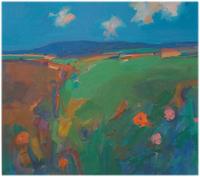
West Penwith Summer Landscape
John Miller
Amanecer en La Antilla
Antonio Povedano

Paesaggio Rosa
Paolo Salvati
Blue Sky and Winter Dusk
Jules Olitski

Antakya-Istanbul-Antakya IV
Artin Demirci
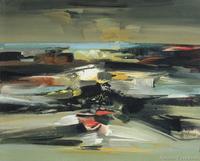
Tormenta
Antonio Povedano
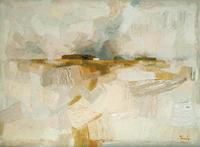
Hortobágy National Park
Ervin Tamas
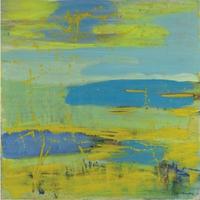
Molto lontano
Antonio Corpora
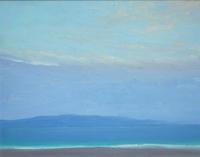
Beach
John Miller
Autumn Day Beach
John Miller
Untitled
Esteban Vicente
Antakya-Istanbul-Antakya XXVII
Artin Demirci
Yellow Shoreline
Wolf Kahn
Untitled
Raoul De Keyser
O Sentir da Paisagem VI
Gil Teixeira Lopes

Egry József , Szölőhegy 1938
Egry József
Vaszary János, Balaton
Vaszary János
Berkeley #32
Richard Diebenkorn

Composition
Jean Le Moal