Analisi esperta di Composition abstraite di Marcelle Cahn
Stile: Abstract Art · Genere: abstract
Expert Analysis: "Composition abstraite" by Marcelle Cahn
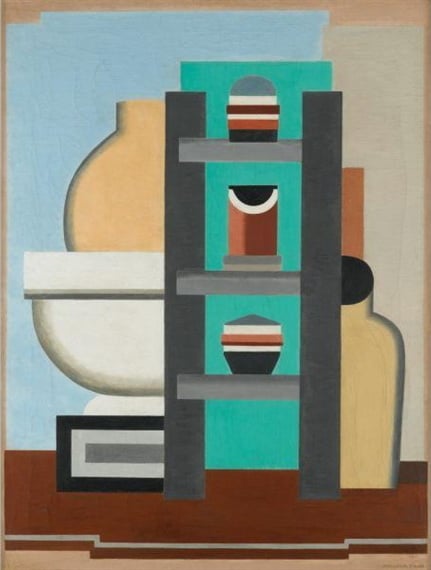
Marcelle Cahn’s "Composition abstraite" stands as a refined example of early 20th‑century geometric abstraction, a movement in which the artist was both a participant and a quietly influential pioneer. Although born into the same generation as many of the male titans of abstraction, Cahn’s career was often sidelined by art history—making this work significant as part of a necessary re‑evaluation of women’s contributions to the development of non‑representational art.
The painting belongs to the broader currents of European abstract art that emerged in the 1920s and 1930s, particularly the ethos of the Abstraction‑Création group, of which Cahn was a member. In "Composition abstraite," she employs a disciplined vocabulary of geometric shapes—rectangles, arcs, and intersecting lines—arranged in a balanced yet subtly dynamic composition. The forms are not static; they appear to float or exert gentle tension against each other, suggesting a controlled energy that is characteristic of her best work.
Cahn’s significance lies in her ability to fuse a rigorous structural logic with a sensitive, almost musical handling of color. Her palette in this piece likely employs clear, often muted hues—earthy reds, cool blues, and off‑whites—that temper the austerity of geometry with warmth and intimacy. This balance between intellectual order and lyrical expression distinguishes her from more dogmatic geometric abstractionists. While contemporaries such as Mondrian or van Doesburg pursued absolute purity, Cahn allowed for a more personal, nuanced vibration within the grid.
Moreover, "Composition abstraite" reflects the artist’s deep engagement with the lessons of Cubism (she studied under Léger and frequented the Section d’Or circle) and her later interest in the psychological resonance of abstract forms. In this work, one can detect a quiet rhythm—a visual pulse that animates the surface without resorting to decorative excess. It is this sense of restrained vitality that makes the piece stand out: it is abstract but not remote; conceptual yet accessible.
For contemporary audiences, Cahn’s "Composition abstraite" is a testament to the diverse paths taken by the first generation of abstract artists. It challenges the canonical narrative of abstraction as a male‑dominated, purely rational endeavor. Here, the feminine is not absent but subsumed into a universal language of shape and color, rendered with conviction and grace. The work is significant not only as a well‑crafted geometric composition but as a reminder that the history of modern art is incomplete without the voices of women like Marcelle Cahn.
Genere
Stile
Visivamente simili
20 opere con composizione e palette affini
Red Pot
Fernand Leger
Washtable
Serge Charchoune
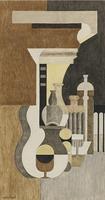
Composition puriste
Amedee Ozenfant
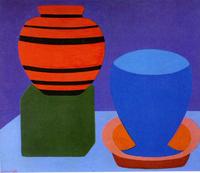
Astrazione oggettiva
Galliano Mazzon
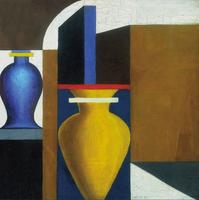
Bortnyik Sándor, Csendélet Vázával
Sandor Bortnyik
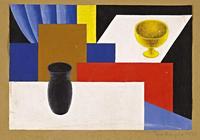
Asztali csendélet
Sandor Bortnyik
Still Life
Constantin Blendea
La Porta Viola
Mario Tozzi
Nature morte du Pavillon de l'Esprit Nouveau
Le Corbusier
Baren
Franciska Clausen
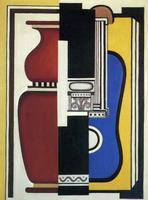
Blue guitar and vase
Fernand Leger
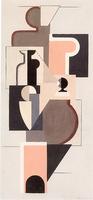
Picture T 21
Willi Baumeister
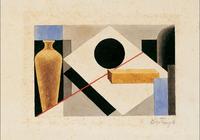
Bortnyik Sándor, Térformációk
Sandor Bortnyik
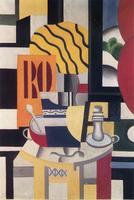
Still life with candle
Fernand Leger
Composition aux trois vases
Nadia Khodossiévitch-Léger
Still Life
Constantin Blendea
Still Life with Numerous Objects
Le Corbusier
Arkitektonisk komposition
Otto Gustav Carlsund
Woman with flower portrait study
Fernand Leger
Still Life with Gingerpot 2
Piet Mondrian