Expertenanalyse zu Paul Jenkinss Phenomena Tibetan Clay Offering
Stil: Abstract Expressionism · Genre: abstract
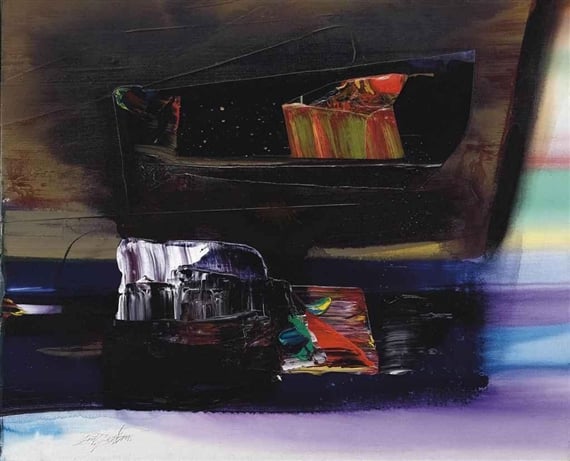
Expert Analysis: "Phenomena Tibetan Clay Offering" by Paul Jenkins
Paul Jenkins’ Phenomena Tibetan Clay Offering (date unspecified) stands as a compelling synthesis of Abstract Expressionist spontaneity and meditative symbolism. As a second-generation Abstract Expressionist who later became associated with the Color Field movement, Jenkins developed a signature technique of pouring layers of liquid pigment onto canvas, tilting the surface to guide the flow. This process—a combination of controlled gesture and happy accident—embodies the Abstract Expressionist ethos of direct, unpremeditated expression.
The title itself is key to the work’s significance. “Phenomena” is the recurring prefix Jenkins used for his series of poured-paint abstractions, signaling a focus on sensory and spiritual experiences rather than narrative. “Tibetan Clay Offering” explicitly invokes Eastern religious practice, likely referencing torma—sculpted butter or clay offerings used in Tibetan Buddhist rituals. By merging this sacred, tactile imagery with the fluid, translucent veils of his paint, Jenkins bridges the gap between Western abstraction’s raw emotion and Eastern contemplative tradition. The resulting composition is not merely abstract but ritualistic: the layered pools of color suggest both the earthy substance of clay and the ethereal luminosity of light passing through stained canvas.
Technically, the work highlights Jenkins’ innovative use of primacolor—paint applied with knives and poured from cups, then manipulated with spatulas and rags. This method produces overlapping washes that seem to radiate from within, creating a sense of depth without illusionistic space. In Phenomena Tibetan Clay Offering, this likely yields a central, glowing mass (perhaps the “offering”) surrounded by diaphanous halos—a visual metaphor for the interplay between materiality and transcendence.
The painting’s significance within Abstract Expressionism lies in its departure from the aggressive, masculine brushwork of the movement’s founders (e.g., Pollock, de Kooning). Jenkins replaced physical force with lyrical flow, merging the chance operations of Surrealism with the spiritual earnestness of Mark Rothko. By explicitly naming a specific cultural ritual, he also pushed abstraction toward a universal language of devotion, making this work a touchstone for how mid-century American artists incorporated global spiritual motifs into the language of pure color and form.
Genre
Visuell ähnlich
20 Werke mit ähnlicher Komposition und Farbpalette
Desert Pass
Helen Frankenthaler
Nature morte en gris
Nicolas de Staël
Bird Cage Variation II
Hans Hofmann
Dew and Dusk
Hans Hofmann
Interior
Dimitris Mytaras
Black on Yellow
Perle Fine
Blueberry Eyes
Franz Kline
Blauwe wolk
Eugene Brands
Ölberg
Gerhard Richter
no title No. 309
Ben Vollers
Malicorne
Huguette Arthur Bertrand
Black Construction
Alexander Bogen
Dibirdibi Country
Sally Gabori
Chromatic Spectacle on the Pyramid
Romul Nutiu
Composition
Nicolas de Staël
A Day at the Races
Richard Diebenkorn
Green Olive
Jose Guerrero
Abstract Painting No.599
Gerhard Richter
Untitled
Larry Zox
Untitled
Helmut Sturm