
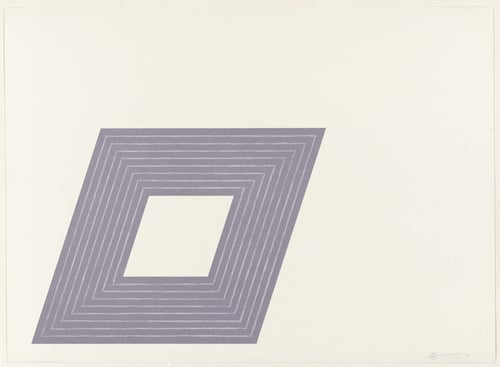
Expertenanalyse zu Frank Stellas Carl Andre (from the Purple Series)
Stil: Minimalism · Genre: abstract
Expert Analysis: "Carl Andre (from the Purple Series)" by Frank Stella
Frank Stella’s “Carl Andre (from the Purple Series)” stands as a quintessential example of Minimalist abstraction, marking a radical departure from the gestural intensity of Abstract Expressionism. Created during the late 1960s, this work belongs to Stella’s Purple Series, a group of paintings that explore stark geometric reduction, industrial finish, and the literal flatness of the picture plane.
Significance within Minimalism
Stella’s Purple Series is pivotal for several reasons. First, it embraces strict, systematic repetition—here, a pattern of concentric bands or parallel stripes in varying shades of purple. This repetition denies any illusion of depth or spatial recession, forcing the viewer to confront the painting as a flat, physical object. The title itself pays homage to fellow Minimalist sculptor Carl Andre, whose own work with unitary, repeated modules (e.g., floor grids of metal plates) parallels Stella’s serial logic. By naming the piece after Andre, Stella acknowledges a shared ethos: that art should be “not symbolic, but literal,” as Andre famously stated.
Second, the work exemplifies Stella’s rejection of composition as emotional expression. Unlike the improvisational drips of Pollock or the color fields of Rothko, “Carl Andre (from the Purple Series)” is premeditated, almost mechanical in its execution. The purple hues—ranging from deep violet to muted lavender—are applied with even, unstroked precision, often using house painter’s techniques (e.g., stripes created with tape). This industrialized finish eliminates the artist’s hand, aligning with Minimalism’s desire to strip art of biography, metaphor, and narrative.
Finally, the painting’s significance lies in its material presence. Stella’s Purple Series frequently employed shaped canvases or unpainted edges, asserting the support as a real, three-dimensional object rather than a window into illusion. Even if this specific work remains rectangular, the relentless patterning draws attention to the canvas’s surface and edges, declaring that what you see is exactly what is there: paint on a flat plane.
Legacy
“Carl Andre (from the Purple Series)” remains a crucial touchstone for understanding Minimalism’s break from the past. It demonstrates how abstract painting could achieve intellectual rigor and physical immediacy without relying on figuration, symbolism, or emotional content. Stella’s dialogue with Andre also highlights the cross-pollination between painting and sculpture in the 1960s. Ultimately, this work is not just an abstract composition—it is a manifesto of restraint, repetition, and radical flatness that reshaped the trajectory of modern art.
Visuell ähnlich
20 Werke mit ähnlicher Komposition und Farbpalette
Conway
Frank Stella
Honduras Lottery Co.
Frank Stella
Les Indes Galantes IV
Frank Stella
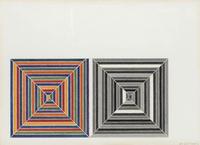
Jasper's Dilemma
Frank Stella

Série Amazônica n° 5
Ivan Serpa
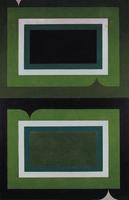
Série Mangueira
Ivan Serpa
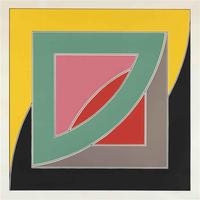
Referendum '70
Frank Stella
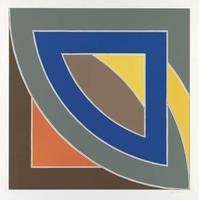
River of Ponds I
Frank Stella
Tilted Cadmium
Richard Anuszkiewicz
Série Amazônica n° 12
Ivan Serpa
Série Amazônica nº 8
Ivan Serpa
Carré-couronne - Re Rom 337
Aurelie Nemours
Série Amazônica n° 27
Ivan Serpa
Variant/Adobe
Josef Albers
Untitled
Aurelie Nemours

Untitled
Carmelo Arden Quin
Island No. 1p
Frank Stella
Gran Cairo
Frank Stella
Variant/Adobe
Josef Albers

Untitled
Verena Loewensberg